
China’s PLA Seeks Public Tip-Offs On Air Force Procurement Irregularities In Rare Anti-Corruption Move
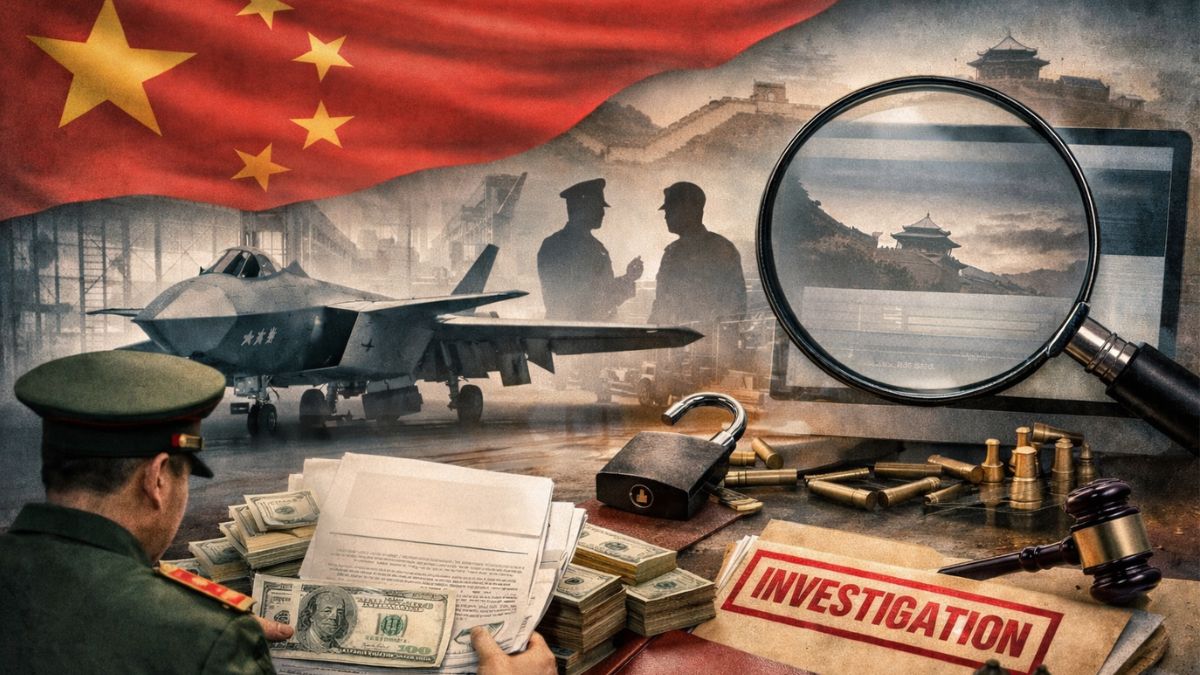
China’s military opens an unusual public window into its internal oversight as scrutiny of Air Force procurement signals a widening anti corruption push within the PLA. Image courtesy: AI genrated picture via DALL-E

In an unprecedented step, China’s People’s Liberation Army (PLA) has publicly invited tip-offs on alleged procurement irregularities within its Air Force, signalling a deepening of Beijing’s sweeping anti-corruption campaign across the military establishment.
The appeal, posted on Monday (December 14, 2025) on the PLA’s official procurement website, calls for information on “irregular” procurement activities conducted by Air Force units.
It marks the first time the PLA has issued such a public request targeting a specific branch of the armed forces, which includes the ground force, navy, air force, rocket force, and newer information, space, cyber, and joint logistics forces.
What does the Chinese PLA’s anti-corruption notice say?
According to the notice, the PLA Air Force is seeking details related to the procurement of materials and services, including bid evaluations, contract performance, and the selection of bidding agents.
Suppliers, bid evaluation experts, intermediaries, and internal personnel involved in Air Force procurement projects have been asked to submit feedback under their real names by June 30 next year.
The move comes amid an intensified review of military equipment procurement that has been underway since 2023, as President Xi Jinping’s administration tightens oversight of defence spending and contract allocation.
How has the Chinese PLA increased anti-graft warnings?
Over the past year, the PLA procurement platform has increasingly published warnings and penalties against companies and individuals found violating procurement rules, reflecting a shift towards greater transparency and deterrence.
In September, the Rocket Force announced the disqualification of 74 bid evaluation experts and 116 suppliers for violations, including bid collusion, highlighting how deeply corruption probes have penetrated sensitive weapons and missile-related domains.
The broader anti-graft drive has led to the downfall of several senior military officials over the past two years, cutting across theatre commands and service branches.
Notably, a month before an investigation was launched into former defence minister Li Shangfu in August 2023, authorities issued a call for public reporting of procurement violations dating back to 2017, when Li assumed charge of the Equipment Development Department, the powerful body overseeing military acquisitions.
Which of the PLA arms were badly affected by corruption?
Despite the scale of the campaign, the Air Force has so far been relatively less affected than other services. In contrast, several top Rocket Force commanders have been removed, while senior navy and ground force officers have been investigated or have vanished from public view. Paradoxically, officers with Air Force backgrounds are now filling key leadership vacancies created by the purge.
During the September 3 military parade this year, Han Shengyan, head of the Central Theatre Command Air Force, became the first Air Force officer to oversee the event after the theatre commander disappeared from public sight.
Similarly, Yang Zhibin was appointed to lead the strategically critical Eastern Theatre Command, the first time the post has been held by an Air Force officer, following the sacking of Lin Xiangyang.
How intensive is the anti-graft action within the PLA?
Military procurement remains a central pillar of Beijing’s anti-corruption push. At the Communist Party’s fourth plenum in October, leaders underscored the need to intensify efforts against graft in the armed forces over the next five years.
Official documents published by Xinhua called for stronger oversight, improved decision-making, and tighter budget management in defence procurement.
Against this backdrop, the PLA Air Force continues to modernise rapidly. At September’s parade, it showcased advanced drones and new fighter variants, including the J-20S, J-20A, and the J-35A, underscoring why procurement integrity has become a critical strategic priority for Beijing.