
Double Whammy For Pakistan As India, Afghanistan Tighten Water Squeeze: Chenab Flow Dispute Rekindled While Kabul Clears Kunar Dam
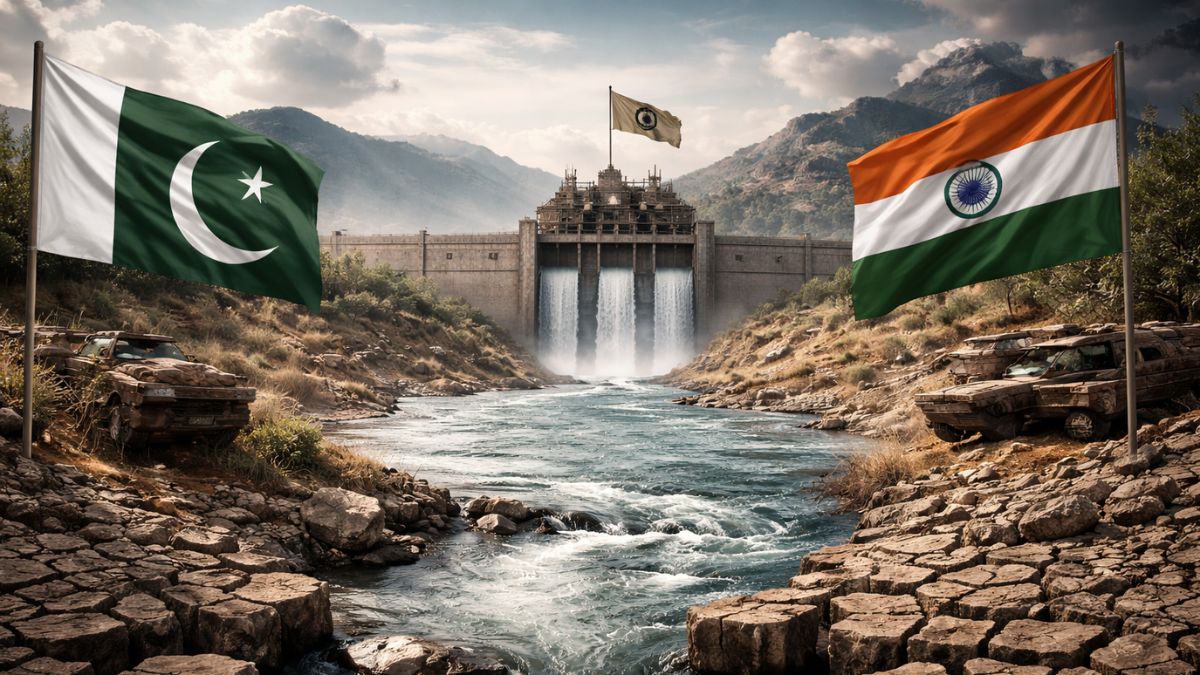
Pakistan confronts a mounting water squeeze as disputes over the Chenab with India and a fresh dam clearance on the Kunar in Afghanistan unfold simultaneously raising fears over agriculture and livelihoods. Image courtesy AI generated picture via DALL-E

Pakistan is facing a mounting water crisis on two fronts, as disputes with both India and Afghanistan over critical river systems intensify, raising fears of severe impacts on agriculture, food security, and livelihoods.
While Islamabad has accused New Delhi of unilaterally manipulating the flow of the Chenab River in violation of the Indus Waters Treaty (IWT), Afghanistan’s Taliban government has approved a major dam project on the Kunar River, another vital lifeline for Pakistan, deepening concerns of a “double whammy” for the country’s already strained water resources.
What’s the trigger for the latest India-Pakistan row?
The immediate trigger for the latest India-Pakistan row is Pakistan’s allegation that India abruptly altered the flow of the Chenab River without prior notice.
Islamabad says the sudden fluctuations, recorded over the past week, could disrupt the sensitive agricultural cycle and threaten economic and food security.
Pakistan’s Foreign Office described the developments as a matter of “extreme concern and seriousness,” adding that its Indus Water Commissioner has formally sought clarification from India in line with treaty mechanisms.
What did Pakistan accuse India of?
Pakistani media outlets have alleged that India released up to 58,000 cusecs of water into the Chenab during the midnight hours of December 7 and 8, 2025, followed by a sharp reduction to as low as 870 cusecs around December 13.
The flow reportedly remained between 870 and 1,000 cusecs until December 17, far below the historical average of 4,000 to 10,000 cusecs for the same period over the past decade.
Islamabad argues that such abrupt variations, especially during a crucial farming phase, directly endanger the livelihoods of millions dependent on river-fed agriculture.
How is this a revival of the Indus Water Treaty debate?
The dispute has revived broader tensions surrounding the Indus Waters Treaty, signed in 1960 and long seen as a rare stabilising framework between the two rivals.
Under the treaty, Pakistan was allocated rights over the western rivers — Indus, Chenab, and Jhelum — while India retained rights over the eastern rivers of the Indus basin.
However, relations have deteriorated sharply since India suspended the treaty after the April Pahalgam attack, in which 26 civilians were killed by Pakistan-based terrorists. India has maintained that “water and blood cannot flow together,” signalling a tougher stance on cross-border issues.
Did Pakistan previously warn that IWT abeyance is an act of war?
Pakistan Prime Minister Shehbaz Sharif has previously warned that any violation of the IWT would be treated as an “act of war,” a phrase echoed by sections of the Pakistani media.
Despite the strong rhetoric, Islamabad says it remains committed to resolving disputes peacefully, even as water levels in two major Pakistani reservoirs reportedly fell to dead storage levels earlier this year.
What compounds the water trouble for Pakistan?
Compounding Pakistan’s challenges is a significant development to its west. Afghanistan’s Taliban government has approved a major dam project on the Kunar River, aimed at diverting water towards the Darunta Dam in Nangarhar province.
While the project is expected to ease water shortages and boost development in eastern Afghanistan, it has triggered alarm in Pakistan, which depends heavily on the Kunar River for agriculture, drinking water, and power generation, particularly in Khyber Pakhtunkhwa.
The Kunar River originates in the Hindu Kush region of Pakistan’s Chitral district, flows into Afghanistan, and then re-enters Pakistan before merging with the Indus.
How could Afghanistan’s latest dam impact Pakistan adversely?
Experts warn that large-scale diversion upstream could have devastating consequences for downstream regions, potentially turning parts of Khyber Pakhtunkhwa arid and affecting Punjab and the Attock belt.
Unlike with India, Pakistan has no formal water-sharing agreement with Afghanistan over the Kunar, leaving it with limited diplomatic or legal leverage.
What’s the geopolitics behind India-Afghanistan moves?
Adding a geopolitical layer to the dispute, India has openly backed Afghanistan’s water and hydropower initiatives. During a recent visit by Afghan Foreign Minister Amir Khan Muttaqi, New Delhi reiterated its support for Kabul’s water management projects, building on past assistance such as the India-built Salma Dam in Herat.
For Pakistan, this convergence of Indian and Afghan actions has heightened anxieties at a time of economic stress and food insecurity.
As regional rivalries sharpen and climate pressures grow, water is emerging as a central fault line in South Asia. With tensions simmering on both its eastern and western borders, Pakistan’s struggle to secure its water future is set to become an increasingly critical and contentious regional issue.