
Idea Of India Getting Its First Woman Admiral Highly Conceivable: Navy Chief Dinesh Tripathi
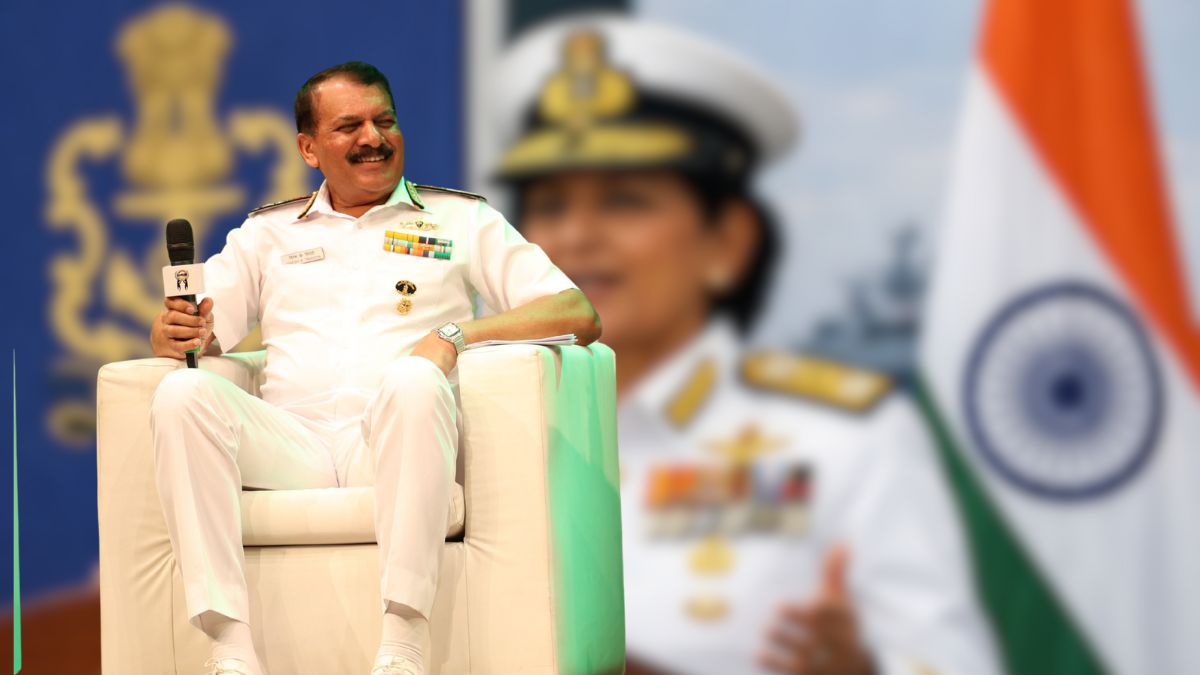
The Navy chief has said it is “highly conceivable” that India could see a woman Admiral, and potentially a woman Navy chief. Image courtesy: RNA

It was over 30 years ago that the Indian Navy started recruiting women as SSC (Short Service Commission) officers in the Education Branch and Law/ Logistics Cadres of the Executive Branch. This transition in the year 1992 marked a significant shift from earlier restrictions where women were only permitted to join the Medical Branch.
Since then, several women officers in the Navy have scripted history, including Lieutenant Kiran Shekhawat (first woman officer in Navy to attain martyrdom while serving the nation), Aastha Poonia (Navy’s first woman fighter pilot), Prerna Deosthalee (first woman officer to command an Indian Naval Warship), among several others.
However, there has never been a female Chief of the Naval Staff. But this too might change soon, CNS Admiral Dinesh Kumar Tripathi has hinted so himself. In a powerful reflection of the Indian Navy’s evolving leadership landscape, the Navy chief has said it is “highly conceivable” that India could see a woman Admiral, and potentially a woman Navy chief, in the coming years.
Women in uniform: From the 1990s to today
Tracing the journey, the Navy chief noted that women have been inducted into the Indian Navy since the early 1990s. What began with limited shore-based roles has since transformed into full-spectrum participation. “Today, we have opened all branches and corridors to women,” Admiral Tripathi said.
Speaking at the Southern Gujarat Chamber of Commerce’s 9th National HR Conclave in Surat, CNS Admiral Tripathi underlined how steadily rising numbers of women officers and expanding operational roles are reshaping the force. It is only the submarine arm that remains to be opened to women, a step he described as inevitable.
Command at sea and in the air
The growing confidence in women officers is reflected in their expanding operational footprint. Fighter pilots and helicopter pilots are now part of naval aviation, women officers command frontline warships, and increasing numbers are entering leadership pipelines across combat, technical and administrative branches.
“A large number of women officers are coming and joining us,” the Navy chief said, pointing to a deepening talent pool that could eventually produce the service’s top leadership.
Why a woman CNS is now realistic
With women officers already commanding ships and flying combat aircraft, senior leadership believes career progression to flag rank is now structurally possible.
“It is a matter of time,” Admiral Tripathi said, noting that sustained induction, operational exposure and command experience are key ingredients that make the idea of a female Chief of Naval Staff (CNS) no longer symbolic, but achievable.
Self-reliance strengthens opportunity
The Navy chief also linked leadership growth to India’s indigenous shipbuilding ecosystem, which offers wider command opportunities. “Ships and submarines are all being built in India now. There’s nothing that is going to be built abroad,” he said, highlighting that India is the only non-P5 nation capable of designing, building and operating an aircraft carrier and Ship Submersible Ballistic Nuclear (SSBNs).
This self-reliance, rooted in the establishment of the Warship Design Bureau in the 1960s, has expanded the Navy’s fleet, and with it, opportunities for command at sea.
India’s maritime workforce and global role
Beyond the Navy, Admiral Tripathi highlighted India’s importance in global shipping, noting that Indians account for nearly 12% of the world’s seafarers. Government efforts aim to push India into the top three seafaring nations, meaning that roughly one in eight sailors worldwide is Indian, regardless of the flag their ship flies.
Reflecting on India’s deep-rooted maritime culture, the Navy chief underscored Gujarat’s historic role, citing ancient ports such as Lothal, Dholavira and Dwarka, and the Baan Sthamb at Somnath, aligned with the South Pole. This legacy, he said, continues into the present with modern platforms like INS Surat, the Indian Navy’s latest stealth destroyer.