

$8 Billion Submarine Mega-Deal: How India–Germany Defence Ties Are Diving Deeper Than Ever
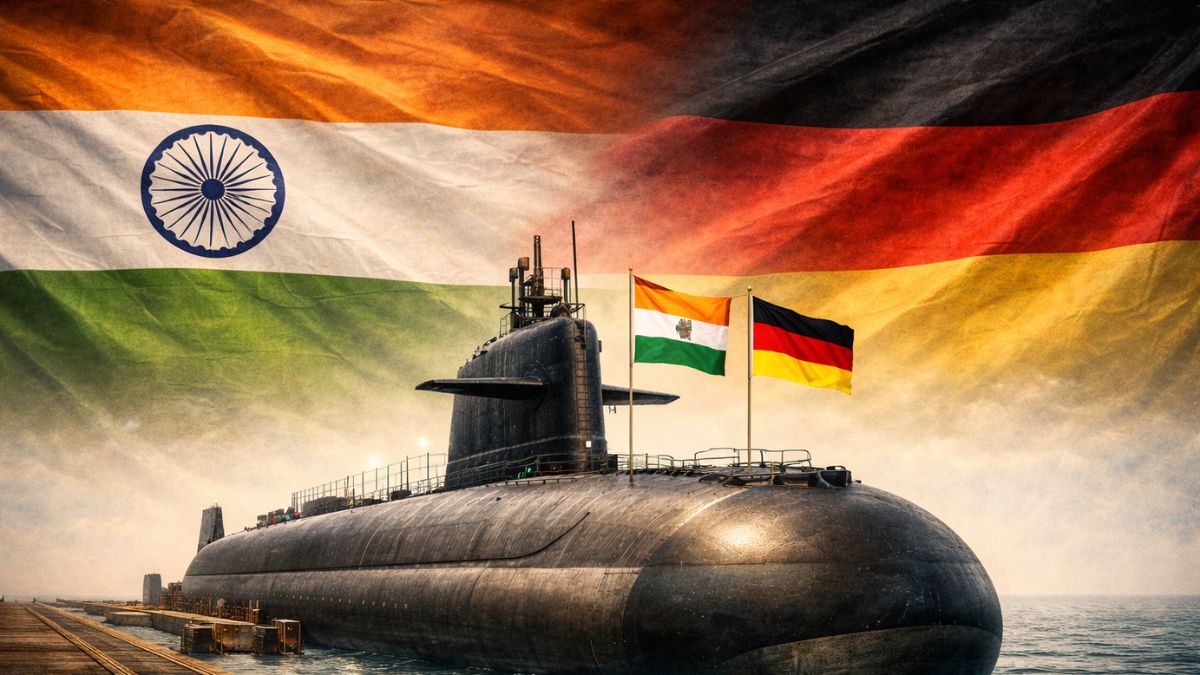
India and Germany move closer on a landmark submarine partnership, signalling a deeper alignment in naval capability and strategic defence cooperation. Image courtesy: AI generated picture via DALL-E

India and Germany are finalising an ambitious submarine manufacturing agreement worth at least $8 billion, a deal that could become India’s largest-ever defence contract and mark a turning point in New Delhi’s push for advanced naval self-reliance.
The agreement, currently being negotiated ahead of German Chancellor Friedrich Merz’s maiden visit to India next week, is set to include full technology transfer for submarine production, a first for India in this sensitive domain.
What is the submarine deal being proposed?
According to officials familiar with the discussions, the proposed deal would see Germany’s Thyssenkrupp Marine Systems (TKMS) partner with Mazagon Dock Shipbuilders Ltd (MDL), India’s state-owned naval shipbuilder, to manufacture next-generation conventional submarines in India.
If concluded, the agreement could prompt the Indian Navy to drop plans to acquire three additional French-built submarines, reshaping the balance of European defence suppliers in the Indian market.
What technology is critical to the India-Germany deal?
At the heart of the deal is the integration of air-independent propulsion (AIP) technology, a capability that allows diesel-electric submarines to remain submerged for significantly longer durations without surfacing.
Such systems are crucial for stealth operations and are expected to dramatically enhance India’s undersea endurance and surveillance reach across the Indian Ocean Region (IOR), where China has steadily expanded its naval footprint.
What is current Indian submarine strength?
India currently operates around a dozen ageing Russian-origin submarines, alongside six modern French Scorpène-class boats.
The proposed German collaboration would not only modernise India’s undersea fleet but also align with New Delhi’s strategic objective of reducing long-term dependence on Russian military hardware, a goal gaining urgency amid shifting global geopolitics.
How does the German Chancellor’s India visit help?
Chancellor Merz’s visit underscores the political weight behind the negotiations. He is scheduled to meet Prime Minister Narendra Modi in Gujarat before travelling to Bengaluru, India’s technology hub, to engage with German companies operating in the country.
Defence cooperation is expected to feature prominently alongside talks on pharmaceuticals and efforts to accelerate the long-stalled India–EU free trade agreement.
This visit will also be Merz’s first overseas trip with a large delegation of German CEOs, reflecting Berlin’s renewed focus on defence and strategic industries following Russia’s invasion of Ukraine.
Germany’s willingness to share sensitive submarine technology signals a significant shift in its defence export posture and a calculated move to strengthen partnerships with trusted Indo-Pacific powers.
What does this submarine deal mean for India?
For India, the deal fits squarely within the ‘Make in India’ and ‘Atmanirbhar Bharat’ frameworks. Since 2020, the Modi government has restricted imports of major defence platforms to force global manufacturers to localise production.
Despite these measures, India remains the world’s second-largest arms importer, according to the Stockholm International Peace Research Institute.
If finalised, the submarine agreement would represent more than a procurement success. It would symbolise a new depth in India–Germany defence diplomacy, combining industrial collaboration, strategic trust, and shared concerns over maritime security in an increasingly contested Indo-Pacific.