





Snow Leopard Squad: J&K Police Unveil Elite High-Altitude Unit To Catch Terrorists In Mountain Hideouts
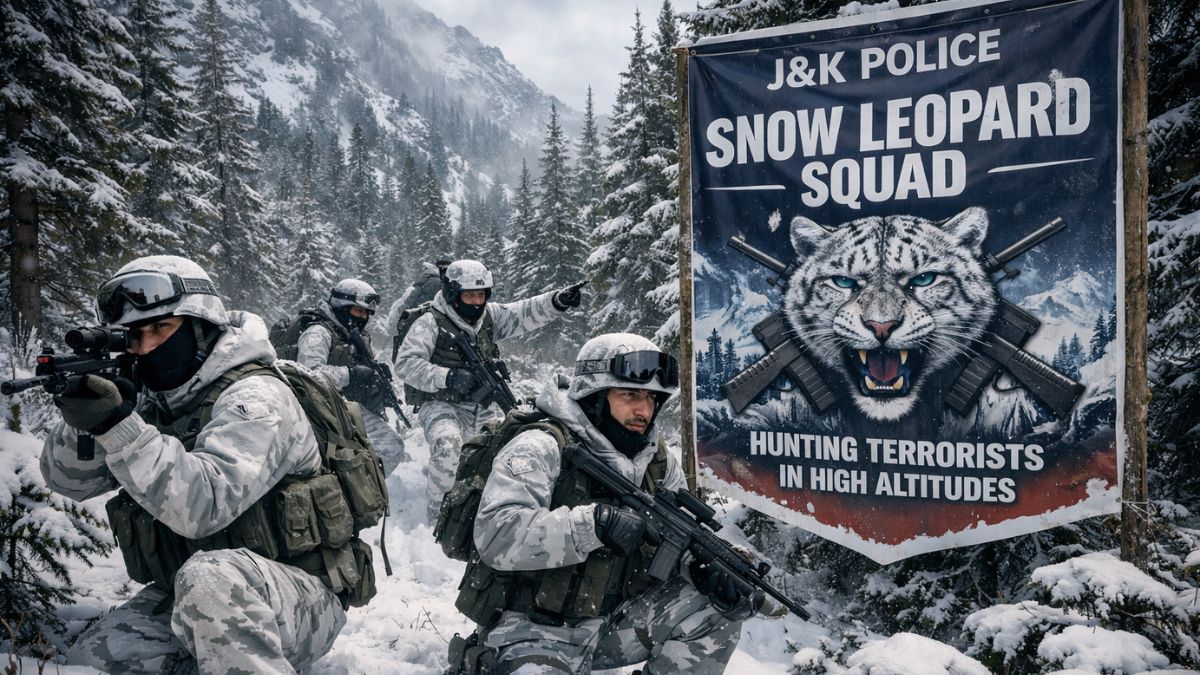
They have been trained specially to work in mountain areas and deal with terrorists hiding there. Image courtesy: AI-generated picture via Sora

As militants attempt to exploit geography for survival, a loud and clear messge is being sent that the high ground is no longer a sanctuary. In a major tactical shift against militancy in Jammu and Kashmir, the J&K Police has raised a specialised high-altitude combat unit – the Snow Leopard Squad.
As the name signifies, the squad would mainly cover the high-altitude regions, which receive snowfall in abundance, thereby becoming a good hideout for terrorists and militants. J&K Police’s Snow Leopard Squad has been designed to track and neutralise terrorists who have increasingly retreated into dense forests and snowbound mountain terrain.
The move marks the first time the police force has created a dedicated high-altitude warfare unit tailored specifically to dominate the Union Territory’s rugged upper reaches.
Why has the Snow Leopard Squad been created?
Security agencies have observed a clear operational shift by terrorist groups in recent years. Instead of urban hideouts, militants have moved deeper into dense forest belts, high-altitude mountain zones, snow-clad and avalanche-prone regions.
Since 2021, militants have frequently taken refuge in forested areas of the Jammu region and north Kashmir, using difficult terrain as a defensive shield after carrying out attacks. Security data suggests that an estimated 100-150 terrorists are believed to be hiding in forested pockets across J&K, with nearly 95% reportedly Pakistani-trained infiltrators.
The Snow Leopard Squad is designed specifically to counter this evolving threat pattern, according to a report in The Tribune.
What makes this unit different?
Unlike conventional anti-terror teams, the Snow Leopard Squad is trained to operate in sub-zero temperatures plunging to minus 20°C, low-oxygen, high-altitude zones, avalanche-prone mountainous terrain, thick forest cover with limited mobility.
The personnel, drawn primarily from the elite Special Operations Group (SOG), underwent over six months of intensive training in the Kashmir Valley and specialised academies outside the Union Territory, a WION report said.
They also trained alongside Indian Army para commandos, enhancing interoperability and sharpening combat skills for mountain warfare.
Deployment begins in sensitive sectors
The first batch of the squad has already been deployed in the snow-clad mountains of Baramulla district in north Kashmir. One team has also been stationed in the Gulmarg sector, where the Khelo Winter India Games are underway. Gulmarg lies close to the Line of Control (LoC) and witnessed a militant attack in 2024 when an Army vehicle was targeted.
By positioning the squad in such sensitive areas, authorities aim to secure both civilian events and vulnerable high-altitude corridors.
Beyond Counter-terror: A dual role force
The Snow Leopard Squad is not limited to combat operations. Given the terrain’s unpredictability, the commandos have also received specialised training in avalanche response, landslide rescue, high-altitude disaster management, mountain survival and evacuation.
This dual-role capability ensures the unit can function as both a counter-terror strike force and a rapid-response disaster team in remote regions.
Lessons from recent attacks
Recent terror incidents have highlighted the tactical challenge posed by mountainous hideouts. In the aftermath of major attacks, including the Pahalgam massacre that killed 26 civilians, militants used dense forest cover and elevated terrain to evade immediate capture before being tracked down in prolonged operations.
Security officials believe the Snow Leopard Squad will significantly reduce such operational delays by maintaining continuous high-altitude presence, conducting long-duration mountain patrols, dominating forest corridors used for infiltration and escape.
The formation of the Snow Leopard Squad signals a proactive strategy, adapting to the enemy’s shift rather than reacting to it.


