



Indian Army Seeks Drone Interceptors From Indian Vendors To Boost Low Altitude Air Defence
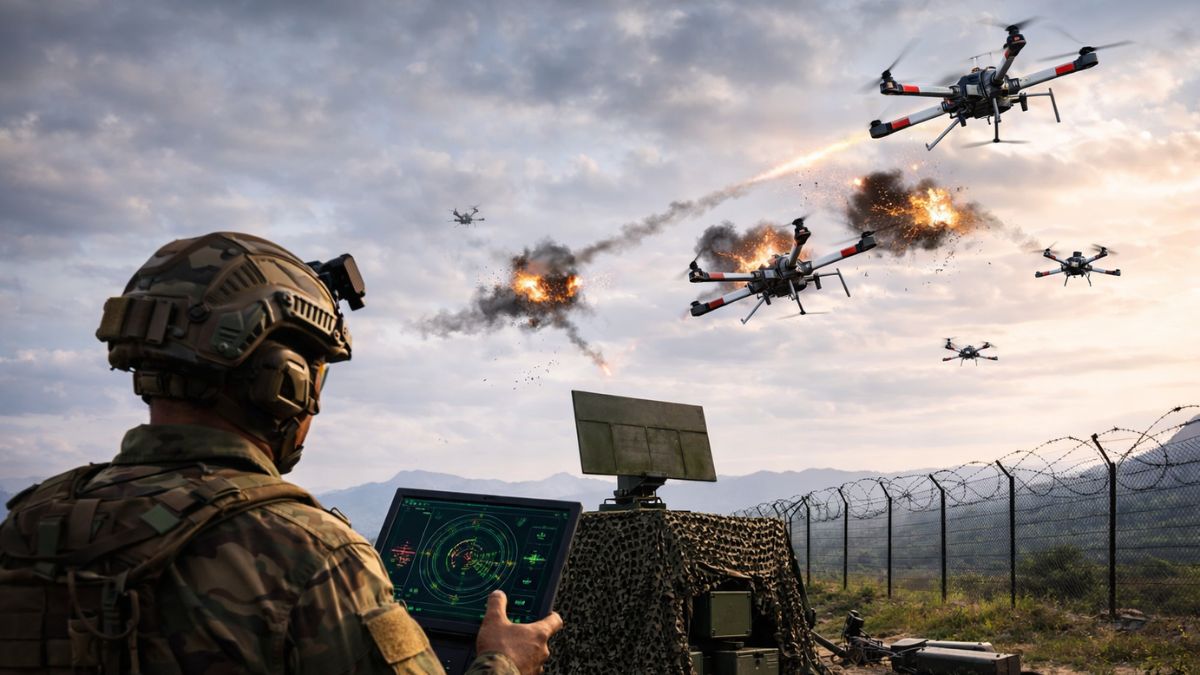
Amid rising low-altitude drone threats and swarm intrusions, the Indian Army has moved to acquire autonomous interceptor systems integrated with Akashteer, aiming to deliver cost-effective, kinetic countermeasures against hostile unmanned platforms. Image courtesy: AI generated picture via DALL-E

The Indian Army is seeking to boost its drone interception capabilities by procuring an autonomous aerial weapon system that can detect and physically destroy hostile unmanned aerial vehicles, including coordinated swarms.
Initiating the procurement process, the Indian Army has issued a Request for Information (RFI) for the drone interception system that would be integrated into the Akashteer indigenous, automated air defence control and reporting system.
The procurement of the drone interception system is aimed at strengthening the Indian Army’s air defence capabilities against the exponentially growing drone threats, in an asymmetric warfare scenario.
The RFI, issued recently, described the proliferation of low radar cross-section drones as an “urgent” threat to the Indian armed forces that required kinetic countermeasures.
The drone interception system should comprise of a ground radar sensor, portable control station, and four interceptor drones, according to the RFI document.
The sensor should be able to track at least 20 targets simultaneously across 360 degrees with a detection range of up to four kilometres for micro-sized unmanned platforms and 10 kilometres for the larger drones.
The interception should come in a fire-and-forget mode, guided by an onboard machine vision, and operable at altitudes of up to 5,000 metres above sea level.
The army requirement is both kinetic-impact and high-explosive interceptor variants. The high-explosive interceptor would need a proximity fuze capable of detonating near the target, rather than after directly hitting it.
With an emphasis on made in India doctrine, the RFI asks Indian vendors to provide a minimum of 50% indigenous content on the interceptor system.
The RFI was driven by the immediate need felt by the Indian Army for such drone interceptor systems after the June 2021 drone strike on the Jammu Air Force Station, a first such attack on an Indian armed forces installation.
The frequent drone intrusions from across the border that the Indian Army has witnessed over the years and the experience during the May 2025 Operation Sindoor when a critical gap in low-altitude air defence against cheap drones were the driving factors for the procurement process to be initiated.
Indian Army officials with knowledge of the matter said the armed forces couldn’t be spending a fortune by firing a costly conventional missile against a cheap drone and wasting its resources, which would be economically unviable.