


India Pushes For TRF Terror Tag At UN, Calls For Stronger Global South Voice In Governance Reforms
The remarks come nearly a year after the Pahalgam terror attack, after which India had intensified efforts to have TRF formally listed at the UN. Image courtesy: X.com/@MEAIndia

India has renewed its diplomatic push at the United Nations on two key fronts: securing the designation of The Resistance Front (TRF) as a global terrorist organisation and accelerating long-pending reforms in global governance structures to better reflect contemporary realities.
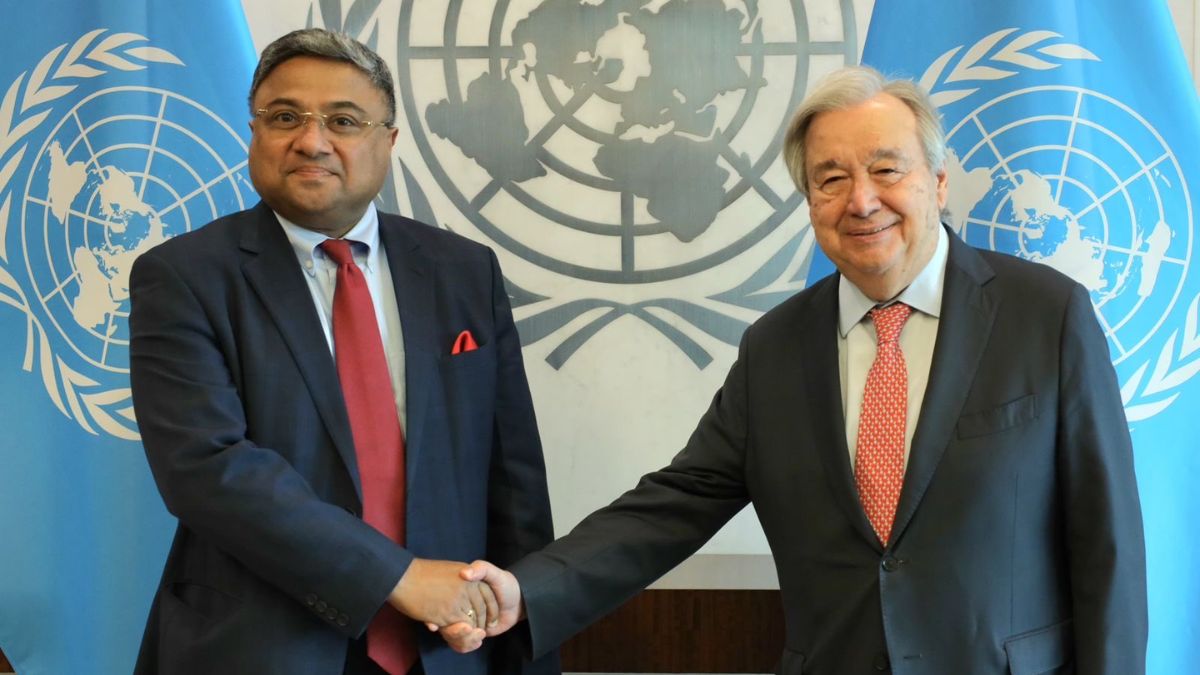
Responding to queries during a recent media briefing, Ministry of External Affairs (MEA) spokesperson Randhir Jaiswal confirmed that Secretary (West) Sibi George held a series of high-level engagements in New York, including a meeting with UN Secretary-General António Guterres.
He noted that several issues central to India’s multilateral agenda were discussed during these interactions. George, who was in New York, also addressed deliberations linked to UN processes, including discussions on United Nations Security Council (UNSC) reforms, a long-standing priority for New Delhi.
What is India’s stand on designating TRF as a terrorist organisation?
India has reiterated that it is continuing to push strongly for the designation of TRF, a proxy of the Pakistan-based Lashkar-e-Taiba, as a terrorist organisation under the UN framework. “In regard to TRF, I can say that the monitoring team is considering this, and we continue to push hard,” Jaiswal said, underlining India’s sustained diplomatic efforts on the matter.
He stressed that building a broad international consensus remains crucial to strengthening the global fight against terrorism. “We continue to push hard because we want to strengthen global fight against terrorism and in that regard it’s important that UN member states are on board with how we approach fighting terrorism globally speaking,” he added.
The issue has gained renewed urgency in the backdrop of the Pahalgam terror attack last year, in which TRF-linked elements were involved. India had subsequently intensified its diplomatic outreach, including sending a delegation to New York to engage with key stakeholders. However, progress has remained slow.
Notably, the United States had in July last year designated TRF as a Foreign Terrorist Organization (FTO) and a Specially Designated Global Terrorist (SDGT), further reinforcing India’s position.
India advocates for reforms in global governance
Alongside its counter-terror push, India has once again called for sweeping reforms in global governance institutions, particularly the UN Security Council, arguing that existing structures no longer reflect present-day geopolitical and economic realities. “Our point remains that global governance needs to be changed because they have to be anchored in contemporary realities,” Jaiswal said.
He further emphasised that India is advocating for a broader, more democratic framework that includes stronger representation of the Global South. “We want to push for broader more democratic global governance which includes the voice of the Global South,” he said, adding that India has a clear stake in expanding these reforms.
India has consistently argued for the expansion of the UNSC in both permanent and non-permanent categories, maintaining that its candidature is backed by its growing global stature and contributions to international peace and security.
What role did Sibi George’s UN engagements play?
Sibi George’s visit to New York forms a key part of India’s ongoing diplomatic outreach at the UN. According to the MEA, his engagements included multiple high-level meetings and participation in important UN discussions, including at the Economic and Social Council (ECOSOC).
“He made several statements there… He also met the Secretary General and several issues that are part of our agenda at the UN were discussed,” Jaiswal said. These engagements underline India’s continued efforts to shape multilateral discourse — from peacekeeping and development financing to counter-terrorism and institutional reform.


