


As India Issues NOTAM For Tri-Service Ex Trishul Near Pakistan Border, It Copies Move To Restrict Airspace
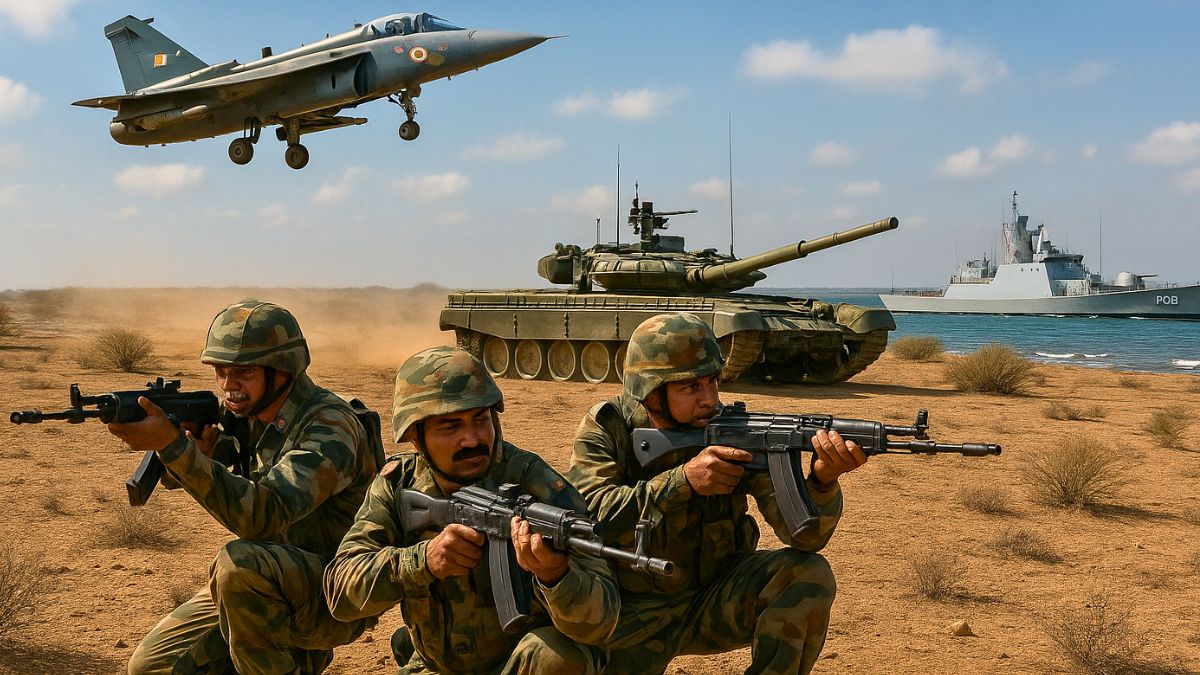
Trishul is designed to refine joint tactics and validate operational readiness against evolving threats. Image courtesy: AI-generated picture via Sora

If there is one thing sure about Pakistan, it is that it gets rattled very easily. In a move that signals nothing but the country’s annoyance, Pakistan has followed in the footsteps of India by issuing a NOTAM, right after a similar notice to airmen was issued by New Delhi in view of the upcoming Exercise Trishul.
India is gearing up for one of its largest joint military operations – Exercise Trishul – bringing together all the three armed forces (Army, Navy, and Air Force) to test and demonstrate seamless multi-domain interoperability and joint combat readiness. Scheduled from October 30 to November 10, 2025, the mega drill will unfold along the western border with Pakistan.
As the armed forces get ready for the massive joint drills, a notice to airmen (NOTAM) has been issued. “India has issued a notification for a Tri-Services Exercise along its western border with Pakistan, the chosen area & scale of activity are unusual Date | 30 October- 10 November 2025,” a tweet by open-source intelligence (OSINT) and satellite imagery analyst Damien Symon read.
Exercise Trishul: Is Pakistan following India with a NOTAM?
Right after India issued a notice to airmen, Islamabad too issued a NOTAM restricting multiple air traffic routes across its central and southern airspace from October 28–29, just before the Indian exercise begins. Symon noted that the move could indicate preparations for a military drill or weapons test, mirroring India’s activity.
His analysis of satellite imagery revealed that India’s reserved airspace for Trishul extends up to 28,000 feet, describing the scale of the operation as “unusual” and significant in scope. Such reciprocal NOTAMs have become a familiar pattern between the two neighbours, particularly after Operation Sindoor.
What will be showcased during Exercise Trishul?
Coming just months after the military stand-off between the two nations, Exercise Trishul will showcase the capabilities of India’s indigenous weapon systems. The exercise will be led by the Southern Command of the Indian Army, under Lieutenant General Dhiraj Seth, and aims to validate integrated operations across land, air, sea, and cyber domains.
The Defence Ministry stated that Exercise Trishul will underscore India’s growing Atmanirbharta (self-reliance) in defence by deploying indigenous weapon systems, electronic warfare platforms, and unmanned assets. The tri-service drill will feature:
- Offensive manoeuvres in the creek and desert sectors,
- Amphibious operations off the Saurashtra coast,
- Electronic and cyber warfare simulations, and
- Coordinated air and maritime missions to validate joint tactics.
A Defence Ministry spokesperson said, “Trishul is designed to refine joint tactics and validate operational readiness against evolving threats, ensuring our forces remain agile and self-reliant.”
How important is the location for Ex Trishul?
The Sir Creek–Sindh–Karachi axis, where the Indian exercise is centred, holds immense strategic importance. The 96-km-long Sir Creek estuary, situated between Gujarat and Pakistan’s Sindh province, determines maritime boundaries and access to crucial sea routes in the Arabian Sea.
The timing of the exercise also follows a strong warning from Defence Minister Rajnath Singh, who recently told troops at Bhuj Air Base, “If Pakistan dares to act in the Sir Creek sector, the reply will be so strong that it will change both history and geography.”
Notably, Exercise Trishul stands as a powerful demonstration of India’s operational synergy, indigenous defence capability, and readiness to deter any cross-border misadventure. By conducting simultaneous joint operations near the Pakistan border, India is signalling not only military preparedness but also its technological and strategic self-reliance.