


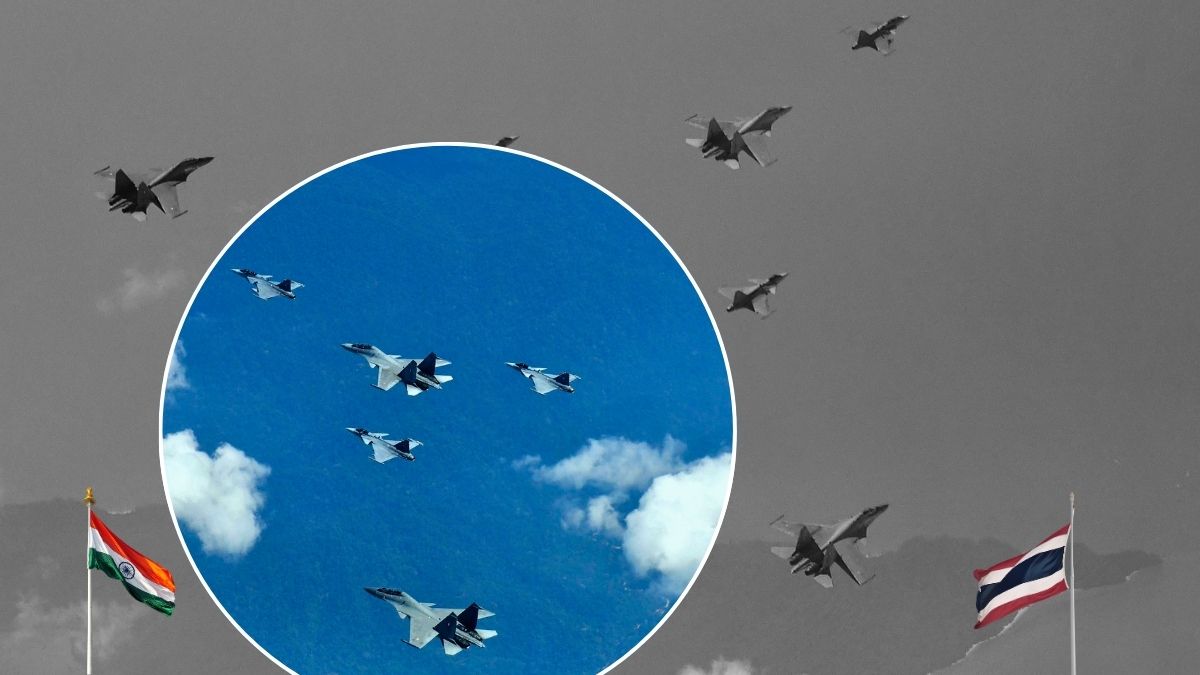
In a joint in-situ air exercise with Thailand, the Indian Air Force has deployed some of its most advanced aerial combat and surveillance platforms like Su-30MKI, AWACS, AEW&C and IL-78 refuelling aircraft, strengthening Indo-Thai defence cooperation and regional synergy.
The air exercise involving IAF and Royal Thai Air Force (RTAF) is aimed at sharpening interoperability and strengthening Indo-Thai defence cooperation. The drill brings together frontline fighter aircraft, airborne surveillance systems and mid-air refuelling assets, underscoring growing air power collaboration between the two nations.
Indo-Thai Air Exercise: What is the focus of the drills?
According to the IAF, the joint exercise is designed to enhance operational coordination and interoperability between the two air forces. It involves complex air operations integrating fighter jets, airborne early warning systems and refuelling aircraft.
“The exercise will enhance operational coordination and interoperability between the two Air Forces,” the Indian Air Force said on X. The exercise reflects a shared emphasis on high-tempo, network-centric warfare and coordinated air domain awareness in a region of increasing strategic importance.
Which frontline assets has the IAF deployed?
The Indian Air Force has fielded a powerful mix of platforms including Su-30MKI multirole fighters, Airborne Warning and Control System (AWACS) aircraft, Indigenous AEW&C platforms, IL-78 mid-air refuelling tankers.
On the Thai side, the Royal Thai Air Force has deployed its Gripen fighter aircraft, known for agility and advanced avionics.
The integration of heavy air dominance fighters like the Su-30MKI with Thailand’s Gripens provides valuable exposure to diverse air combat tactics and operational doctrines.
Why is Su-30MKI central to the drill?
The Su-30MKI forms the backbone of the IAF’s combat fleet. A twin-engine, multirole air dominance fighter, it is designed for air superiority, deep strike and maritime operations. Equipped with thrust-vectoring engines, advanced radar and electronic warfare systems, the aircraft excels in beyond-visual-range engagements and high manoeuvrability dogfights.
What role are AWACS and AEW&C providing in the exercise?
Airborne Warning and Control System (AWACS) aircraft act as flying command centres, offering 360-degree radar surveillance and real-time battle management. These platforms extend situational awareness well beyond ground radar limits and coordinate fighter formations during complex missions.
The indigenous AEW&C system supplements AWACS by providing tactical airspace monitoring and rapid deployment capability. Together, they create layered air defence and surveillance coverage.
Moreover, the IL-78 aerial refuelling tanker serves as a force multiplier. By enabling mid-air refuelling, it extends the operational reach and endurance of fighter aircraft, allowing sustained air operations without returning to base. This capability is particularly important for long-range maritime and regional contingencies.
How does this air exercise fit into India-Thailand defence ties?
India and Thailand established diplomatic relations in 1947 and celebrated 75 years of ties in 2022. Defence cooperation is guided by a 2012 Memorandum of Understanding and includes joint maritime patrols, annual staff talks, training exchanges and multilateral engagements.
Thailand’s “Act West” policy complements India’s “Act East” outreach, with both nations sharing maritime proximity in the Indo-Pacific. The air exercise signals a steady expansion of bilateral defence engagement, particularly in the aerospace domain.