


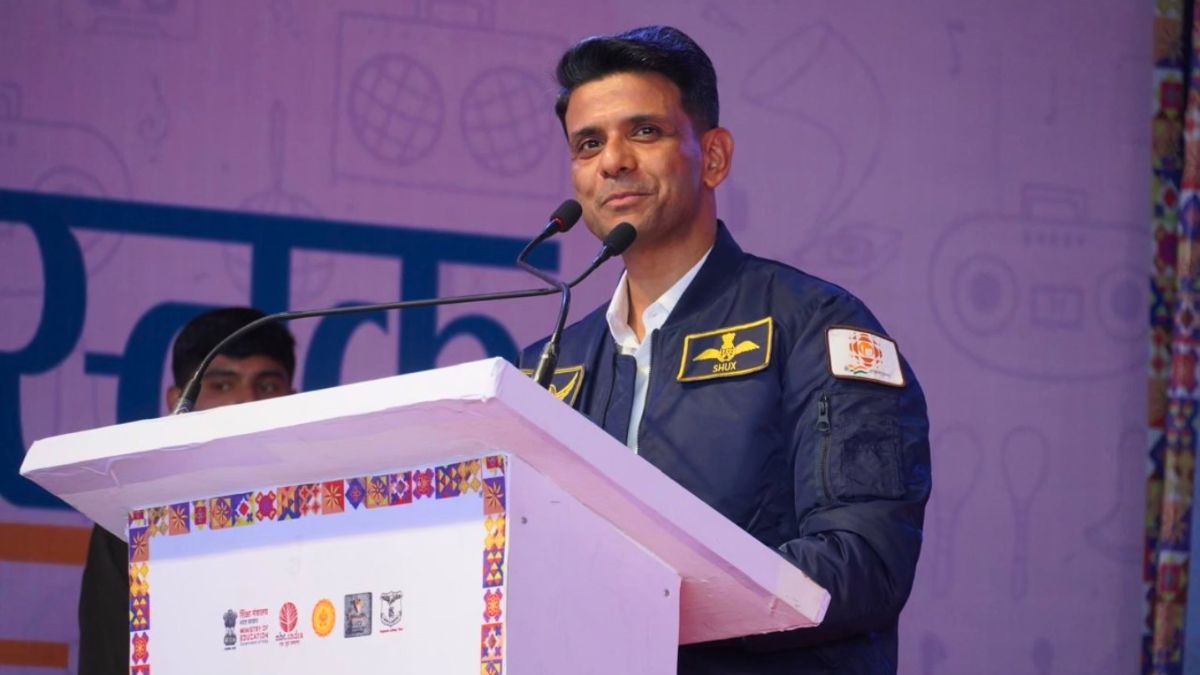
Earlier this year in June, India celebrated Lucknow boy Shubhanshu Shukla, who piloted the ambitious Axiom-4 mission. He created history by becoming the first Indian astronaut to visit the International Space Station (ISS) as pilot of the Axiom Mission 4 (Ax-4) in June 2025. This was the first time in 41 years that an India reached the ISS.
It was the time when India’s growing stature in global spaceflight received fresh recognition and now the astronaut, also an Indian Air Force Group Captain has been named the “Man of the Year”. The IAF has extended its congratulations to Group Captain Shukla on being honoured by The Week magazine in its December 21, 2025 edition.
The honour celebrates Shukla’s historic role as mission pilot of Axiom-4 (Ax-4), a breakthrough private astronaut mission that elevated India’s presence in human space exploration. During the 18-day mission, which concluded with a splashdown landing on July 15, crew conducted experiments on medicine, agriculture, and effect of space
What was the Axiom-4 mission?
Axiom-4 is the fourth private astronaut mission organised by US-based Axiom Space, in partnership with NASA and SpaceX, to the International Space Station (ISS). Group Captain Shukla, along with astronauts Peggy Whitson (US), Slawosz Uznanski-Wisniewski (Poland), and Tibor Kapu (Hungary), conducted more than 60 experiments and 20 outreach sessions.
After experiencing space and microgravity, he conducted several scientific tests. According to ISRO, about Rs 600 crore were spent on the Axiom-4 mission, including astronauts training and related costs. Around Rs 600 crore were spent on this mission, covering training for two astronauts and other space journey preparations.
For India, Poland and Hungary, Ax-4 marked their first-ever missions to the ISS, underscoring the mission’s historic significance.
A milestone moment for India in space
Launched in June 2025 aboard a SpaceX Crew Dragon spacecraft, Ax-4 made Shukla the first Indian astronaut to visit the ISS, and only the second Indian to travel to space, after Wing Commander Rakesh Sharma in 1984. Originally planned as a 14-day mission, Ax-4 was extended to 18 days, during which Shukla played a central role in mission operations and scientific research.
During his stay aboard the ISS, Shukla conducted multiple STEM and microgravity experiments, documented daily life on the space station, and engaged directly with students and young scientists in India, inspiring a new generation to pursue science, technology and exploration.
How does this shape India’s future space ambitions?
Shukla’s participation in Ax-4 is seen as a strategic step forward for India’s broader human spaceflight goals. Officials note that the mission aligns closely with the Gaganyaan human spaceflight programme, and long-term plans for the Bharatiya Antariksh Station.
By contributing to an international, privately-led ISS mission, India reinforced its role as an active and capable partner in global space exploration.