


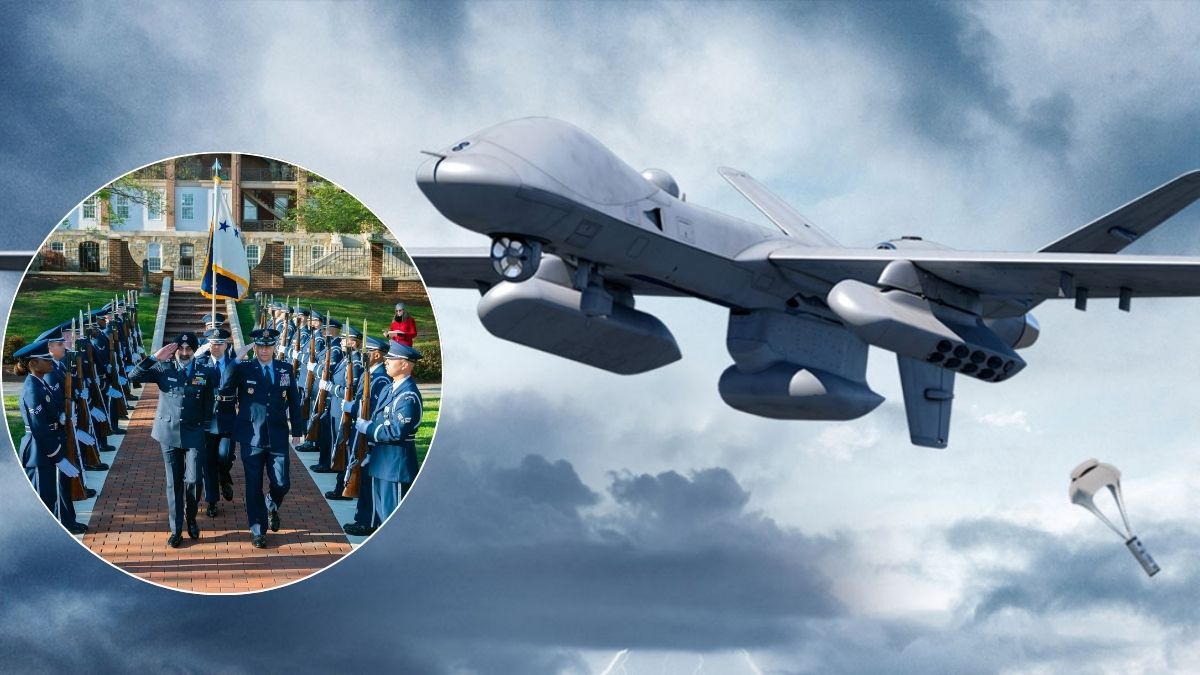
In a significant development for India-US defence cooperation, Washington has assured the seamless integration of MQ-9B Sea Guardian drones into the Indian armed forces, reinforcing a key pillar of the strategic partnership. The assurance came during Indian Air Force Chief Air Chief Marshal AP Singh’s high-profile visit to the United States.
During his visit, which coincided with that of Foreign Secretary Vikram Misri’s 3-day Washington trip, IAF chief Singh held extensive discussions with top American military leadership. The development underscores growing trust and operational alignment between the two countries, particularly in advanced military technologies.
MQ-9B drones integration into Indian forces
US Air Force Chief General Kenneth Wilsbach welcomed India’s procurement of the armed drones and reaffirmed Washington’s commitment to their operational deployment. The US Air Force stated, “General Wilsbach emphasised the US Air Force’s commitment to ensuring that the Indian Armed Forces can seamlessly and effectively employ the platform upon delivery.”
During the visit, the IAF Chief was also shown “full-spectrum MQ-9 operations”, indicating the depth of technological and operational cooperation being extended.
What makes the MQ-9B ‘Predator’ drones so significant?
The MQ-9B Sea Guardian drones, part of a nearly $4 billion deal signed in October 2024 for 31 units, are among the most advanced unmanned aerial systems in the world.
Designed for long-endurance missions, the drones can operate at altitudes above 40,000 feet and remain airborne for up to 40 hours (depending on configuration) in all types of weather. Equipped with precision strike capabilities, they carry missiles and small-diameter bombs, along with advanced surveillance systems including electro-optical sensors, infrared imaging, and synthetic aperture radar.
SeaGuardian is capable of safely integrating into civil airspace, enabling joint forces and civil authorities to deliver real-time situational awareness anywhere in the maritime domain, day or night. With encrypted communications, secure GPS, and automatic take-off and landing, the MQ-9B offers persistent, long-range surveillance and real-time intelligence gathering.
How will these drones enhance the Indian Air Force’s capabilities?
The induction of MQ-9B drones is expected to significantly enhance the Indian Air Force’s intelligence, surveillance, reconnaissance (ISR), and strike capabilities. These drones will allow India to monitor vast maritime and land borders continuously, conduct precision strikes with minimal risk to personnel.
Additionally, these aircraft would also enhance the capabilities of the armed forces by strengthening real-time battlefield awareness, and improving long-range surveillance across the Indo-Pacific. The ability to operate for extended durations makes them especially valuable for tracking threats and securing critical sea lanes, particularly in the Indian Ocean Region.
What were the key highlights of Air Chief Marshal AP Singh’s US visit?
The IAF Chief’s visit marked a series of high-level engagements aimed at deepening military cooperation. He received a ceremonial welcome at Joint Base Anacostia-Bolling and met US Air Force Secretary Troy Meink and General Wilsbach at the Pentagon. Discussions focused on interoperability, joint training, capability development, and shared learning.
The visit also included briefings at Peterson Space Force Base on advanced aerospace and defence systems, engagements at Nellis Air Force Base, including a familiarisation flight in an F-15EX fighter jet.
Senior US leaders highlighted the importance of the partnership in ensuring a free, open, peaceful and prosperous Indo-Pacific region.
What does this mean for India-US defence cooperation?
The MQ-9B deal and the high-level military exchanges signal a deepening of India-US defence ties, with a growing focus on cutting-edge technologies and joint operational readiness. General Wilsbach underscored the US Air Force’s readiness to support India’s modernisation efforts, pointing to expanding defence industrial collaboration as a mutually beneficial pathway.