


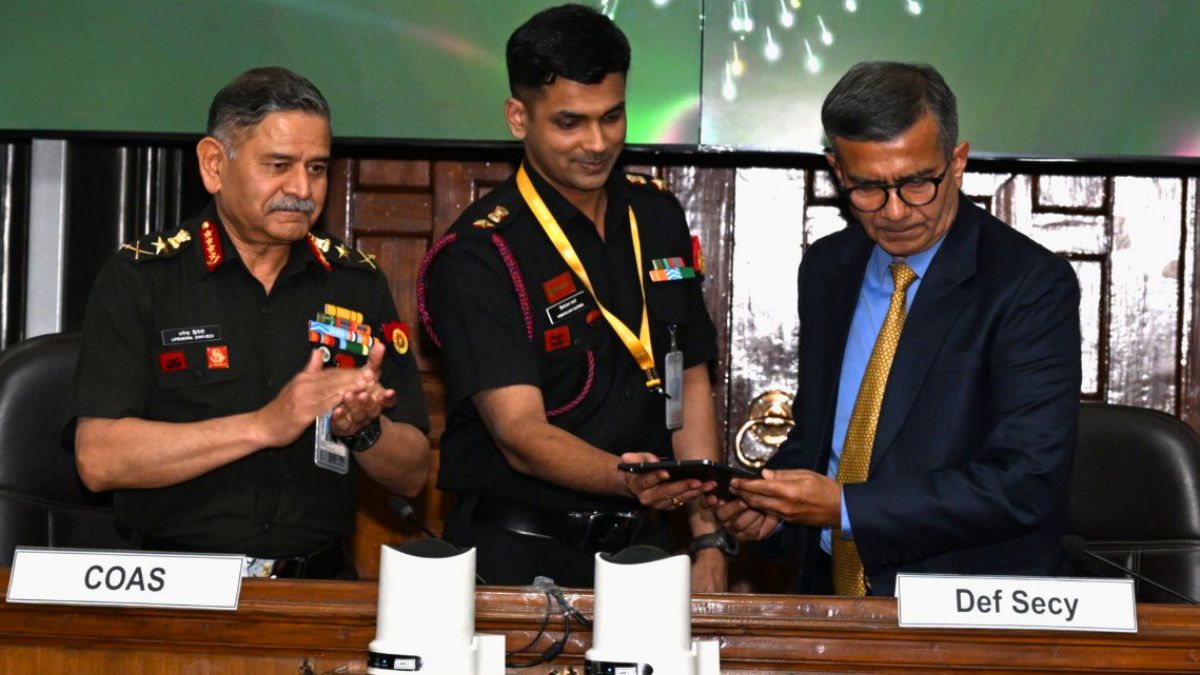
While there is already a push to accelerate indigenous defence production to safeguard national security, India’s top Army leadership has made another strong case for the same, especially at a time when global conflicts like the West Asia conflict are severely affecting and disrupting supply chains.
At the recently concluded four-day Army Commanders’ Conference (ACC), senior leadership underlined that self-reliance is no longer optional but a strategic necessity in an era marked by trade blockades and geopolitical uncertainty.
The Ministry of Defence noted that the deliberations focused on strengthening long-term strategic resilience in view of the current global supply chain crisis. Worth mentioning here is that the Indian Army has designated the year 2026 as the year of “Networking and Data Centricity” aligned with the vision of evolving into a ‘Future Ready Force’.
Army Commanders’ Conference: What were the key takeaways?
Chaired by the Chief of the Army Staff (COAS), the high-level conference brought together the country’s top strategic and security leadership, including the Cabinet Secretary, Chief of Defence Staff, Defence Secretary, NSAB Chairman, and the Chief of Naval Staff.
The discussions covered a wide operational spectrum, including military modernisation and combat readiness, technology infusion in operations, doctrinal and training requirements, along with networking and data-centric warfare.
The Ministry of Defence noted that the aim of the conference was to enhance operational readiness and address emerging security challenges in a rapidly evolving threat environment.
How are lessons from global conflicts shaping India’s military thinking?
Drawing from ongoing conflicts worldwide, including in West Asia, the Army leadership emphasised the need to strengthen hard power capabilities.
“Based on the lessons learnt from Operation Sindoor, and in keeping with the current operational dynamics globally, senior army leadership also focussed on operational capability requirements including employment of Unmanned Aerial Systems (UAS) and Counter Unmanned Aerial Systems (C-UAS),” the statement read.
The focus on drones and counter-drone systems reflects how modern warfare is increasingly driven by autonomous and asymmetric technologies, reshaping battlefield strategies.
Why is indigenous capability crucial in today’s geopolitical climate?
With global trade disruptions and restricted access to critical defence supplies, the conference highlighted the risks of overdependence on foreign sources. The leadership stressed that boosting domestic manufacturing ecosystems would ensure uninterrupted supply of critical military hardware.
Additionally, domestic manufacturing would also reduce vulnerability to geopolitical shocks
Strengthen India’s position as a self-reliant defence power. The push aligns with India’s broader ‘Atmanirbhar Bharat’ vision in defence.
How is India progressing on defence self-reliance?
The renewed emphasis comes at a time when India is already witnessing record growth in defence production and exports.
Recent data highlights that defence production in India crossed Rs 1.5 lakh crore in 2024-25 with the defence exports hitting a record Rs 38,424 crore in 2025-26. Moreover, this is also helping increase the induction of indigenously developed platforms and systems. These milestones indicate that India is steadily transitioning from a major importer to a growing defence manufacturing hub.
What role does jointness and national coordination play?
A key theme emerging from the conference was the need for a whole-of-nation approach to security. Senior leaders called for enhanced civil-military synergy, a stronger inter-ministerial coordination, and integrated responses to complex and multi-domain threats.
The conference signals a clear shift in India’s defence posture, one that is technology-driven, self-reliant, and globally aware.