


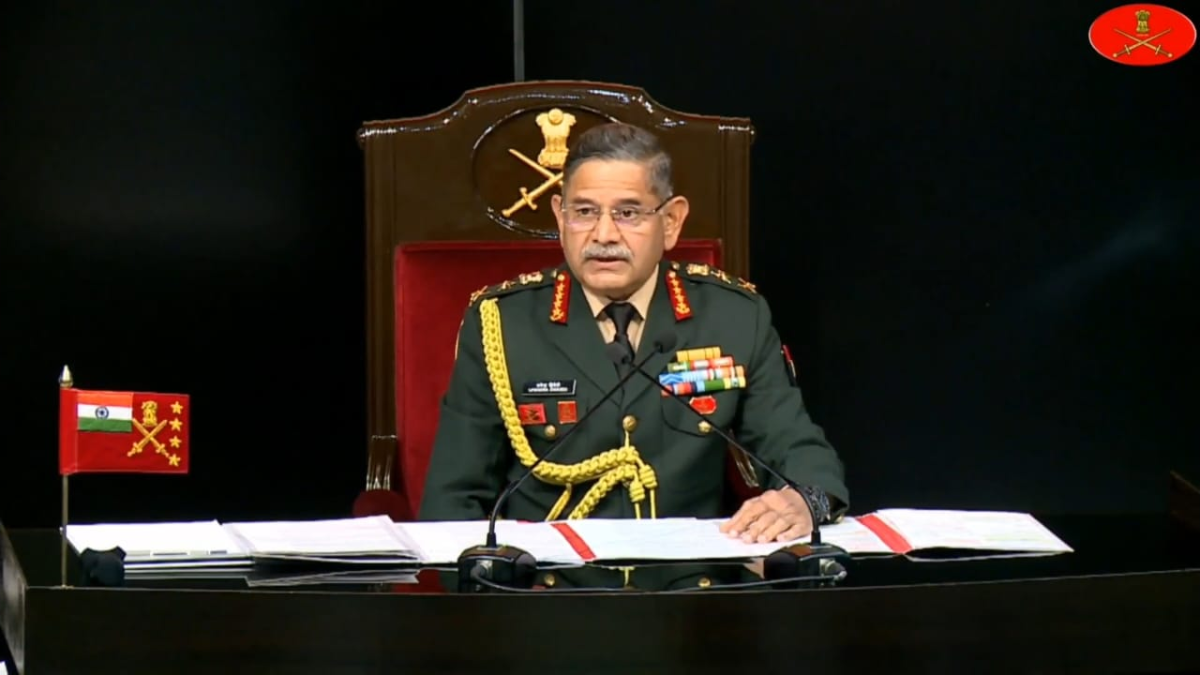
Chief of Army Staff General Upendra Dwivedi on Tuesday (January 13, 2025) firmly rejected China’s recent claims over the Shaksgam Valley, pushing back against assertions contained in a joint statement issued in China on CPEC 2.0.
Addressing journalists during the annual press conference ahead of the Army Day in New Delhi, General Dwivedi responded to Beijing’s defence of its infrastructure development in the high-altitude region.
General Dwivedi said, “As far as the Shaksgam Valley is concerned, India considers the 1963 agreement between Pakistan and China as illegal.” He added, “Therefore, we do not approve of it. And in these terms, the MEA has already issued the statement.”
He added that India does not accept the joint statement issued in China about the CPEC 2.0 and considers it an illegal action being carried out by the two nations.
The statement came on the heels of comments from Chinese Foreign Ministry spokesperson Mao Ning earlier in the day, who insisted that the Shaksgam Valley “belongs to China” and defended the construction work there as fully justified on what Beijing regards as its territory. Mao cited the 1960s boundary deal with Pakistan as the legal basis for Chinese claims.
The Shaksgam Valley, a roughly 5,180-square-kilometre area north of the Karakoram Range, was transferred to Chinese control under a boundary agreement signed between Islamabad and Beijing in March 1963. India has consistently maintained that Pakistan, having no lawful title to the area, could not cede it, and that the region remains part of the Union Territories of Jammu and Kashmir and Ladakh.
For China and Pakistan, the valley holds significant strategic value due to its proximity to Xinjiang Province, Gilgit-Baltistan (administered by Pakistan), and the Siachen Glacier front, making it a focal point in broader India-China and India-Pakistan geopolitical dynamics.
Furthermore, regarding the situation on the northern front, General Upendra Dwivedi said that the situation along the northern front remains stable but requires constant vigil. He said, “Senior-level interactions, renewed contacts, and confidence-building measures are contributing to gradual normalisation. Grazing activities, hydrotherapy camps, and other engagements along the border have resumed. Our deployment along the Line of Actual Control remains balanced, robust, and strategically oriented. Capability development and infrastructure enhancement continue through a whole-of-government approach.”
Line of Actual Control
Speaking about the tensions along the Line of Actual Control (LAC), he said that India and China were slowly trying to increase the trust factor on both sides.
“On 21 October 2024, there was an understanding between both sides. Prior to that, the two top leaders met in Kazan, followed by meetings in Tianjin.” He added that in between, engagements were also held under the Working Mechanism for Consultation and Coordination (WMCC) framework. Apart from this, he said that the Defence Ministers and the Foreign Ministers of the two countries had met twice.
He added that there is a clear sense of urgency and mutual acceptance on both sides to keep the borders as calm and quiet as possible.
According to General Dwivedi, the key to this approach is maintaining open communication.
General Dwivedi said that India and China now have multiple levels of engagement, with officials at different echelons communicating regularly to ensure that minor issues are resolved locally and do not escalate into larger problems. “These include station-level meetings, Commanding Officer–level meetings, and engagements up to the Corps Commander level. In areas where such mechanisms are not yet in place, we have proposed similar arrangements under the Eastern Command as well.” He added that the objective is to resolve issues at the earliest opportunity—quickly, effectively and in a manner that is amicable to both sides.
“Regarding force reduction and deployment, I would like to emphasise that this is a matter of time, space and resources. Forces must be positioned in a manner that allows them to reach designated deployment areas within stipulated timelines and strength levels. This is the framework we are currently examining,” General Dwivedi said.
He added that to manage the situation effectively, two groups have been constituted–an expert group and a working group. “The expert group is examining boundary delimitation, while the working group is focused on boundary management. Once these groups provide further guidelines, corresponding developments on the ground will follow,” General Dwivedi said.