


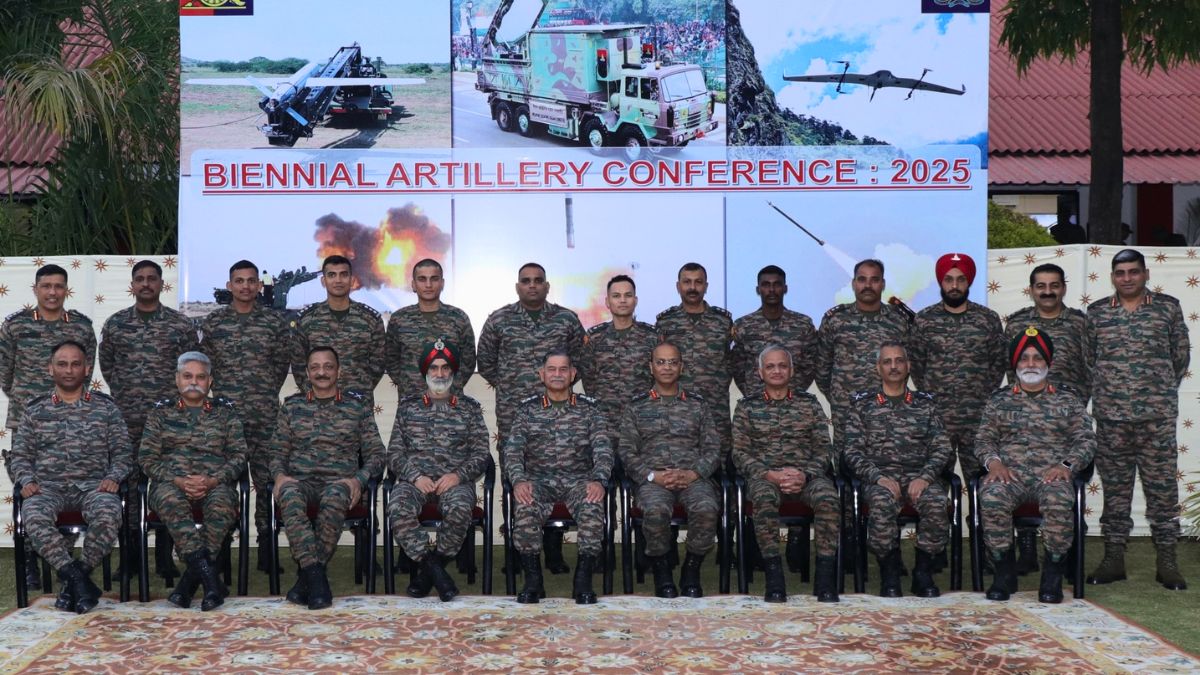
Chief of Army Staff General Upendra Dwivedi on Friday (December 12, 2025) attended the Biennial Conference of the Regiment of Artillery at the School of Artillery, Devlali, underscoring the Indian Army’s push towards next-generation warfare. Senior leadership including the Director General of Artillery, Colonel Commandants, Formation Commanders and Commanding Officers took part in the deliberations.
The conference focused on key themes such as force restructuring, modernisation and technology infusion to enhance the operational effectiveness of the artillery arm.
Focus on technology-driven warfare and training
During his visit, COAS General Dwivedi reviewed facilities at the Drone Experience Centre, which is designed to prepare troops for technology-intensive battlefields. He was briefed on simulator laboratories, an incubation centre and a drone manoeuvre arena, where personnel train in mission planning, surveillance and precision targeting.
Addressing station officers, General Dwivedi praised their emphasis on modernising warfare practices and improving training standards, urging them to maintain momentum across all operational domains. For the past few years, the Indian Armed Forces, especially the Army, has been taking steps towards modernisation, increasing technology, drone use, and other tactics that aid the troops on the ground.
Regiment of artillery’s enduring operational role
The Indian Army highlighted the Regiment of Artillery’s legacy as a battle-winning arm, with a history of decisive contributions during major conflicts, counter-terrorism operations and overseas missions. The Gunners have also played a critical role in disaster relief and humanitarian assistance, earning recognition for professionalism and dedication.
Indigenous counter-drone systems get a major boost
In a parallel boost to India’s air defence and counter-drone capabilities, the Indian Army and Indian Air Force are set to place orders for 16 indigenous Drone Detection and Interdiction Systems.
Developed by the Defence Research and Development Organisation (DRDO), the Integrated Drone Detection and Interdiction System (IDDIS) Mark-2 can engage hostile unmanned aerial systems at a range of up to 2 kilometres using laser beams. The system employs a 10-kilowatt laser, doubling the engagement range of earlier variants.
Lessons from Operation Sindoor drive laser weapon push
The accelerated development follows the extensive use of drones by Pakistan during Operation Sindoor, which Indian forces successfully neutralised. DRDO is now developing longer-range laser-based systems to counter evolving aerial threats. The organisation has already successfully tested a 30-kilowatt laser-based direct energy weapon.
It is capable of engaging targets at up to 5 kilometres, with trials being conducted in coordination with the armed forces.
Earlier this year in April, India publicly demonstrated its ability to shoot down fixed-wing aircraft, missiles and swarm drones using the 30-kilowatt laser weapon system, marking a significant milestone in indigenous directed energy weapon (DEW) development. The combined focus on artillery modernisation and advanced counter-drone systems once again signals India’s intent to stay ahead in high-technology, multi-domain warfare.