


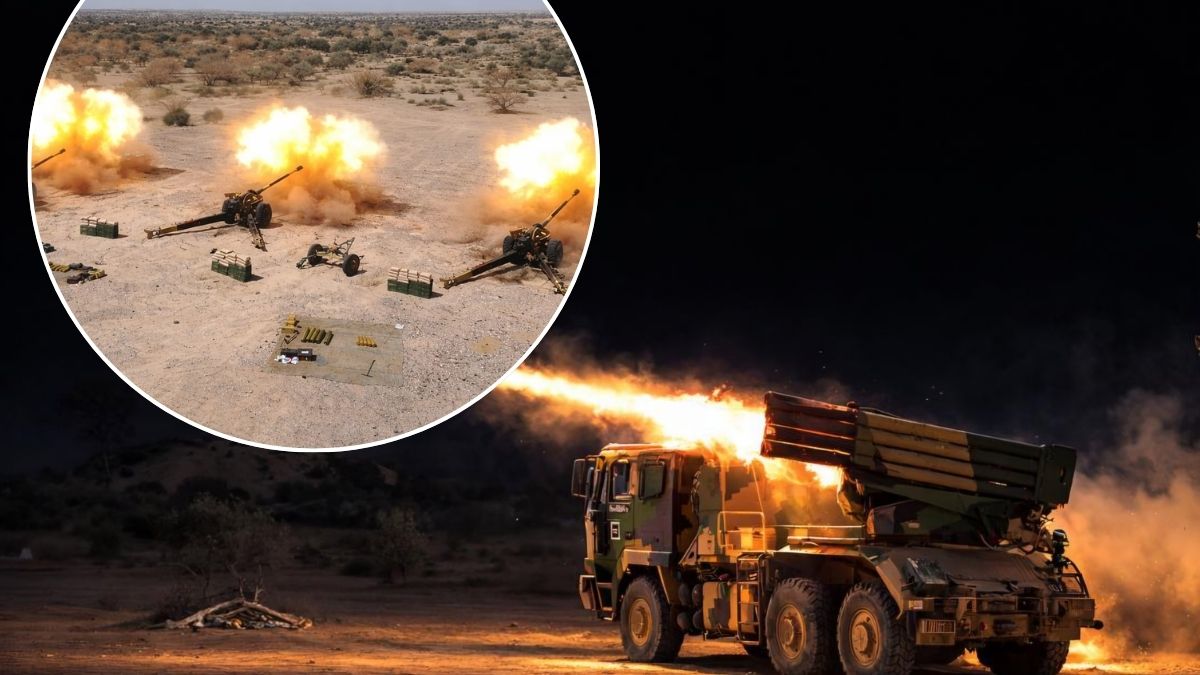
Indian Army constantly demonstrates its warfare and battlefield capabilies, and its tropps once again proved how capable they are by conducting a high-intensity firepower exercise. Amid rising regional instability, including renewed tensions between Pakistan and Afghanistan and a broader uncertain global security environment, the Army recently conducted a firepower exercise at the Pokaran Field Firing Range.
The exercise, titled ‘Blazing Steel, Decisive Impact – Battlefield Thunder’, was designed not just as a demonstration, but as a validation of evolving combat techniques, coordination and rapid strike capabilities. Unlike routine drills, this exercise stood out for its integration of advanced technology with traditional artillery systems.
Additionally, the battefield exercise also had a strong emphasis on precision, speed and real-time coordination.
Indian Army’s Battlefield Thunder
Some of the key distinguishing features of the battlefield drills included simulated battlefield conditions in harsh desert terrain, coordinated multi-system firing missions, focus on rapid response and high-accuracy targeting, integration of indigenous systems like Pinaka with legacy platforms.
The Army used the exercise to test and refine new operational doctrines, particularly for desert warfare scenarios, which remain strategically critical for India.
Pinaka and BM-21 Grad: Precision and firepower on display
A major highlight of the drill was the deployment of powerful rocket and artillery systems, including BM-21 Grad Rocket System, which was truck-mounted with 40 launch barrels, as it fired a full salvo in just 20 seconds, displaying an effective range of 0.5 to 45 km. Moreover, the system is capable of deploying multiple warhead types.
India’s upgraded BM-21/LRAR variant demonstrated enhanced reliability, mobility and strike capability, successfully neutralising simulated enemy targets.
Pinaka Multi-Barrel Rocket Launcher
It is an indigenous system showcasing India’s growing defence self-reliance, known for high precision and quick deployment. It played a key role in coordinated strike missions. Together, these systems highlighted the Army’s ability to deliver rapid, high-volume and accurate firepower in combat situations.
Konark Corps leads high-intensity operations
The exercise was spearheaded by the Konark Corps, with artillery units, often referred to as the Army’s “Gunners”, demonstrating seamless coordination and operational efficiency. Over several days, troops conducted complex firing drills, target tracking and engagement exercises, synchronised multi-platform strikes.
Officials noted that the performance reflected high levels of discipline, training and technical proficiency.
Why Desert warfare training matters
The choice of Pokaran, with its vast, arid terrain, is strategically significant. Desert environments pose unique challenges like extreme weather conditions, limited cover and concealment, need for long-range precision strikes.
Training in such conditions ensures that the Army remains prepared for high-intensity conflict scenarios along India’s western front.