


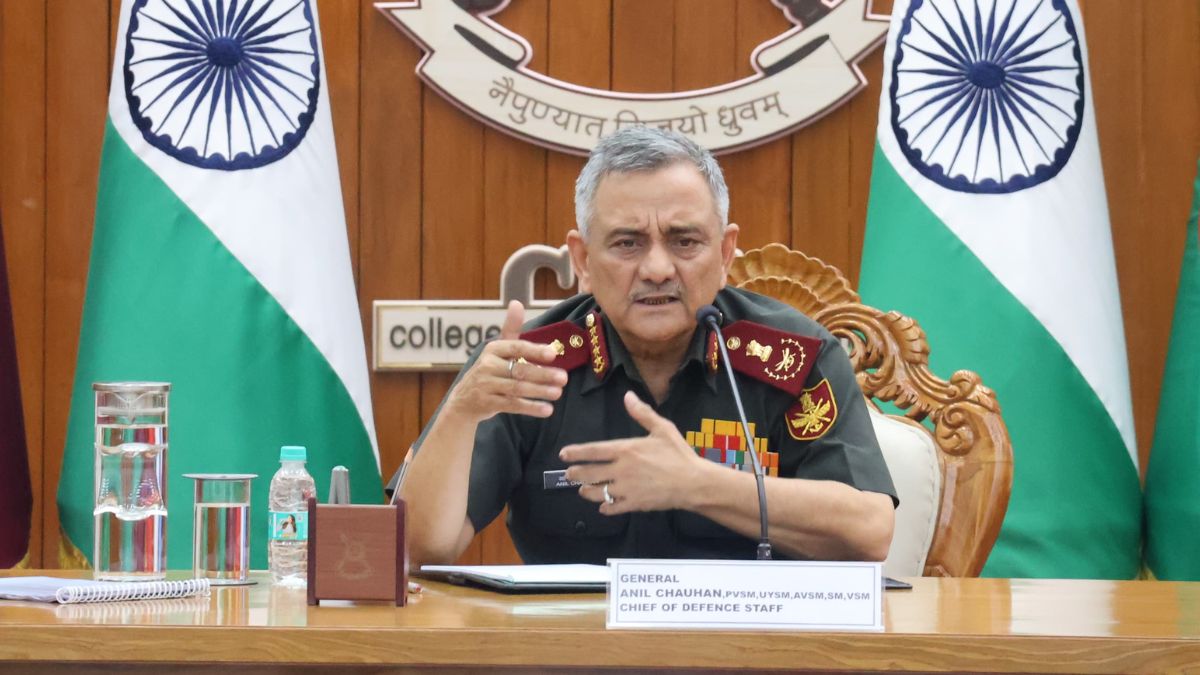
Chief of Defence Staff (CDS) General Anil Chauhan has outlined a sweeping and structured vision of India’s national security architecture, emphasising that future conflicts will demand jointness, foresight and a deep understanding of both geography and technology. With this, he explained national security through 3 concentric circles.
Speaking at the Indian Military Heritage Festival in Delhi, he described national security through “three concentric circles” – mission security, mission defence and the core of military preparedness – offering a rare strategic insight into India’s evolving security doctrine.
While the outermost circle outlines the steps to secure a mission, the middle circle is part of it. “And how do you defend your mission? And in the centre of that is the military preparedness of a mission… They may help to derive a national security strategy, a defence strategy, or a military strategy, or all three of them,” General Chauhan said.
How does the CDS define India’s new security architecture?
General Chauhan underscored that securing a nation is no longer a purely military function but a fusion of diplomacy, economic strength and technological edge. Explaining his framework, the CDS called the three concentric circles a layered model, arguing that it helps shape a broader national security, defence and military strategy.
“Our job is to visualise how wars will unfold in the future… understand the operating environment, the threats, and equip and train ourselves accordingly,” he stated.
How is Geography central to future warfare?
In a pointed reminder to planners, General Chauhan stressed that geography remains the bedrock of operational design. “Whenever you do any appreciation, you first analyse the terrain… then relative strength, then time and space,” he said, highlighting two levels of geography – physical, which sets the stage for operations; and human, which is crucial for counterinsurgency and counter-terror operations.
At the geopolitical level, the CDS underlined, a nation’s geographic location defines its strategic weight.
Why jointness is significant for the armed forces?
General Chauhan reaffirmed that military jointness, central to the ongoing theatre command reforms, does not erode the identity of individual services. “Each service will retain its identity… We are extracting best practices from all three,” he stressed. General Chauhan cited an example from recent operational adjustments along the northern borders, where urgent asset relocations were coordinated seamlessly between services without bureaucratic delays.
“This is what jointness looks like,” he said, highlighting trust and lateral communication among commanders.
Calling this period “a phase of sweeping reforms,” the CDS said he has been making deliberate efforts to reach out to middle and junior leadership across the Army. Given the scale of restructuring, from joint commands to capability realignment, he emphasised the need for every rank to be “on the same page” to ensure reform succeeds.
To sum it up, General Chauhan’s remarks signal a clear recalibration of India’s defence posture, which entails preparing for multi-domain, technology-driven wars, synchronising diplomacy, economy and defence for deterrence, integrating services under a joint warfighting framework, prioritising both physical terrain and human terrain in operations.