


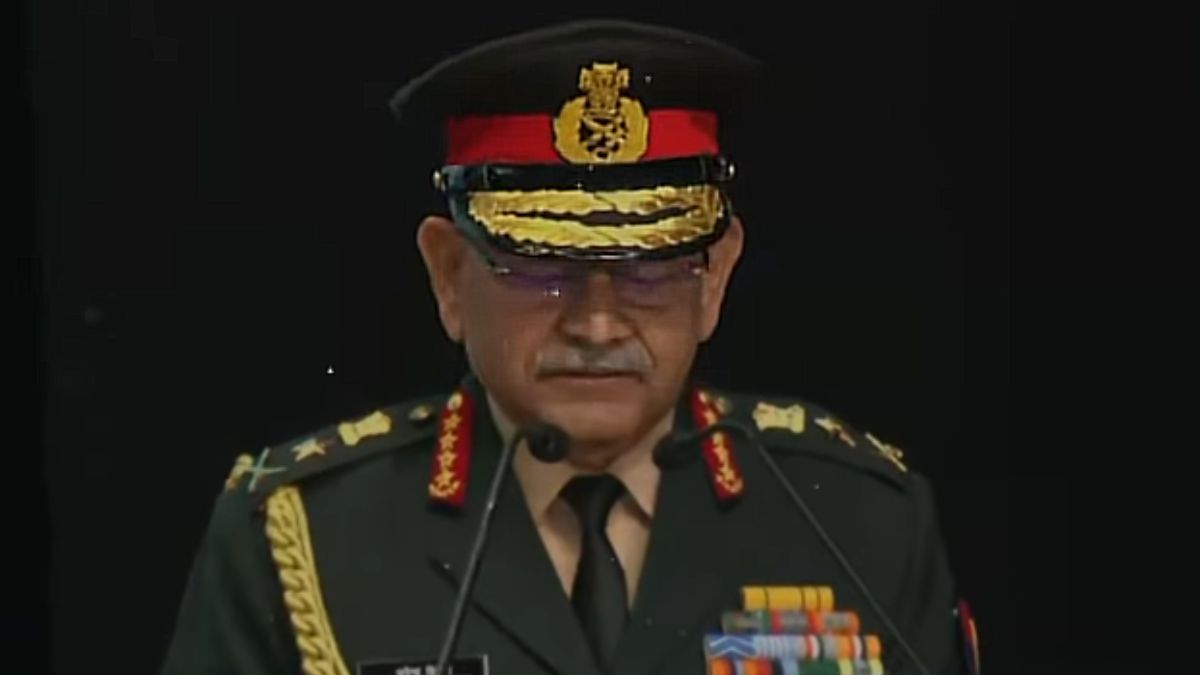
In a stark assessment of the global security landscape, Army Chief General Upendra Dwivedi warned that the period often described as the “long peace” is steadily collapsing, replaced by a world marked by fractured geopolitics, rising conflicts and relentless power competition.
Speaking at the inauguration of the Chanakya Defence Dialogue 2025 in New Delhi on Thursday (November 27, 2025), Gen Dwivedi said the international system has transitioned from Cold War bipolarity to a brief unipolar moment and now into a turbulent multipolar and uncertain order.
Underlining that with over 50 conflicts raging across continents, the Army chief stated that calling this a turbulent time may be an understatement. “We are living in an increasingly multipolar world, where major powers are continuously jostling and competing. The long piece is declining, and comprehensive conflicts are on the rise,” Gen Dwivedi remarked.
Army’s transformation: What role does PM Modi’s 5Ss vision play?
General Dwivedi raised the fundamental question – how must the Indian military transform to remain decisive and ready in this rapidly-evolving global landscape. Answering this, he emphasised that the foundation for India’s strategic evolution lies in Prime Minister Narendra Modi’s 5Ss approach — Samman (respect), Samvad (dialogue), Sahayog (cooperation), Samridhi (prosperity) and Suraksha (security).
He said these principles should guide India’s whole-of-nation response as the country navigates the Amrit Kaal, steering towards Viksit Bharat.
The Army Chief highlighted that the theme of Chanakya Defence Dialogue 2025 — “Reform to Transform: Sashakt and Aur Surakshit Bharat” — aligns with this national vision, bringing together senior military leaders, strategic experts and global partners to deliberate on the challenges ahead.
How is the Indian Army reshaping itself for the future?
Recalling the Army’s Decade of Transformation plan (2023–2032), Gen Dwivedi outlined a three-phase trajectory designed to prepare the force for multi-domain challenges:
Phase 1 – (2032): Agenda-setting and restructuring
Phase 2 – (2037): Five-year strengthening based on Phase 1 gains
Phase 3 – (2047): Achieving an integrated, future-ready force design
“Phase one, 2032, is a comprehensive framework under the decade of transformation or accelerated transition. Phase two, till 2037, is a five-year period of consolidated gains from phase one. And phase three, a jump to 2047, when we graduate to the next level of integrated future-ready force design,” he explained.
He said this roadmap has already shown its impact, most notably in Operation Sindoor, where reforms and readiness “translated into decisive outcomes.” The central question now, he added, is determining what must propel the Army’s next leap forward.
Which ‘springboards’ will drive India’s military transformation?
Aatmanirbharta (Self-Reliance), Anusandhan (Accelerated Innovation), Anukulan (Adaptation), Ekikaran (Military–Civil Fusion) are the four strategic springboards which Gen Dwivedi listed that will shape the Army’s transformation in the decade ahead.
On Aatmanirbharta, he said, “Its results are visible in defence manufacturing, space achievements, and rapid military technology absorption. Much more remains to be done as we deepen our self-reliant capability base.”
On Anusandhan, the Army chief stated that while initiatives like IDEX and ADITI are accelerating the idea to prototype pipeline, we must now move on from experimentation to enterprise-scale impact at a much faster pace in AI, cyber, quantum, autonomous systems, space, and advanced materials.
He expressed confidence that the 2025 Dialogue would produce “actionable outcomes” vital for India’s security future.
Meanwhile, the presence of President Droupadi Murmu, the Supreme Commander of the Armed Forces, underscored the national importance of the annual conclave. Gen Dwivedi said her participation “acts as a catalyst” for the Army as it pushes ahead to build a force capable of effective deterrence and decisive multi-domain operations.