


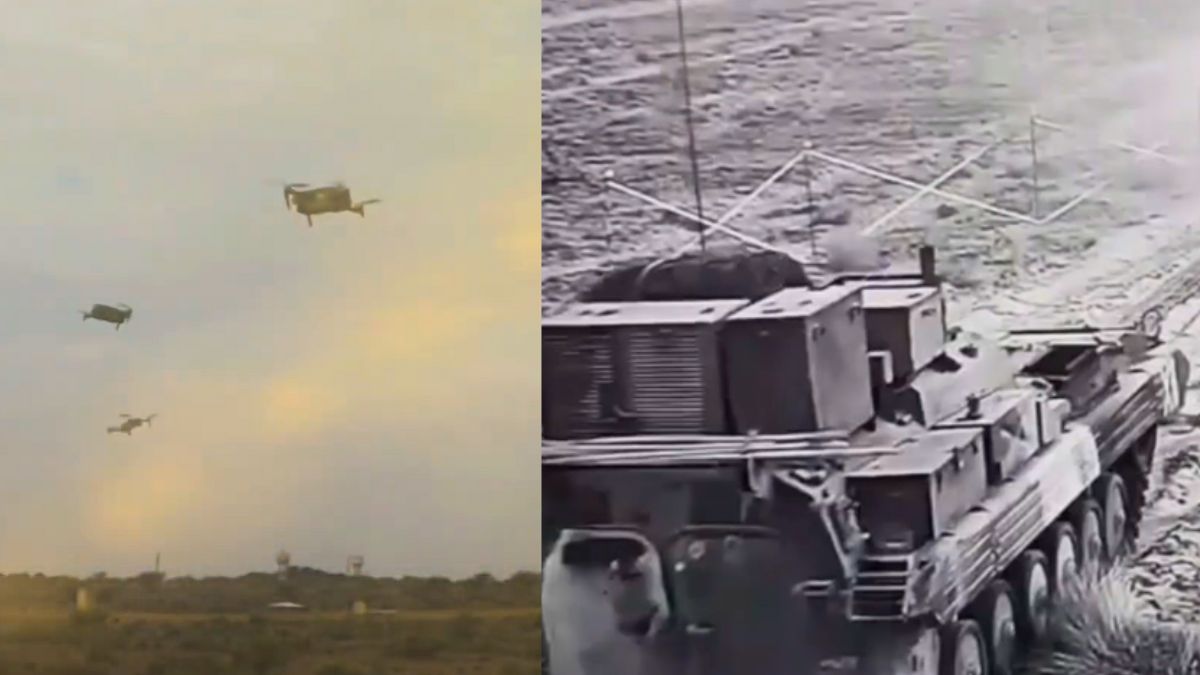
In a powerful display of jointness, synergy, and combat readiness, the Konark Corps troops under the Southern Command are currently conducting Exercise Akhand Prahar in the desert sector. The large-scale manoeuvres are part of India’s ongoing effort to strengthen integrated operational capability across the Army, Navy, and Air Force.
The exercise focuses on validating integrated battle drills and multi-domain operations, enabling formations to fine-tune Tactics, Techniques, and Procedures (TTPs) for Combined Arms operations both by day and night in the challenging desert terrain.
Tech-enabled and mission-oriented, the exercise embodies the armed forces’ resolve to operate as a unified, networked fighting force capable of dominating future battlefields.
How does Exercise Akhand Prahar fit into Exercise Trishul?
Exercise Akhand Prahar forms a key part of the broader Tri-Services framework of Exercise Trishul, a theatre-level warfighting exercise designed to validate joint planning, execution, and coordination between the Indian Army, Navy, and Air Force. Under Exercise Trishul, multiple formations across India’s southern and western theatres are testing the interoperability of sensors, shooters, and decision-makers, using real-time data integration and AI-driven command tools.
By nesting Akhand Prahar within Trishul, the armed forces aim to simulate multi-domain warfare, covering land, air, maritime, cyber, and space domains.
Why these exercises matter for India’s future warfare
Notably, the Southern Command, under the guiding mantra “Eagle on Every Arm,” has built a comprehensive in-house ecosystem for the design, development, and large-scale production of combat-ready Unmanned Aerial Systems (UAS). These indigenous drones were field-tested during Exercise Trishul recently, during which they demonstrated exceptional precision, endurance, and mission flexibility under contested combat conditions.
With the nature of warfare rapidly evolving towards high-technology and network-centric operations, both Akhand Prahar and Trishul reflect the Indian Armed Forces’ commitment to future readiness.
The emphasis on integration, real-time coordination, and precision engagement underlines India’s growing capability to conduct swift, decisive, and coordinated operations across diverse terrains.
Meanwhile, Exercise Trishul is as much about training and readiness as it is about deterrence. It signals that the Indian military, fresh off the success of Operation Sindoor, is not just reacting, but proactively securing the western frontier.