


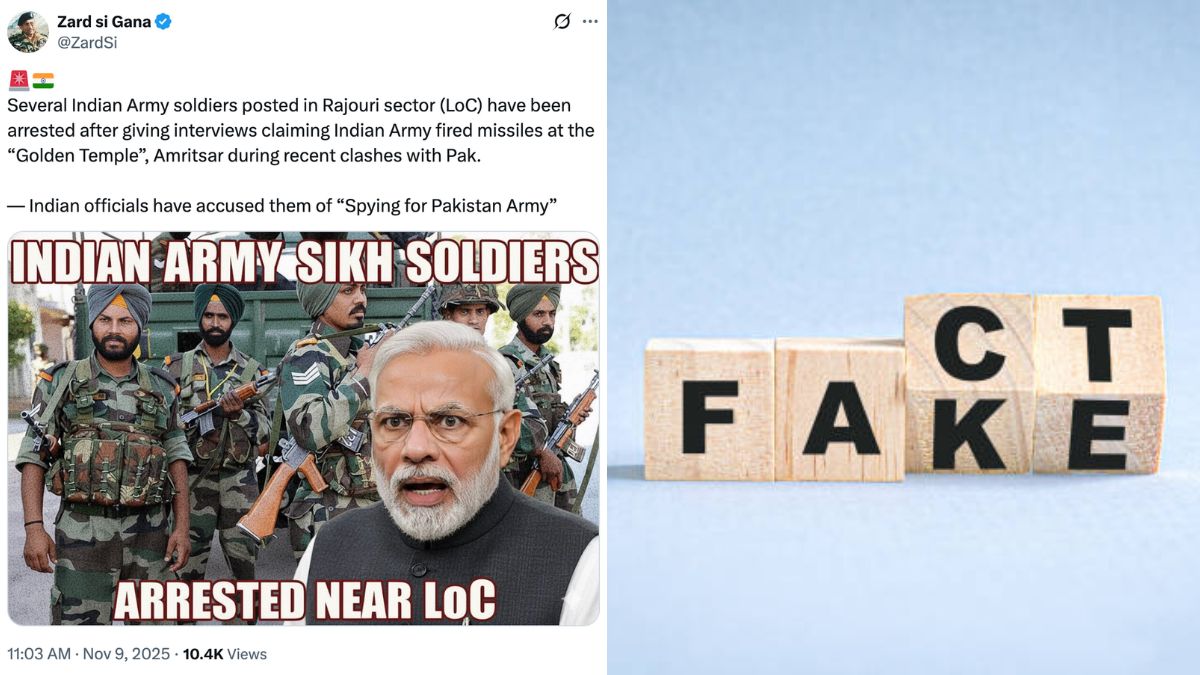
A viral post on X (formerly Twitter), originating from a Pakistani handle, has alleged that Indian Army soldiers stationed in Rajouri, Jammu and Kashmir, were arrested because they claimed that India had fired missiles at Amritsar’s Golden Temple.
The allegation is a complete fabrication. There are no credible reports or official statements suggesting any such arrests or military action. In fact, the rumour appears to distort a retracted May 2025 Indian Army statement about Pakistan’s missile activities, turning it into a baseless accusation against India.
Sikh leaders have reportedly denied that any attack occurred, and no evidence from local or international media supports the claim.
What is the purpose of such disinformation?
The fabrication follows a familiar pattern in Pakistan’s coordinated disinformation ecosystem targeting India’s armed forces and communal harmony. By exploiting sensitive religious imagery—such as the Golden Temple—and invoking Sikh identity within the Army, these campaigns aim to provoke outrage and sow division.
The viral claim, featuring images of Sikh soldiers and AI-generated visual of Prime Minister Narendra Modi, bore hallmarks of fake news: not citing or linking any reliable news sources to back the claim, using AI visuals, and the account’s history of posting misinformation.

According to researchers tracking online information warfare in South Asia, Pakistan-based troll networks frequently recycle old or doctored military content—sometimes twisting previous official statements—to build a false sense of authenticity. These operations typically spike during times of heightened diplomatic or military friction between India and Pakistan.
What does Pakistan’s systemic disinformation operation look like?
Over the past few years, Indian government agencies and independent digital investigators have identified hundreds of Pakistan-linked accounts spreading anti-India narratives on platforms such as X, Facebook, and Telegram.
Recurring tactics include:
- Circulating fake letters or “leaked” orders allegedly from Indian defence institutions.
- Spreading claims of dissent among Indian troops, particularly in border regions like Rajouri or Ladakh.
- Using fabricated communal angles involving Sikh, Muslim, or Dalit soldiers to stir social tensions.
- Linking unrelated incidents—such as missile tests or accidents—to religious or political sites.
In several cases, these narratives have been traced back to networks aligned with Pakistan’s state-linked media ecosystem and intelligence-linked “influence clusters.”
What has India’s response been?
India’s Press Information Bureau (PIB) and independent fact-checkers have stepped up digital monitoring, issuing public clarifications on viral posts aimed at undermining trust in the Indian Army. In the aftermath of Operation Sindoor, it has become clear that such propaganda is part of a strategic psychological warfare campaign to manipulate perceptions within India and abroad.
Citizens and media outlets have been urged to verify information before sharing it.