


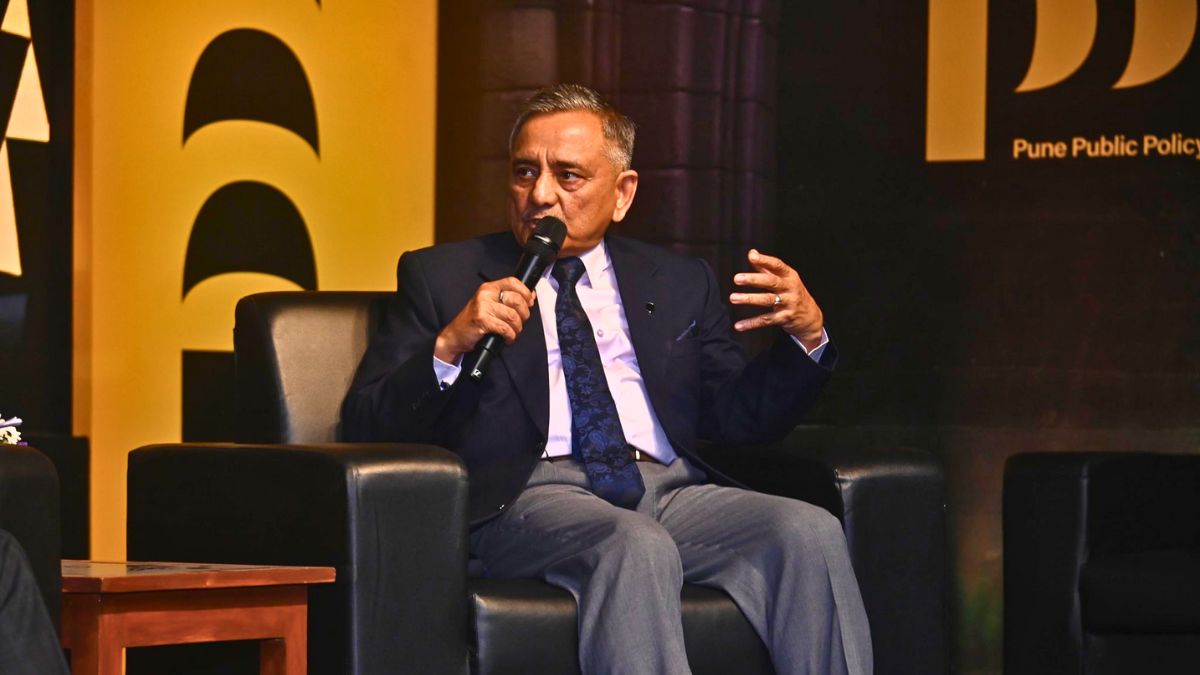
Reflecting on how made in India defence equipment and products eventually end up benefitting the country’s economy, Chief of Defence Staff (CDS) General Anil Chauhan offered a fresh and strategic take on the long-running debate between economic welfare and defence expenditure.
He further shared that sustained economic growth could ensure smooth implementation of modernisation plans. Speaking at the Pune Public Policy Festival on Friday (January 9, 2025), CDS General Chauhan made a strong point for indigenisation in the defence industry, explaining why.
General Chauhan said the traditional “guns versus butter” argument is outdated if defence resources are deployed intelligently, especially through domestic procurement and indigenisation.
Can defence spending strengthen economic welfare?
Addressing concerns over budget priorities, General Chauhan underscored defence and welfare need not be opposing choices. “There has always been a debate between guns and butter. But if we play smartly, one can contribute to the other. The gun can contribute to the butter,” the CDS said.
He underlined that over the past three years, the bulk of defence procurement has shifted to domestic sources, ensuring that government spending cycles back into the economy. With every indigenous purchase attracting 18% GST, he said, defence expenditure now contributes to government revenue, job creation, industrial growth and manufacturing capacity.
“This is a change of strategy that we must realise,” he noted.
Military modernisation and India’s defence budget trajectory
On current allocations, General Chauhan noted that India’s defence budget stands at just under 2% of GDP, but emphasised that economic growth is the real enabler of military modernisation. “If GDP continues to grow at around 8%, inflation remains low and we see a 10% year-on-year increase, our modernisation plans should move smoothly,” he stated.
The Chief of Defence Staff also acknowledged that some high-ticket acquisitions may require short-term spikes in spending, but stressed that the overall funding curve can stabilise with sustained economic momentum.
How is warfare changing and why does it affect spending?
The CDS said defence planning must evolve as warfare undergoes a fundamental transformation. He described three major Revolutions in Military Affairs (RMA), including manoeuvre warfare, net-centric warfare, and convergence warfare – an emerging, intelligent, data-driven form of conflict.
“We are at the cusp of the third revolution – convergence, an intelligent, data-centric kind of warfare,” he explained.
How will India prioritise military modernisation?
Reflecting on a revised capability roadmap, General Chauhan said future investments could be rebalanced as 60% for conventional warfare, support and manoeuvre; 30% for net-centric and network-enabled operations; 10% for cognitive, intelligent and non-nuclear static deterrence domains.
This shift reflects growing emphasis on space, cyber, electromagnetic and cognitive warfare.
Is India overhauling its defence procurement system?
Yes, the CDS confirmed that procurement planning is being reworked. He shared that instead of relying solely on the Integrated Capability Development Plan (ICDP), the armed forces are now using extensive Operational Research and Scientific Analysis (ORSA) studies to identify the right equipment, determine optimal quantities, align purchases with future battlefield needs.
“This is a different method from what we followed earlier,” he said.
What is the CDS’s operational role in modern warfare?
Clarifying misconceptions, General Chauhan stressed that the CDS does not exercise direct command over the three service chiefs. However, he explained that the role carries operational responsibility through the Chiefs of Staff Committee, where he serves as permanent chairman.
Citing Operation Sindoor, he said key decisions were taken collectively by the committee. He also highlighted his direct operational role in emerging domains such as space, cyber, cognitive warfare, electromagnetic spectrum operations.
Regarding the whole nation’s approach, he says, “It means the armed forces don’t fight a war; the nation goes to war. In the context of Operation Sindoor, we required cooperation between the armed forces and the intelligence agencies.”
This coordination was done largely at three levels. One is the NSA level, the national agencies; the other is the three Services, Chief of Staff Committee, CDS; and the RM office and our Raksha Mantri getting all the secretaries with defence production… within a few days for Operation Sindoor, the Raksha Mantri gave an emergency pass for procurement, he shared.
How does India view multi-front threat scenarios?
On concerns about a possible three-front challenge involving Pakistan, China and Turkey, the CDS urged a nuanced assessment. “One of these countries does not even share a border with us,” he said, noting the absence of any formal military alliance among them.
He added that India routinely plans contingencies, including redeployment of assets across fronts, as demonstrated during Operation Sindoor.