


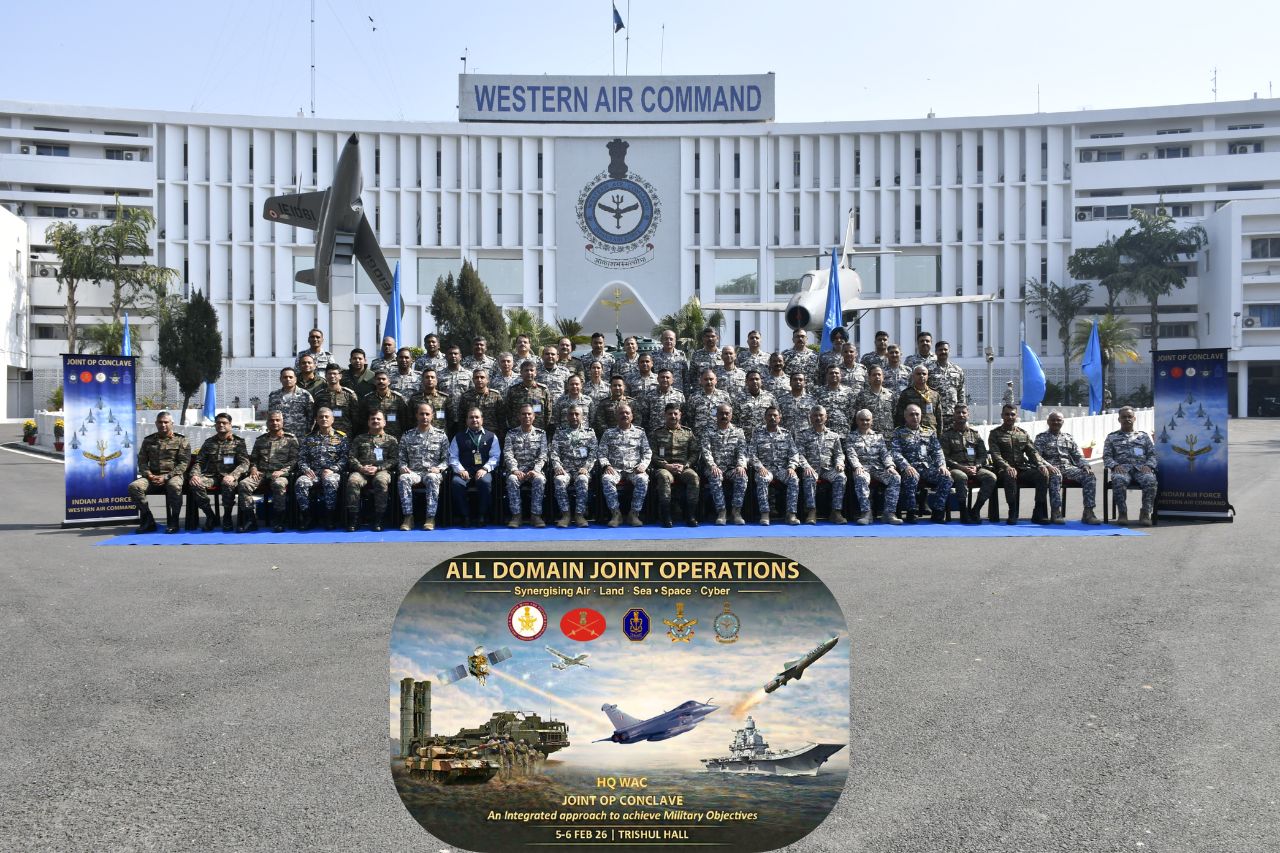
India’s armed forces took another step toward building a fully integrated, future-ready military with the conclusion of a high-level Joint Operations Conclave held on February 5–6, 2026, under the All Domain Joint Operations (ADJO) Exercise 2026 framework.
Hosted by the Headquarters Western Air Command (WAC) at Subroto Park in New Delhi, the conclave underscored the growing emphasis on jointness, interoperability and multi-domain operations in the face of evolving security challenges, according to a Ministry of Defence statement on Friday (February 6, 2026).
According to officials, the conclave was aimed at deepening both intra-service and inter-service interaction at the operational level of warfare, the statement said.
The focus was on strengthening joint operational capabilities across the Army, Navy and Air Force, while integrating newer domains such as space, cyber and intelligence into a unified warfighting approach.
The defence ministry said the ADJO Exercise 2026 represents a significant milestone in India’s ongoing military transformation.
It is expected to play a decisive role in building a truly interoperable force capable of operating seamlessly across the full spectrum of modern conflict, from conventional warfare to contested and denied environments shaped by cyber and space-based threats.
Senior officers from the Headquarters Integrated Defence Staff (IDS), the Army, the Navy, the Defence Space Agency and the Defence Intelligence Agency participated in the deliberations, alongside top leadership from the Indian Air Force.
The wide representation reflected New Delhi’s push to institutionalise joint planning and execution, a key pillar of India’s long-term defence reforms.
In his inaugural address, Air Marshal J. S. Mann, Senior Air Staff Officer at Western Air Command, stressed the paramount importance of jointness and integrated warfighting in contemporary and future conflicts.
He highlighted the need for an all-domain operational approach that ensures seamless integration across air, land, sea, space and cyber domains, enabling decisive outcomes against technologically advanced adversaries.
Air Marshal Mann also emphasised enhancing interoperability among the services, promoting “domain-agnostic decision-making,” strengthening sensor-to-shooter linkages, and refining operational procedures to improve efficiency and effectiveness on the battlefield.
Chief of Integrated Defence Staff, Air Marshal Ashutosh Dixit, called for the institutionalisation of joint mechanisms for integrated planning, intelligence sharing and capability prioritisation.
He underlined the importance of coherent inter-service responses and the structured identification of capability gaps to ensure comprehensive operational preparedness for future contingencies.
Accelerated doctrinal evolution and tri-service resource alignment, he said, were essential to achieving sustained strategic readiness.
Air Marshal Jeetendra Mishra, Air Officer Commanding-in-Chief of Western Air Command, drew critical lessons from Operation Sindoor, outlining their implications for the conduct of future warfare.
He highlighted the pivotal role of air power in generating decisive strategic effects, the need to synchronise surface manoeuvre with offensive air operations, and the strategic advantages offered by stand-off weapons.
Calling for a resolute shift away from legacy attrition-based models associated with the 1971 era, as well as from rigid effects-based frameworks, Air Marshal Mishra advocated a more agile, adaptive and fully integrated joint warfighting paradigm.
He stressed the imperative of identifying and bridging existing capability gaps to reinforce combat effectiveness and operational credibility.
The conclave reaffirmed the armed forces’ commitment to jointness, operational synergy and continuous adaptation, the key enablers as India prepares its military to meet complex, multi-domain threats in an increasingly contested strategic environment.