


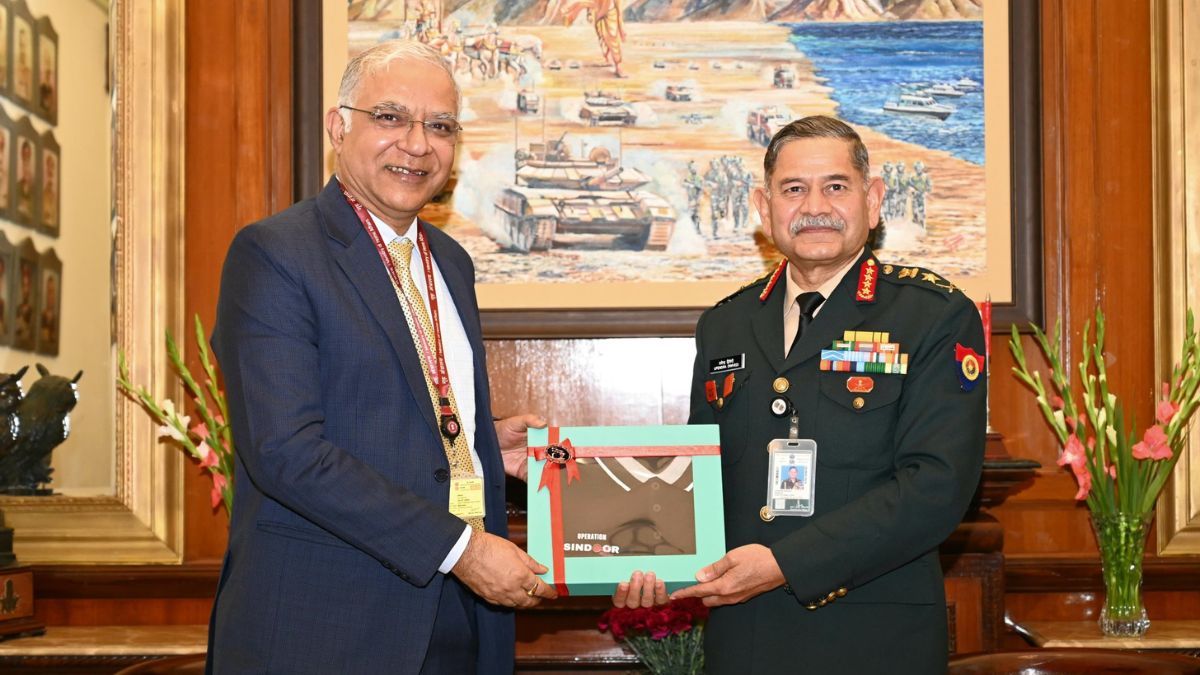
India and Sri Lanka reaffirmed their commitment to deepening defence and strategic cooperation during a meeting between Indian High Commissioner to Sri Lanka Santosh Jha and Chief of Army Staff (COAS) General Upendra Dwivedi in New Delhi on Friday (November 28, 2025).
The interaction comes at a time when both nations are expanding military exchanges and maritime collaboration in the Indian Ocean Region (IOR).
What did the Indian Army say about the meeting?
According to a post shared by the Indian Army on X, the discussions focused on strengthening the India–Sri Lanka strategic partnership, assessing regional security dynamics, and exploring new avenues for diplomatic and defence cooperation.
The Army highlighted that deeper civil–military engagement remains a key component of India’s outreach to its neighbours, particularly in the context of evolving geopolitical challenges in the IOR.
What is the relevance of the meeting?
The meeting also underscored India’s longstanding role in providing humanitarian assistance and disaster relief (HADR) to neighbouring countries.
New Delhi has been one of the first responders during natural disasters in the region, extending support through coordinated military, diplomatic, and logistical efforts.
How have India-Lanka military ties grown recently?
The diplomatic engagement coincided with India’s strong naval presence at the Sri Lanka Navy International Fleet Review (IFR) 2025, held in Colombo from November 27 to 29 as part of the Sri Lanka Navy’s 75th anniversary celebrations.
India deployed its first indigenous aircraft carrier, INS Vikrant, and the indigenously built stealth frigate INS Udaygiri to participate in the multilateral event.
What was the significance of the naval participation?
The Ministry of Defence said the deployment marks the maiden overseas operational visit for both platforms, underscoring India’s expanding capabilities in indigenous defence manufacturing.
INS Vikrant’s debut at an international fleet review highlights India’s growing naval profile, while the presence of INS Udaygiri reflects the Navy’s commitment to enhancing maritime interoperability and maintaining a secure and stable Indian Ocean Region.
The participation of Indian naval assets at IFR 2025, coupled with high-level military diplomacy, signals New Delhi’s focused approach to strengthening regional partnerships and reinforcing its role as a key maritime security provider in South Asia.