


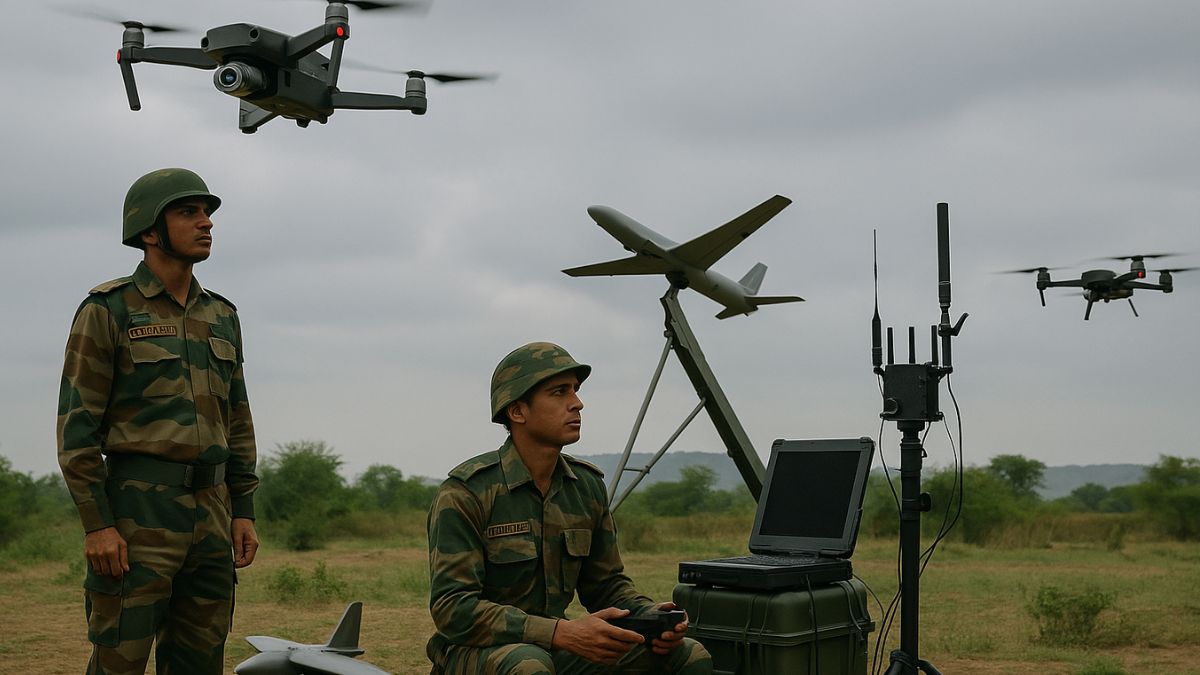
The Indian Army has begun placing orders worth over ₹5,000 crore for a new generation of indigenous unmanned aerial systems (UAS) capable of operating in intense electronic warfare environments, following rigorous trials that replicated battlefield conditions encountered during Operation Sindoor.
The emergency procurement, cleared after lessons drawn from Operation Sindoor, focuses on drones that can function effectively despite heavy GPS spoofing and signal jamming.
The orders span a wide range of roles, including short-range kamikaze strikes, long-range precision munition delivery, and battlefield reconnaissance, marking one of the Army’s largest investments in domestically produced drone technology.
How were these drones screened for Chinese parts?
To ensure operational reliability, the Army adopted a three-tiered selection process. The first stage involved mandatory screening to eliminate any Chinese-origin components, reflecting growing concerns over supply chain security. Specialised inspection teams meticulously examined each system before allowing it into trials.
In the second stage, the Army established a dedicated electronic warfare testing zone, where drones were subjected to extreme jamming and spoofing from the launch point itself.
Only platforms that maintained navigation, communication, and mission effectiveness under these conditions were cleared further. The final stage involved high-altitude trials to validate performance across diverse operational terrains.
Which companies were selected after the rigorous testing?
In a notable development, public sector firm Munitions India Limited emerged as a key winner, securing contracts worth nearly ₹500 crore for loitering munitions—its first major order in this segment.
In the private sector, NewSpace Research & Technologies and SMPP Pvt Ltd jointly bagged orders of around ₹725 crore for surveillance and kamikaze drones, establishing themselves as major players.
Other companies shortlisted include ideaForge for surveillance drones and JSW for vertical take-off and landing unmanned systems, with additional contracts expected to be finalised soon.