


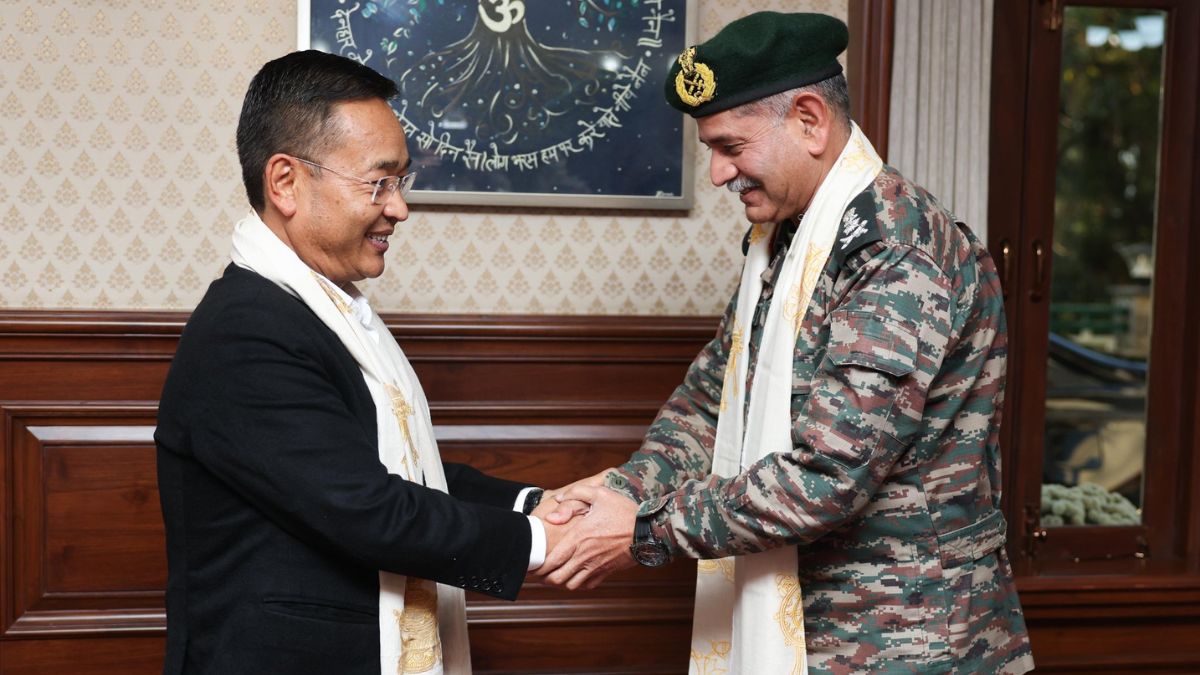
General Upendra Dwivedi, India’s Chief of Army Staff (COAS), concluded his two-day visit to Sikkim to review India’s operational readiness along the sensitive Line of Actual Control (LAC) on Wednesday (November 19, 2025).
His visit came a day after he stated that relations between India and China have “improved a lot” over the past year due to enhanced communication at multiple levels between the two neighbours.
What are the Army Chief’s tour plans?
During his tour, General Dwivedi interacted with field commanders and assessed the preparedness of the formations responsible for defending the Sikkim sector.
The critical task of securing the 220-km LAC in this region rests with the Trishakti Corps, headquartered in Sukna, West Bengal. This formation plays a key role in maintaining stability along one of the most strategically significant stretches of the India–China boundary.
How did the thaw in India-China relations build?
Tensions between the two sides have eased gradually after the October 2024 disengagement from all standoff points in eastern Ladakh.
However, both Indian and Chinese troops, with their equipment and armaments, remain deployed in depth along the 832-km LAC in the high-altitude Ladakh sector.
The standoff had begun in May 2020 after a violent clash between the PLA and the Indian Army at Finger 4 on the northern bank of Pangong Tso, prompting China to undertake a massive force build-up.
What have India, China done to reduce military tensions?
To reduce friction and prevent escalation, India and China have steadily expanded military communication mechanisms.
A new hotline between the Indian Army at Kongra La in North Sikkim and the PLA at Khamba Dzong in Tibet was activated in 2021, adding to the network of confidence-building channels.
Six operational hotlines now connect ground commanders across the LAC: two each in eastern Ladakh, Sikkim, and Arunachal Pradesh. These include links at Daulat Beg Oldi, Chushul, Nathu La, Bum La, and Kibithu.
What is the historical background of India-China conflicts?
India shares a 3,488-km border with China passing through Jammu & Kashmir, Himachal Pradesh, Uttarakhand, Sikkim, and Arunachal Pradesh.
Sikkim’s geography makes it particularly significant, not just because of its 220-km LAC, but also due to its proximity to the narrow Siliguri Corridor.
This vulnerable stretch, just 20–22 km at its narrowest point, connects mainland India to the northeastern states and hosts critical highways, rail routes, pipelines, and digital infrastructure.
What has India done to secure Siliguri Corridor?
Recognising its importance, the government announced in 2023 that border guarding forces would take on an expanded role in enhancing the security of the Siliguri Corridor, also known as the Chicken’s Neck, during peacetime.
General Dwivedi’s visit underscores the Army’s focus on ensuring readiness, bolstering communication, and maintaining stability along the LAC at a time when the broader India–China relationship shows signs of cautious improvement.