


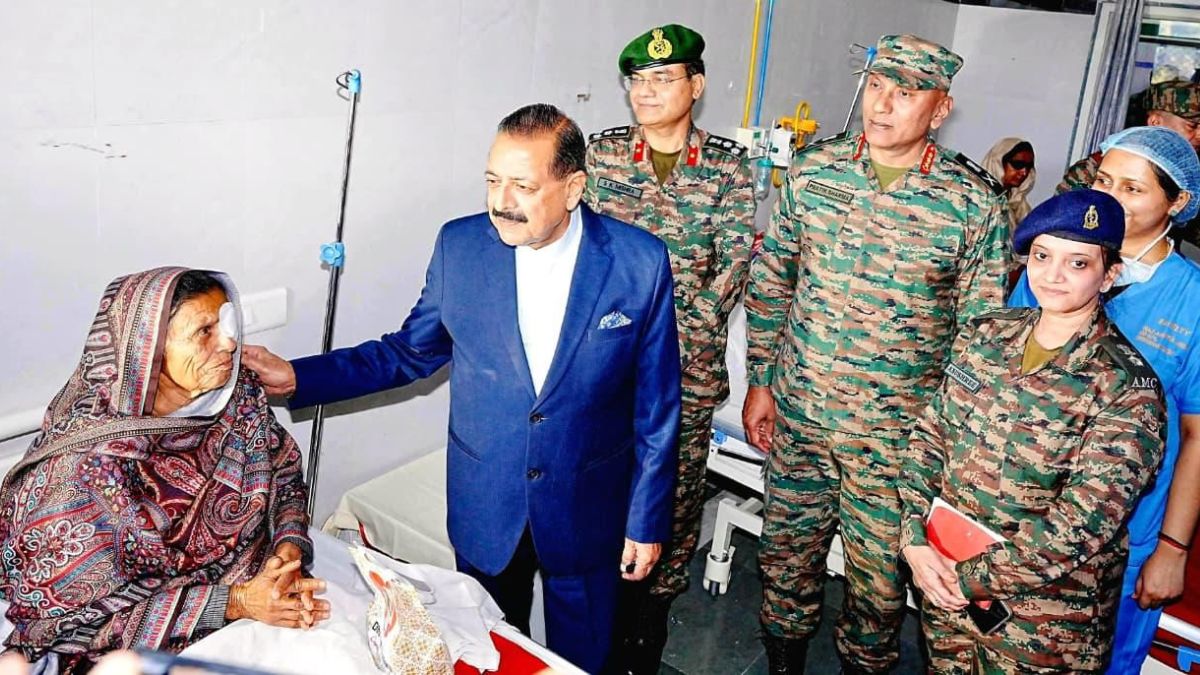
The Indian Army on Saturday (November 22, 2025) announced that it had launched a nationwide Advanced Surgical Eye Camp this month. Camps were conducted across New Delhi, Dehradun, Jaipur, Bagdogra and Udhampur as part of the initiative, Operation Drishti.
According to a social media post by the Indian Army, the mission was assisted by a highly specialised team of ophthalmologists and dedicated paramedical staff from the Army Hospital (Research & Referral).
The initiative has now provided more than 2,000 screenings. At Udhampur alone, the camp employed state-of-the-art ophthalmic technology to perform over 400 complex surgeries, restoring vision and hope to some of the most vulnerable residents of remote and conflict-affected areas.
Patients travelled from districts including Poonch, Rajouri, Kishtwar, Ramban and Doda to Udhampur, many of them living in areas where access to specialist medical services remains limited. Their journeys reflect long-standing gaps in healthcare rather than any dramatic new shift in local conditions.
Why did this camp target the borderlands?
In sectors where years of insecurity and terrain have limited access to specialist medical care, many residents live with progressive visual loss that has gone untreated. The camp, organised under the supervision of Lieutenant General Prateek Sharma of the Northern Command, responded to the need for care in service families, civilians and Veer Naris.
According to a report by ANI, among the beneficiaries was Surinder Singh, a 72-year-old resident of Poonch who had been blind for 2-3 years and whose community had seen the grief of neighbours killed during Operation Sindoor. He became a local champion, using his regained sight to help mobilise others.
Transporting surgeons, high-end equipment and sterile operating environments across thousands of kilometres of difficult terrain required detailed logistics and local coordination. Many surgeries were “mature” cataracts and retinal disorders that demand high technical skill and careful post-operative care.
How does the mission tie into national security and outreach efforts?
The camp was a demonstration of the Indian Army’s commitment to national service, especially in the operational theatre of Jammu & Kashmir.
Initiated following a request from Lieutenant Governor Manoj Sinha and driven at ministerial level by Defence Minister Rajnath Singh, the initiative was executed by the Army and the Armed Forces Medical Services (AFMS) under the leadership of Brigadier Sanjay Kumar Mishra, a distinguished ophthalmologist who has operated on two Presidents of India.
The timing and scale of the effort also link to the context of Operation Sindoor, the four-day military campaign launched by India on May 7 in response to the Pahalgam terror attack.
The achievement presents a template for how advanced medical care can be brought to operational environments and communities otherwise underserved by geography and terrain. It also shows the Indian Army’s widening role in extending healthcare outreach alongside its operational responsibilities.
In restoring sight for hundreds of individuals, Operation Drishti showed how targeted medical intervention can help rebuild confidence and access to care in remote regions.