


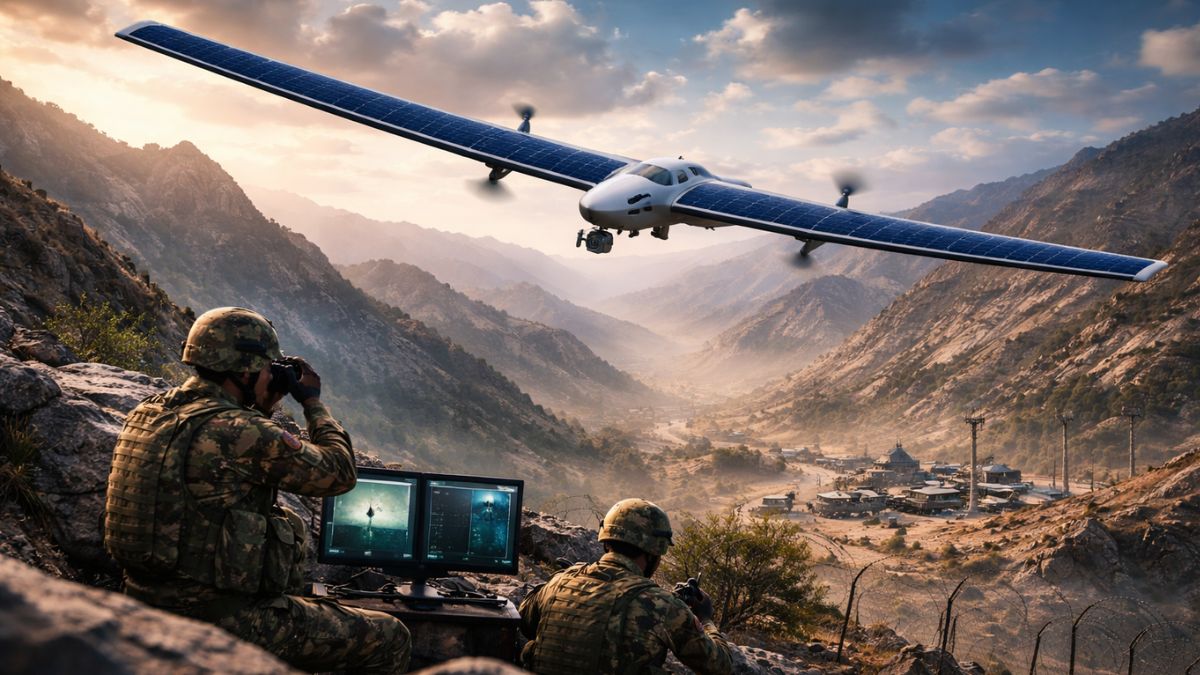
The Indian Army is moving decisively in the direction of long-endurance surveillance along its difficult borders with Pakistan and China, signing a Rs 168-crore deal with an Indian startup for a drone that can give it a distinct edge: long hours of monitoring enemy movement and relaying intelligence using solar energy.
The contract was signed last week with Bengaluru-based NewSpace Research & Technologies, which has won the Indian Defence Ministry’s iDEX challenge for startups previously, according to military sources.
What triggered the Indian Army to go for solar-powered drones?
The solar-powered drone deal, the first in the Indian Army’s history, comes against the backdrop of India’s four-day military conflict with Pakistan in May 2025, when most of the battle at the tactical level was done with the use of drones, all along the Line of Control and International Borders between the two nations.
Following the trajectory witnessed in other military conflicts, such as the Russia-Ukraine war and the Israel-Hamas conflict, Operation Sindoor, carried out by India to target terror camps and military installations inside Pakistan and the Pakistan-occupied territories, resulted in Rawalpindi using tactical drones to target the Indian side along the borders.
What gaps did the Indian Army intend to plug?
The Indian Army has now bought the solar-powered Medium Altitude Persistent Surveillance System (MAPSS) from NewSpace Research and Technologies to bridge a critical gap witnessed during Operation Sindoor: long endurance surveillance of enemy activity.
The justification for the purchase is the current fleet of tactical drones that the Indian Army uses: all use either batteries or fuel to power them, hence limiting the hours they can remain airborne.
MAPSS, by using solar energy, can remain in the air for longer periods to keep a tab on enemy activity without having to return to base for refuelling or charging the batteries.
How would the Indian Army deploy the MAPSS?
The Indian Army plans to deploy MAPSS for Intelligence, Surveillance, and Reconnaissance (ISR) purposes, particularly in vulnerable regions of the Indian border with Pakistan and China, in both mountainous and desert terrains, according to sources.
Apart from keeping track of the border movements, the MAPSS would help in establishing a critical communication network and in completing the sensor-to-shooter loop.
The advantage MAPSS brings to the Indian Army table is its electric power. The drone has a very small sound and heat signature, enabling stealth operations, they said.
What are the MAPSS from NewSpace?
The MAPSS project, according to the company, emerged out of its previous work on high-altitude solar-powered drones, and the resultant testing of these platforms for long endurance of over 24 hours in the air at altitudes of over 26,000 feet.
NewSpace had tested the drones at the Chitradurga-based Aeronautical Test Range, and the MAPSS was customised for the Indian Army’s requirement of medium-altitude use. Later, the MAPSS was put through successful trials in operational areas and validated for deployment, the sources said.
What trajectory have the drone acquisitions taken after Operation Sindoor?
MAPSS acquisition comes amidst a flurry of drone and counter-drone purchases by the Indian armed forces following the experience of Operation Sindoor, with particular focus on loitering munitions and platforms for surveillance.
The Indian Army alone has done deals for autonomous platforms of over Rs 5,000 crore since May 2025, and is budgeting for more such assets in the coming months in 2026, particularly from home-grown aerospace and defence companies, as the Indian A&D ecosystem matures through innovation and indigenous Research and Development.
The deal for solar-powered MAPSS signals a shift in the Indian armed forces’ approach to building capabilities in ISR through local industry under both the ‘Make in India’ and ‘Aatmanirbhar Bharat’ (Self-Reliant India) macro approaches of the Indian government.