


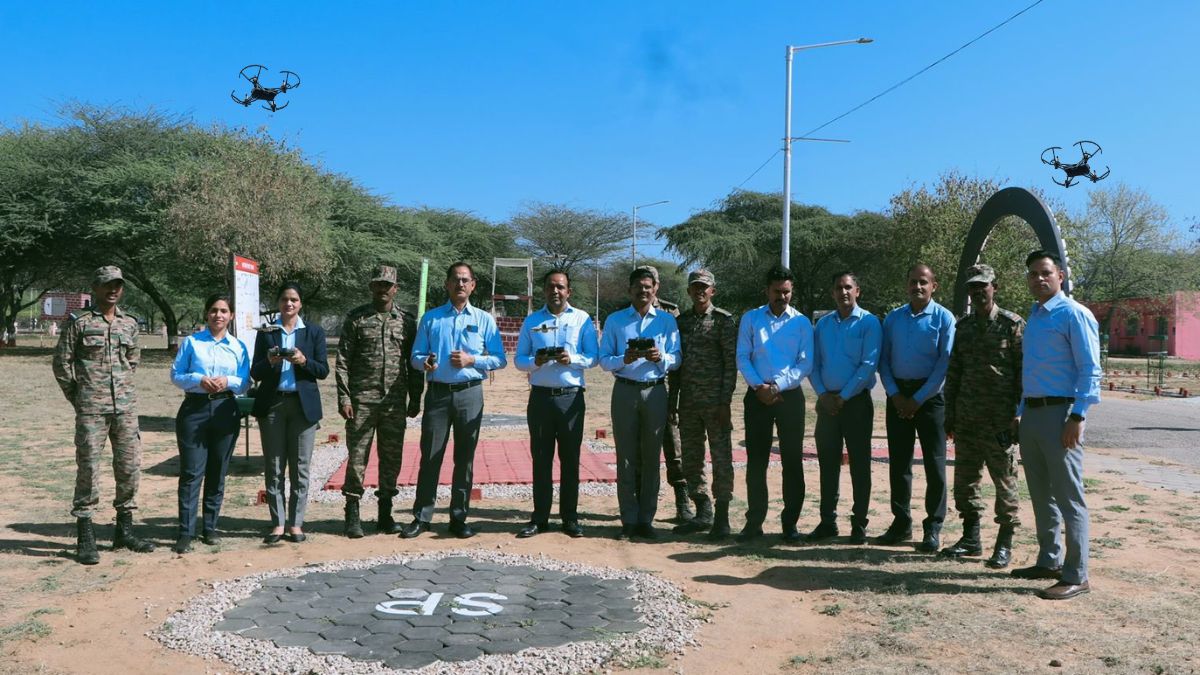
As modern battlefields increasingly rely on unmanned systems and autonomous technologies, the Indian Army is expanding its efforts to integrate drones, counter-drone capabilities and advanced surveillance systems into its operational framework. Operation Sindoor was an example of the same.
In line with this push, the Battle Axe Division of the Army’s Southern Command recently organised an academia-industry interaction on drone innovation, aimed at strengthening collaboration between the armed forces, technology companies and research institutions.
The initiative was conducted under the Military-Civil Fusion (MCF) programme, which seeks to harness civilian technological expertise to support the development of next-generation defence capabilities.
What was discussed at Army’s drone innovation interaction?
Bringing together more than 50 representatives from the technology industry, academic institutions and the Indian Army, the interaction created a platform to exchange ideas on the future of unmanned systems in warfare. According to a defence spokesperson, discussions focused on advancements in drone innovation, skill development in emerging defence technologies.
They also talked about operational requirements for modern battlefields, counter-drone and multi-domain warfare capabilities. Participants also explored how regional talent, academic research and industrial innovation can be aligned with the rapidly evolving technological needs of the armed forces.
Experts highlighted that unmanned systems are becoming central to intelligence gathering, surveillance, reconnaissance and precision strike operations.
How Operation Sindoor showed the growing role of drones
The Indian Army’s growing reliance on drones has already been demonstrated in recent operations, including Operation Sindoor, where unmanned aerial systems played a key role in surveillance, situational awareness and operational coordination. Such operations underline how drones are becoming a force multiplier for modern militaries, allowing commanders to monitor the battlefield in real time while reducing risks to personnel.
Military planners say the experience gained from these deployments is shaping the Army’s future doctrine on unmanned and network-centric warfare.
The Military-Civil Fusion initiative reflects the Army’s effort to tap into India’s rapidly growing technology and startup ecosystem. By working closely with industry innovators, defence startups and academic researchers, the armed forces aim to accelerate the development of indigenous defence technologies under the broader push for self-reliance.
Moreover, Southern Command’s industry-academia interaction also explored ways to strengthen long-term partnerships between defence institutions and technology developers, particularly in areas such as artificial intelligence-driven drones, autonomous systems, counter-drone technologies, multi-domain operational platforms, along with preparing for the future battlefield