


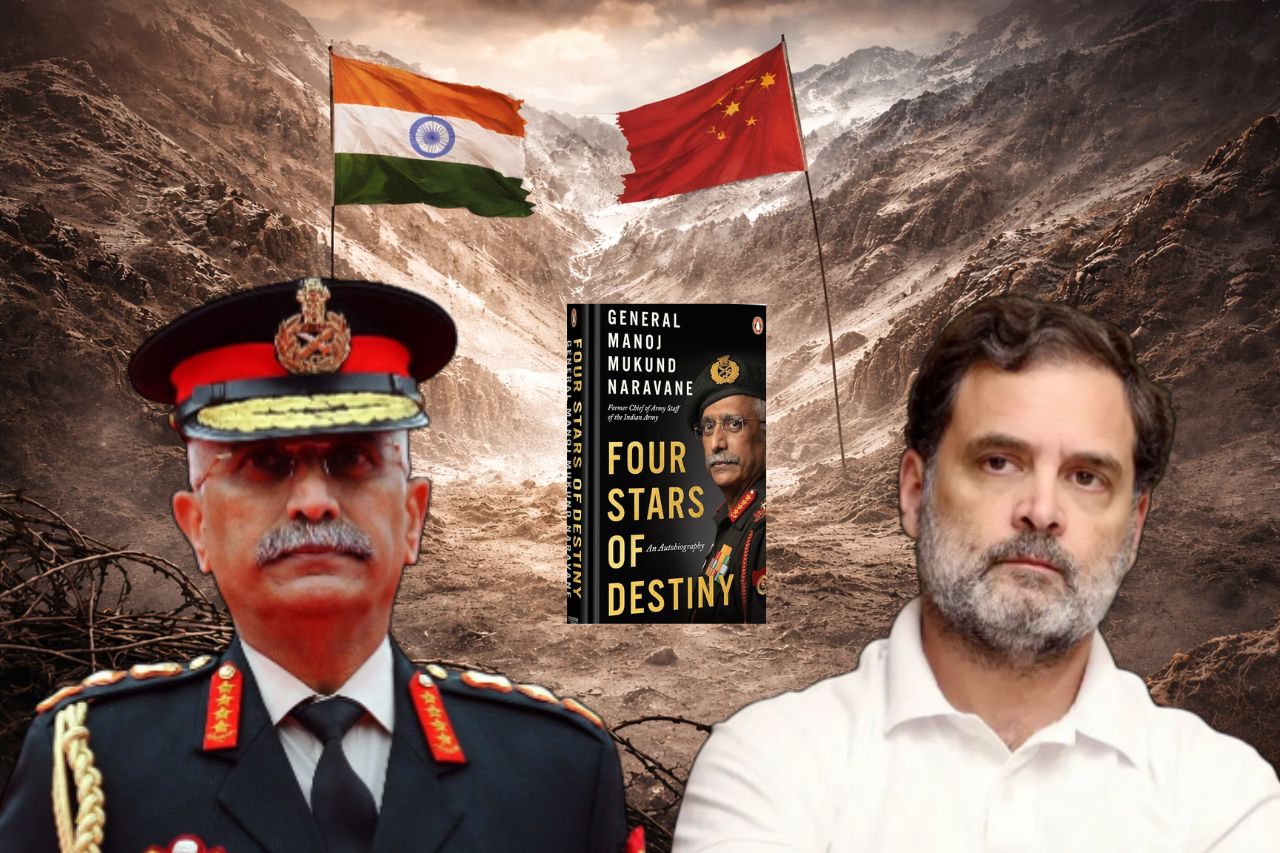
An unpublished memoir of former Indian Army chief General MM Naravane has triggered a political slugfest, both inside and outside India’s parliament, over the India-China military conflict in Ladakh between 2020 and 2024.
The controversy erupted after Rahul Gandhi, the Leader of the Opposition in Lok Sabha (the lower house of the bicameral parliament), attempted to quote from an Indian magazine article that had reproduced the excerpts from the unpublished book, tentatively titled ‘Four Stars of Destiny’.
This led to an intervention inside parliament by India’s Defence Minister Rajnath Singh, who countered Rahul Gandhi by noting that the so-called book was yet unpublished, and quoting from its passages was violation of house procedures.
He also pointed out that the unpublished work was unauthenticated, and that citing such material was against parliamentary rules. Rajnath Singh was supported by India’s Home Minister Amit Shah, resulting in Lok Sabha Speaker Om Birla ruling that the government’s view was correct regarding unpublished and unauthenticated books.
Birla also disallowed Rahul Gandhi from quoting the excerpts. The scenes witnessed on February 2, 2026, were repeated on February 3, 2026, resulting in disruptions and chaos by opposition members and their ultimate suspension from proceedings during this parliamentary sitting, after several adjournments by the chair.
Since then, Rahul Gandhi has been raising the issue outside parliament and with media persons, arguing that the book ought to have been allowed to be published by the government.
He also accused Prime Minister Narendra Modi and Rajnath Singh of “abdicating” their responsibility in taking key security decisions during the Ladakh crisis.
Media reports on General Naravane’s book described a situation during the Ladakh conflict that began in April 2020, when China moved its military units toward Kailash Ranges sometime in August 2020.
The incident being mentioned in the excerpts related to an aggressive manoeuvres by China almost four months after the standoff had begun, and what the media report failed to highlight was that General Naravane was the Indian Army chief then, both when the conflict began and when the Kailash Ranges manoeuvres by China.
Since the Ladakh conflict had begun, the Modi government, specifically the prime minister and the defence minister, had empowered the Indian Army chief to take all military actions needed to defend the Indian territory and prevent China’s ‘Salami Slicing’ strategy.
Even during the August 2020 incident, Rajnath Singh told General Naravane in Hindi: “jo uchit samjho woh karo” (“do whatever you deem appropriate”).
Incidentally, General Naravane, interacting with the media as Army chief on May 14, 2020 and after his retirement, had himself claimed multiple times that India had given a befitting reply to a regional “bully” in Ladakh and that not an inch of territory had been lost by India.
Military analysts, including then Ladakh Corps Commander Lt Gen YK Joshi and other retired senior officers such as Lt Gen SL Narasimhan, in their media interactions on the subject, have interpreted Rajnath Singh’s message, as a “free hand” to the Army chief to decide operational details.
Other senior military analysts and officers too have noted that writing a book on an ongoing ‘sensitive’ conflict by the retired Army chief, albeit on an operation he was personally involved with, wasn’t necessary at the time the book was ready for publication in January 2024.
India and China came to a final agreement on withdrawal of troops from the borders only in October 2024, after a meeting between Modi and Chinese President Xi Jinping in Kazan, Russia earlier that year.
Incidentally, the media report on the book excerpts also noted that General Naravane only had praise for Modi and his government.
When such was the case, the question that arises is, why the Opposition parties are weaponising an unpublished book, whereas the 1962 war-related Bhagat-Henderson report has remained unpublished for over 60 years now, during both the previous and present governments.