


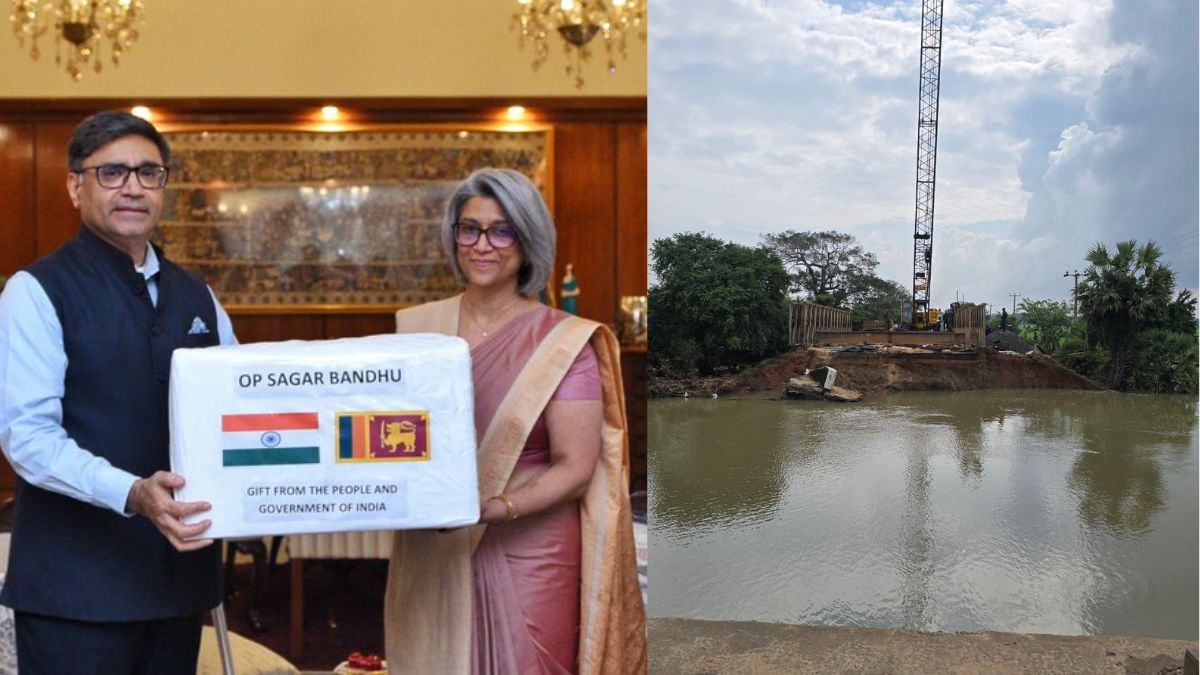
As Cyclone Ditwah triggered unprecedented flooding across Sri Lanka, crippling power lines and terrestrial communication networks, New Delhi moved swiftly under its Neighbourhood First policy. India positioned itself as an early responder, activating Operation Sagar Bandhu.
Under this widespread operation, the Indian Armed Forces delivered immediate humanitarian assistance and disaster relief (HADR) to its island neighbour at a moment when connectivity and coordination had all but collapsed. From helping locals by equipping them with basic necessities to restoring communication, India has taken several steps to help its coastal neighbour.
Satellite internet: India’s force multiplier in disaster response
In a landmark demonstration of technology-driven diplomacy and disaster response, the Indian Army deployed satellite-based internet connectivity in flood-ravaged Sri Lankan regions. This is powered by Eutelsat’s OneWeb Low Earth Orbit (LEO) satellite constellation in partnership with Airtel.
The initiative restored secure, real-time communications where ground infrastructure had failed, reinforcing India’s capacity to deliver rapid, high-impact assistance. With the deployment of Eutelsat’s OneWeb high-speed, low-latency LEO services, the Indian Army has been able to re-establish reliable communications.
The connectivity is facilitating 24/7 telemedicine consultations with specialist medical teams, ensuring the Army is able to deliver essential healthcare and emergency assistance to affected communities without delay.
What challenge did Indian responders face on the ground?
Cyclone Ditwah isolated entire communities, cutting off access to medical care, logistics support, and real-time situational awareness. For Indian Army units operating in remote and inundated terrain, the absence of reliable communications posed a critical operational challenge.
The rapid deployment of OneWeb terminals proved decisive, enabling uninterrupted connectivity even in inaccessible disaster zones.
How this technology is saving lives during Operation Sagar Bandhu?
With satellite links established, Indian teams enabled 24/7 telemedicine consultations with specialist doctors based in India, allowing immediate diagnosis and treatment guidance for the injured and vulnerable. Beyond healthcare, the connectivity supported coordination between rescue teams, logistics planning, and live updates.
India’s intervention went beyond emergency relief. The deployment showcased how New Delhi is leveraging advanced capabilities to support neighbours in crisis, aligning humanitarian action with its Vision MAHASAGAR and its ambition to be the First Responder in the Indian Ocean Region.
Over 53 tonnes of relief material were dispatched, NDRF teams deployed, and Navy and Air Force assets used to evacuate more than 2,000 Indians and foreign nationals.
What does this say about the future of satellite internet in disasters?
The Sri Lanka operation highlights the growing relevance of LEO satellite internet in disaster resilience. Unlike traditional networks that fail during floods or cyclones, LEO satellites offer rapid deployment, low latency, and wide-area coverage, bridging the digital divide when it matters most.
As Eutelsat’s APAC Vice President Neha Idnani noted, resilient connectivity is essential to safeguarding lives and enabling critical services in crisis zones.
Despite the mission’s success, satellite broadband in India remains limited by regulatory clearances. OneWeb currently operates under a testing license, while global players such as SpaceX’s Starlink await market entry. Experts argue that easing spectrum and licensing norms, while addressing security concerns, could unlock transformative connectivity for remote regions, borders, and disaster-hit areas across India.
Op Sagar Bandhu: What is the larger takeaway
As climate-driven disasters intensify across South Asia, India’s swift response to Cyclone Ditwah underscores how technology, diplomacy, and humanitarian action are converging. By stepping up early for Sri Lanka, New Delhi not only delivered relief but also reinforced its strategic commitment to regional stability.
With Operation Sagar Bandhu, India once again proved that Neighbourhood First is no longer just a policy slogan, but an operational reality. India was the first country to deploy trained disaster responders in Sri Lanka, ensuring that specialised teams reached within the first 24 hours of Cyclone Ditwah.