


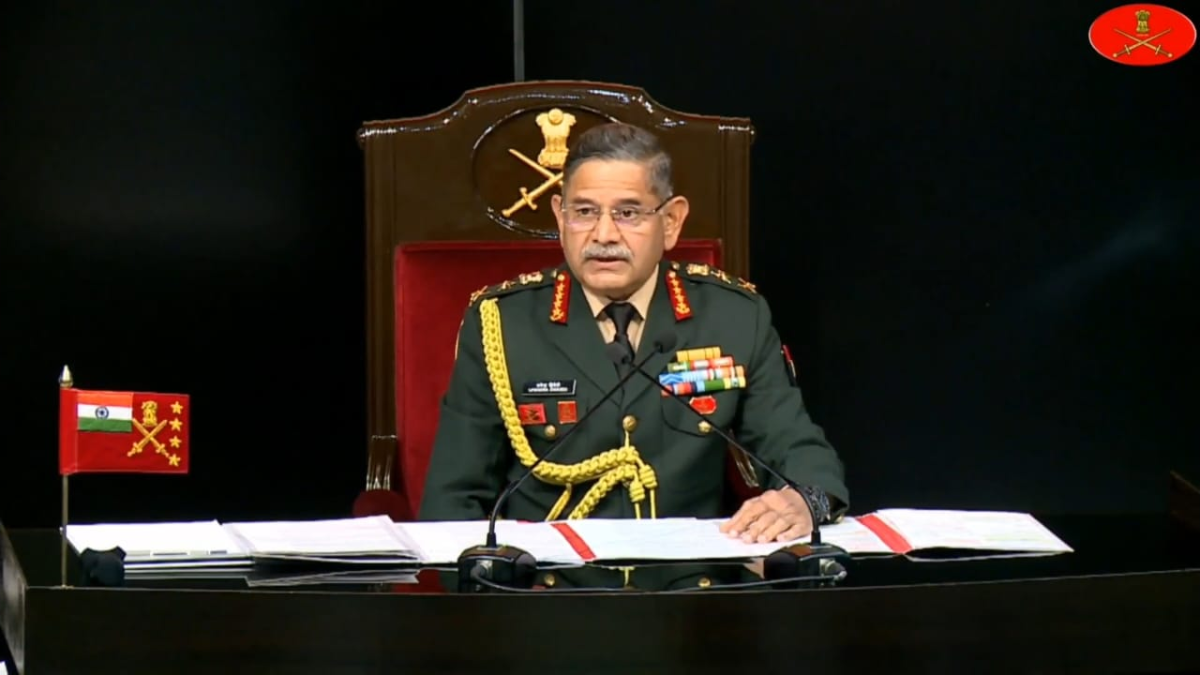
Operation Sindoor reset strategic assumptions by striking deep, dismantling terror infrastructure and puncturing long-standing nuclear rhetoric, Chief of Army Staff Gen Upendra Dwivedi said, outlining the outcomes of the ongoing operation, changes in force structure, and the security situation in Jammu and Kashmir.
Operation Sindoor: Timeline and Outcomes
“Through 22 minutes of initiation on 7th May and an orchestration that lasted 88 hours up to 10th May, the operation reset strategic assumptions by striking deep, dismantling terror infrastructure and puncturing the long-standing nuclear rhetoric. The army successfully destroyed 7 out of the 9 targets and thereafter played a pivotal role in ensuring calibrated response to Pak actions. As you may be aware, Operation Sindoor remains ongoing, any future misadventure will be resolutely responded to.”
Nuclear Rhetoric and Conventional Space
Addressing questions on nuclear rhetoric, Gen Dwivedi said DGMO-level talks did not involve nuclear issues and that any nuclear messaging largely came from political discourse or public statements in Pakistan, not from military channels.
He said the operation demonstrated an expansion of conventional space and that mobilisation during the 88-hour period ensured preparedness if Pakistan escalated or compelled ground operations.
Counter-Terror Operations in 2025
“Further, he said, in 2025, 31 terrorists were eliminated of which 65% were Pakistani origin including the 3 perpetrators of the Pahalgam attack neutralised in Operation Mahadev. Active local terrorists are now in single digits. Terrorist recruitment is almost non-existent only till 2025.”
Force Structure Changes After Operation Sindoor
Gen Dwivedi said drones were already playing an important role, but their integration accelerated sharply after Operation Sindoor. While concepts had been validated earlier across desert and high-altitude terrain, the operational context required faster commissioning and formal structuring.
He said drones at the infantry battalion level were no longer a general skill and required trained operators for surveillance, force application, anti-radiation tasks, jamming, loitering munitions and counter-UAS roles.
Infantry Drone Platoons and Bhairav Battalions
Infantry battalions have raised specialist drone platoons, with eight platoons established and staffed by personnel qualifying through defined standards.
The Army has also raised Bhairav Light Commando Battalions, with 13 established initially, to bridge the gap between infantry formations and special forces using modern UAS, counter-UAS equipment and loitering munitions. In artillery, Divyastra Batteries have been raised to support commanders with UAS, counter-UAS and loitering munition capabilities.
Shaktimaan Regiments are being established, with three battalions initially, expanding to twelve, and further growth planned. Their operating ranges are expected to expand from 100–400 km to 750–1000 km over time.
Armoured and Mechanised Formations
Similar organisations are being introduced in armoured and mechanised formations, with non-kinetic counter-UAS already present in key brigades, including air defence formations.
Planned force levels include 25 Bhairav battalions, 15 Shaktimaan units initially followed by 11 more, 34 Divyastra batteries, and Rudra brigades with two already implemented and seven more planned.
Integrated Battle Groups Approved
Gen Dwivedi said the Integrated Battle Group concept, which had been under consideration earlier, had now been approved. Each IBG will command roughly 16± units, led by a Major General, with a support group also commanded by a Major General.
Future Transformation Cell and Command Reforms
The Army has created a Future Transformation Cell under a two-star officer aligned directly with the COAS to enable faster decision-making on new structures. The possibility of the Training Command evolving into a Futures Command is also being examined.
DGMO Understanding and Mobilisation Rollback
On forward movement during Operation Sindoor, Gen Dwivedi said that based on the DGMO understanding, mobilisation was reduced in a phased manner, with time allowed to complete the process by the end of May.
He said DGMO talks were held to reassure both sides and avoid misinformation, and that both sides carried out significant mobilisation, the details of which remain classified.
Assessment of Terrorist Camps
Gen Dwivedi said the Army assesses that around eight terrorist camps remain active, with two opposite the International Border and six opposite the Line of Control.
He said there was still some presence and training activity in these camps, that they were being monitored closely, and that if activity escalates again, the Army will respond as intended.
Regarding drone intrusions, India has conveyed to Pakistan through the DGMO channel that it does not agree with such actions and has asked Islamabad to exercise control and keep a close watch, the Indian Army Chief said.