


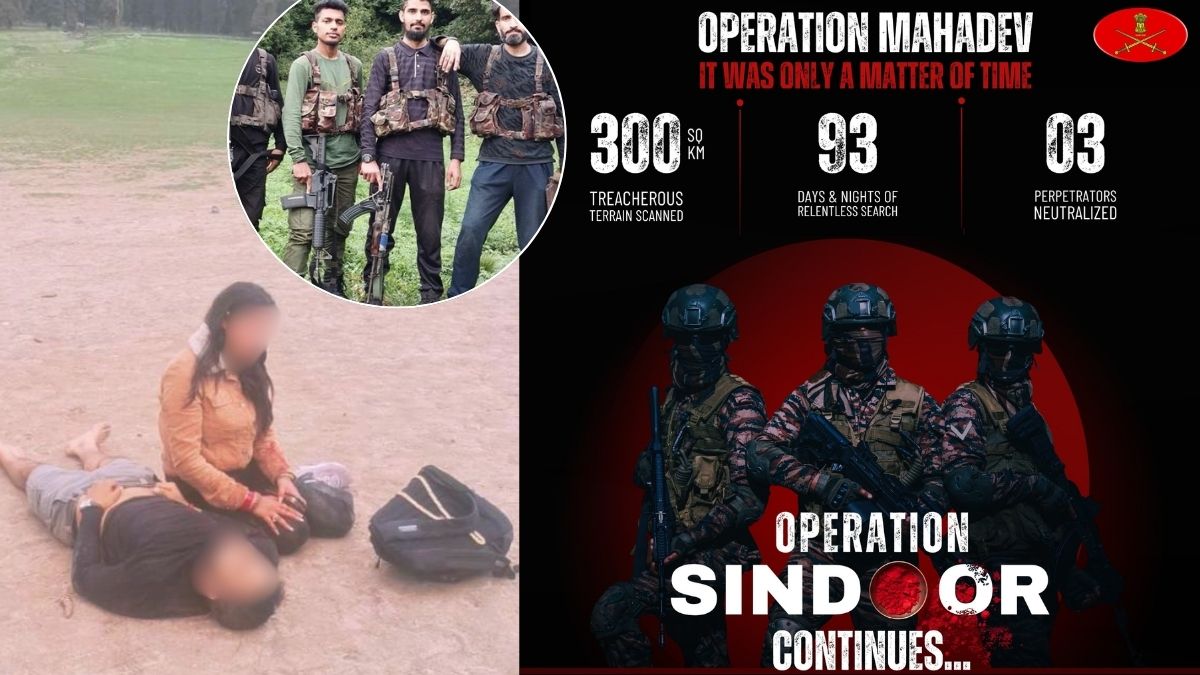
“India will not forget, and India will not forgive,” ruling party Bharatiya Janata Party (BJP) posted on social media on Wednesday (April 22, 2026) on the first anniversary of the cowardly Pahalgam terror attack. And why should we? India has always called out and clearly made its stance against terrorism clear, however, should anyone try to disturb our peace, our security forces know how to deal with the matter.
A year has passed since the chilling afternoon in Pahalgam when terror struck without warning, claiming 26 innocent lives, most of them tourists who had come seeking peace in the valleys of Kashmir. Last year on April 22, the serene meadows of Baisaran turned into a site of grief, sending shockwaves across India and drawing condemnation from leaders and governments around the world.
Even today, the memory lingers, of families shattered, dreams cut short, and a place once synonymous with beauty marked by tragedy.
Pahalgam attack anniversary: The incident that shook India to its core
It was a dastardly attack, carried out by terrorists linked to Pakistan-based Lashkar-e-Taiba, making the Pahalgam massacre one of the deadliest assaults on civilians in recent years. Gunfire echoed through Pahalgam’s popular tourist zone on the afternoon of April 22, 2025, leaving 26 people dead and many others traumatised.
Among those killed were Lieutenant Vinay Narwal of the Indian Navy, six days into his honeymoon, Corporal Tagehalying of the Indian Air Force, and Adil Hussain Shah, a local pony operator who died shielding the very visitors he made his living from.
The brutality of the act not only devastated families but also struck at the heart of Kashmir’s tourism-dependent economy, instilling fear among visitors and locals alike.
How did India respond with force and precision after the attack?
India’s response was swift, calibrated, and far-reaching. Just around a fortnight after the attack on the intervening night of May 6 and 7, 2025, the Indian Armed Forces launched Operation Sindoor, a punitive and targeted campaign to dismantle terror infrastructure across the Line of Control and deeper inside Pakistan.
The well-coordinated strikes precisely hit nine terrorist camps in Pakistan and Pakistan-Occupied Jammu and Kashmir (PoJK), eliminating over 100 terrorists, including trainers, handlers, and operatives from groups such as Jaish-e-Mohammed, Lashkar-e-Taiba, and Hizbul Mujahideen.
The operation inflicted maximum damage on terror networks while ensuring minimal civilian harm. It demonstrated India’s capability for high-precision, coordinated military action across land, air, and sea, and is now seen as a defining moment in India’s defence history, clearly reflecting India’s resolve and deterrence.
Parallelly, the security forces also launched Operation Mahadev to hunt down those directly responsible for the Pahalgam attack. After a relentless pursuit, all three terrorists involved were neutralised on July 28, 2025, bringing a measure of closure. The Army reiterated its stance this week, warning that when “boundaries of humanity are crossed, the response is decisive.”
Pahalgam attack 1 year: Kashmir marks anniversary under a security shadow
On the first anniversary, Kashmir observed the day with restraint and heightened vigilance. Security across south Kashmir, especially in and around Baisaran Valley, was significantly stepped up. Authorities carried out additional deployments, intensified vehicle checks, and area domination exercises to ensure peace.
No large public gatherings were allowed, reflecting both caution and the sensitivity of the day. Officials confirmed that the anniversary passed without any untoward incident. A senior police officer told Deccan Herald, “There is enhanced deployment in vulnerable areas, especially tourist locations, to ensure that the anniversary passes off peacefully.”
Indian Army posted on X, “For acts against India, the response is assured. Justice will be served. Always.”
Has Pahalgam tourism recovered, or do scars still remain?
Tourists have gradually begun returning to Pahalgam, but the recovery remains cautious.
While areas like Betaab Valley and Aru are open and receiving visitors, Baisaran, the site of the attack, remains heavily guarded and restricted. Tourist inflow is still below usual seasonal levels, indicating that the psychological impact of the attack continues to linger. Some visitors have been stopping at memorial sites to pay homage, a quiet reminder that while the valley is healing, it has not forgotten.


How did India and the world remember the victims?
Across India and beyond, tributes poured in for the victims. Prime Minister Narendra Modi said the victims “will never be forgotten” and reaffirmed India’s unwavering resolve against terrorism. “As a nation, we stand united in grief and resolve. India will never bow to any form of terror. The heinous designs of terrorists will never succeed.”
Congress leader Rahul Gandhi noted that the memory of the attack “still shakes our heart.” He added that the memory of those innocent lives brutally snatched away still shakes our hearts today. “The grief of the martyrs’ families is the grief of us all. The martyrdom of those sons of the nation will forever remain etched in the soul of India.”
“India will never bow before the forces that spread hatred and fear—we will stand against them with even greater strength, unity, and resolve,” he added.
Defence Minister Rajnath Singh, who is currently in Germany on a 3-day visit, also remembered the unfortunate afternoon of the Pahalgam attack. Recalling the same, he issued a pointed message to Pakistan, without naming it, warning that if it “tries to create trouble” again, then “dot, dot, dot.”
Reiterating India’s long-standing charge from Germany, Singh added that apart from one, “all neighbours are fine.” At an event with the Indian community, Rajnath Singh, in a video shared by news agency ANI, was heard issuing direct warning to Islamabad against any repeat of incidents like Pahalgam.
“There is no need to tell you what our army has done in Operation Sindoor. Our military power has also become stronger than before. India has never attacked any country in the world from its own side. But if a neighbour tries to create trouble, then ‘dot, dot, dot’. All neighbours are fine, only one is troublesome,” he stated.
The solidarity extended globally.
Australia’s High Commissioner Philip Green said, “We honour the victims & their families who continue to grieve today. Australia stands against terrorism in all its forms.”
The United Kingdom reiterated its commitment to peace and security, stating, “We pay our respects to the victims… and remain committed to working with partners.”
France, along with the European Union, recalled its solidarity with India, reaffirming its “steadfast commitment” against terrorism.
Israel’s Foreign Minister Gideon Sa’ar said, “We honour the memory of the innocent lives lost and stand with their families in grief… Together with India, we will continue to confront this threat.”
What does this anniversary signify today?
One year on, Pahalgam stands as both a symbol of loss and resilience.
The valley remains under tighter security, the nation remains vigilant, and the message from India is unequivocal, terror will be met with firm and decisive action. But beyond strategy and security, the day belongs to remembrance. To the families who continue to grieve. To the lives that were lost too soon. And to a nation that refuses to forget.