


There’s no contention to the fact that not just demography, but India’s topography is equally or even more diverse. Sharing land border with 7 countries, with Pakistan on the West, Nepal in the North, Bangladesh in the East, along with China in the North and East both, it is crucial for New Delhi to bolster its defences.
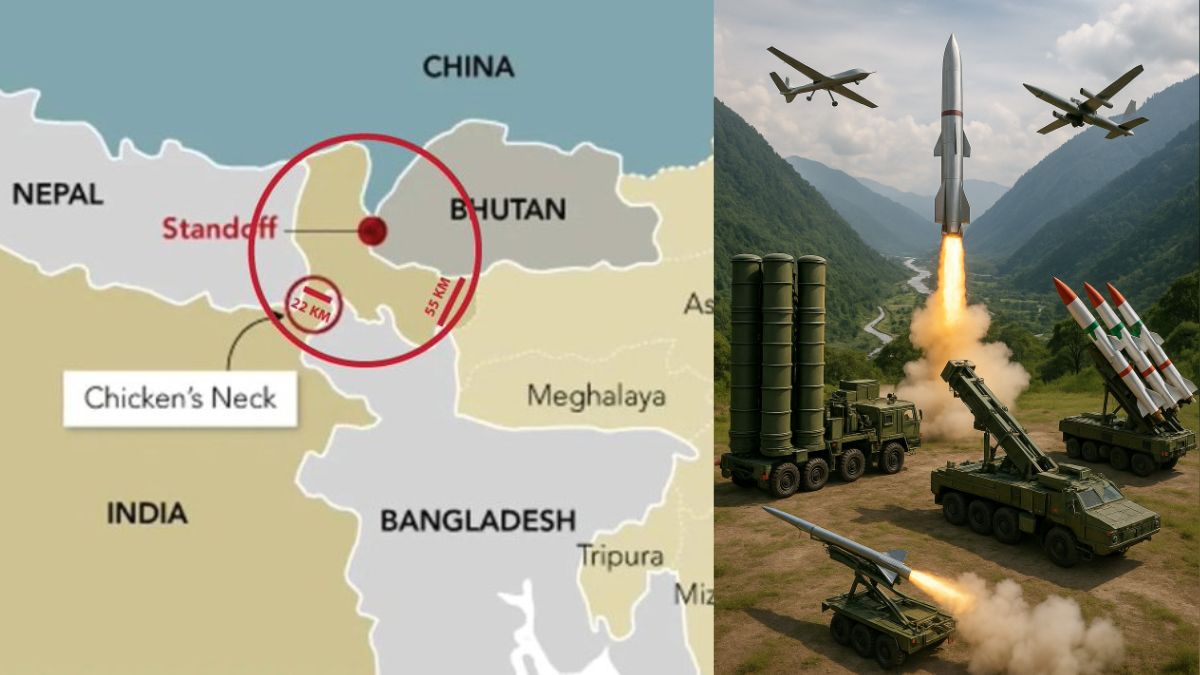
An interesting region that can never be overlooked when it comes to defences is India’s Chicken Neck or the Siliguri Corridor, which is a narrow 22-km-wide land bridge connecting mainland India with the Northeast. Amid increased interactions between Pakistan and Afghanistan late, India has heightened security in the region.
India has significantly reinforced the security architecture of its eastern flank by establishing three fully operational military garrisons along the Indo-Bangladesh border at Bamuni (near Dhubri), Kishanganj, and Chopra. The addition of these forward locations strengthens the defence grid around the Siliguri Corridor.
Why India has increased security around Chicken’s Neck?
According to top intelligence sources cited by India Today, the move is aimed at plugging tactical gaps, improving surveillance density, and accelerating rapid-response capability in one of India’s most strategically sensitive geographies.
The deployments come amid an evolving regional landscape, including increased interaction between Bangladesh’s interim Chief Adviser Muhammad Yunus and the Pakistani military establishment, reportedly covering connectivity and defence cooperation.
Bangladesh’s current recalibration, marked by outreach to Pakistan and renewed economic overtures to China, has prompted Indian agencies to reassess the security matrix around the corridor. Further, intelligence assessments suggest these developments may be part of an attempt to “reshape the power balance” across the eastern neighbourhood.
Is Chicken Neck really a vulnerability?
While it has often been stressed that the region can become susceptible to any foreign threats very easily for its small size, the Indian Army doesn’t think so. Despite periodic concerns about its narrow geography, senior Indian commanders assert that the Siliguri Corridor is far from a weak link.
An Army officer told India Today, “The Siliguri corridor is under multi-layered security cover. The new garrisons will enhance quick mobility, logistics, and real-time intelligence integration.” The Army Chief has earlier remarked that the so-called Chicken’s Neck is actually India’s strongest region, owing to seamless mobilisation capability from West Bengal, Sikkim, and the Northeast.
The area is defended by the Trishakti Corps (33 Corps), headquartered at Sukna, which routinely conducts integrated combat drills, including T-90 tank manoeuvres, suited for riverine and high-altitude terrain.
Rafales, BrahMos, S-400s: Layered air and missile defence for Chicken’s Neck
A robust aerial and missile shield reinforces the corridor’s security posture, which incldude Rafale fighters operating from Hashimara Airbase, additional MiG variants for layered air operations, a BrahMos missile regiment providing high-speed precision strike capability. In addition, there is an integrated air-defence triad comprising S-400 long-range air defence system, MRSAM (medium-range), indigenous Aakash missile system.
The S-400 unit deployed in the region provides a credible deterrent against potential Chinese or hostile aircraft intrusions into Indian airspace.
In addition, the Defence Ministry recently cleared Rs 8,160 crore for procuring two more regiments of the Akash-Advanced system, featuring a new seeker and 360-degree engagement capability.
Drone warfare capability enhanced post Operation Sindoor
Following Operation Sindoor, the Indian Army has accelerated its transition into precision drone warfare. Newly raised units include Ashni platoons with FPV and kamikaze drones; Bhairav battalions optimised for rapid precision strikes and close-support missions. These units are designed for quick integration with ground formations.
With China expanding its footprint in Bangladesh through the BRI, and Dhaka signalling fresh alignments with Beijing and Islamabad, Indian planners view the security environment as dynamic and evolving. “India is alert and has factored in every emerging dynamic. We are not reacting; we are reinforcing,” a senior military planner said.
Rajnath Singh vs Yunus: What happened?
Meanwhile, a war of words seems to have emerged between India and Bangladesh over Defence Minister Rajnath Singh’s recent remarks, in which he said Muhammad Yunus should be careful and that we do not seek tense relations with the neighbours.
During an interview, Singh was asked about Yunus’s recent “provocative statements” and gifting a book to a senior Pakistani military official that showed “some areas of northeast India as part of Bangladesh”. “It is very unfortunate. He should be careful. As far as neighbours are concerned, we want to maintain ties. We do not seek tense relations with our neighbours,” Singh had said.
Bangladesh’s Foreign Ministry on Sunday (November 9, 2025) described Singh’s remarks as “incorrect” and “not respectful”. “We consider that Singh’s comments are incorrect and unhelpful and not respectful of propriety and diplomatic nicety,” Foreign Office spokesman SM Mahbubul Alam was quoted as saying by the state-run BSS news agency.