


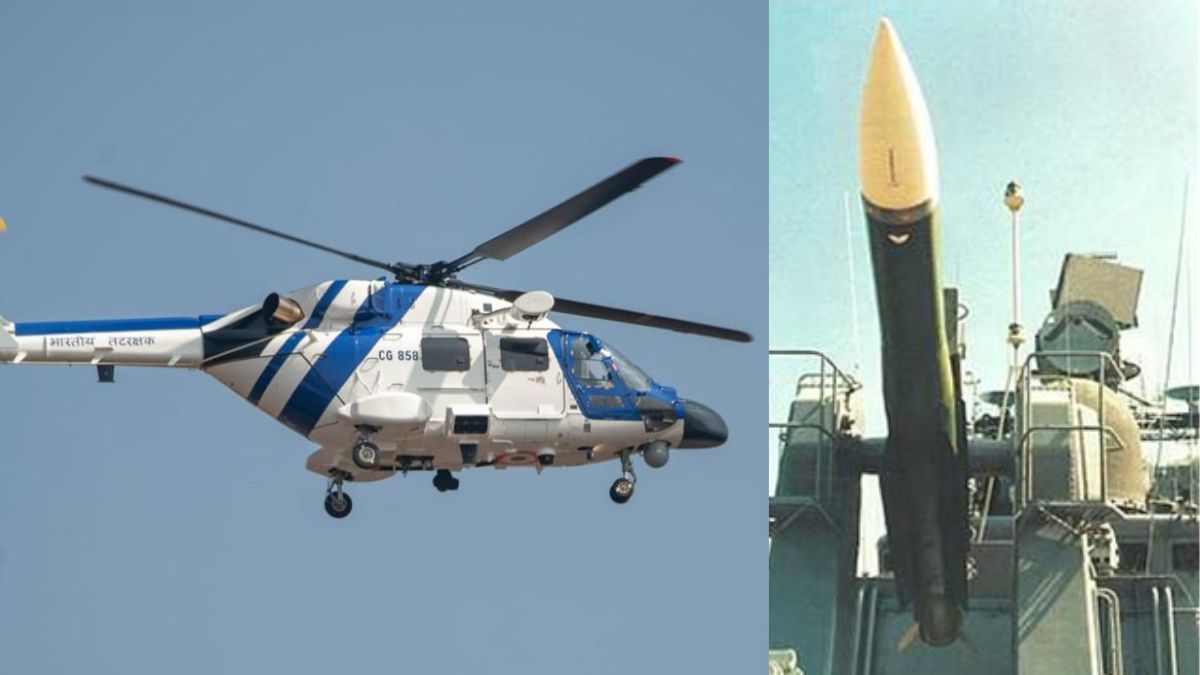
To further boost the armed forces’ ALH fleet, the Ministry of Defence has on Tuesday (March 3, 2026) signed contracts worth a total of Rs 5,083 crore for the acquisition of six Advanced Light Helicopters Mk-III (Maritime Role) for the Indian Coast Guard and Surface-to-Air Vertical Launch – Shtil missiles for the Indian Navy.
Worth mentioning here is that the major defence procurement decision comes at a time when the United States is tightening sanctions on Russia. India has moved ahead with the signing a Rs 2,182 crore contract for Russian-origin surface-to-air missiles for the Navy, alongside a Rs 2,901-crore deal for indigenous ALH.
The twin agreements, inked by the Ministry of Defence, underline India’s calibrated balancing act of strengthening frontline combat capability while deepening indigenous defence manufacturing, even as US President Donald Trump has warned of “very severe sanctions” against countries maintaining trade ties with Russia.
India to procure Russian missiles despite US sanctions
The contract involves procurement of the Shtil surface-to-air missile (SAM) system, developed by Russia’s Almaz-Antey Air and Space Defence Corporation. The deal has been signed with JSC Rosoboronexport. The Shtil system engages aerial threats up to 45 km, provides rapid-reaction, has an all-weather capability.
Additionally, the missile also has an enhanced survivability in contested maritime environments, and strengthens layered air defence of frontline warships. The acquisition includes missiles and associated holding frames, aimed at boosting the Indian Navy’s preparedness against evolving aerial threats.
Defence officials say the move is intended to significantly upgrade naval air defence amid growing maritime competition in the Indian Ocean Region (IOR).
How does this fit into the US sanctions backdrop?
In November last year, President Trump announced a fresh wave of sanctions targeting Russia, warning that nations continuing trade with Moscow could face punitive action. India’s decision to proceed with the Shtil procurement signals continued operational reliance on legacy Russian platforms, along with strategic autonomy in defence procurement.
The MoD described the contract as reflective of the “longstanding and time-tested defence partnership between India and Russia, founded on mutual trust and strategic alignment.”
India has previously navigated US sanctions pressure under CAATSA during the S-400 air defence system acquisition, maintaining that its defence choices are guided by national security priorities.
What is the strategic significance for the Navy?
For the Navy, strengthening shipborne air defence is critical as maritime threat vectors expand. With increasing drone warfare, long-range precision munitions and anti-ship missile proliferation globally, warships operating in contested waters require:
Multi-layered air defence shields, quick-reaction intercept capability, high survivability in saturation attack scenarios. The Shtil system enhances fleet air defence, particularly for frontline warships operating in sensitive theatres across the Arabian Sea and Bay of Bengal.
MoD reaffirms faith in the ALH Mk-III
Alongside the Russian missile contract, the MoD signed a Rs 2,901 crore deal with Hindustan Aeronautics Limited (HAL) for six additional Advanced Light Helicopter (ALH) Mk-III units for the Indian Coast Guard. The package includes operational equipment, engineering support, performance-based logistics.
The contract comes days after ALH fleets of the Navy and Coast Guard were cleared for flying following a prolonged grounding.
What led to the grounding of ALH fleets?
ALH helicopters operated by the Navy and Coast Guard were grounded after a Coast Guard crash on January 5 last year that killed three personnel. A defect investigation team set up by HAL identified cracks in swashplates, attributed to prolonged exposure to saline maritime environments, raising concerns over material fatigue.
Clearance for operations has now been granted with certain conditions.
Fleet strength across services includes ~200 ALHs with the Army, ~75 with the Indian Air Force, 51 with the Navy and Coast Guard combined. The new induction is expected to enhance the Coast Guard’s ability to safeguard offshore installations and artificial islands, conduct maritime surveillance, protect fishermen, and support environmental and disaster response missions.