


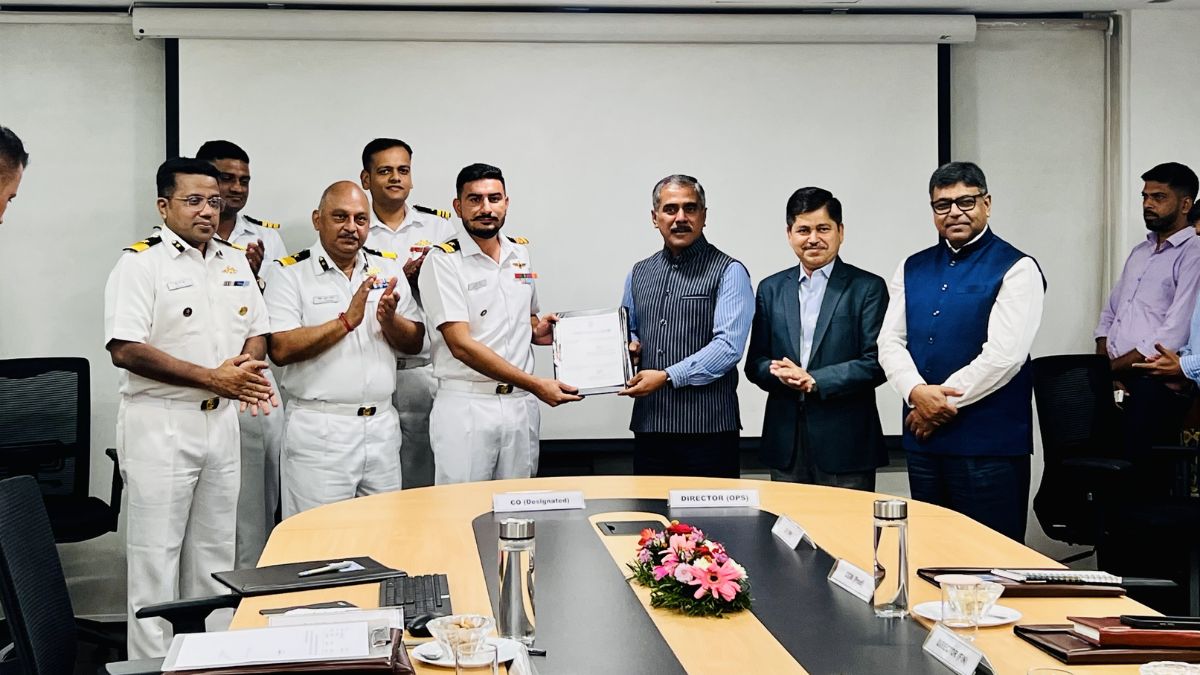
In a significant boost to India’s coastal and offshore security grid, Goa Shipyard Limited (GSL) has handed over ICGS Amulya (Yard 1272), the third vessel in a series of eight next-generation Fast Patrol Vessels (FPVs) built for the Indian Coast Guard under the government’s ‘Make in India’ initiative.
The vessel was formally delivered in the presence of GSL Chairman & Managing Director Brajesh Kumar Upadhyay and Commandant Anupam Singh, who will lead the ship as its first Commanding Officer.
What is Coast Guard ship Amulya?
At 51.43 metres long and 8 metres wide, with a displacement of 330 tonnes, ICGS Amulya represents a major upgrade in patrol capability.
It is powered by twin marine diesel engines connected to controllable pitch propellers (CPP), a first for this FPV class, offering greater propulsion efficiency and quicker response times during high-stakes missions.
The ship can sprint beyond 27 knots and remain at sea for up to 1,500 nautical miles, backed by an advanced integrated machinery control system that ensures high readiness levels and enhanced sustainability during extended operations.
What are Amulya’s capabilities?
Operated by a crew of six officers and 35 sailors, the vessel has been purpose-designed for fisheries protection, Exclusive Economic Zone (EEZ) patrols, anti-smuggling missions, anti-piracy operations, and round-the-clock coastal surveillance.
It will also play a pivotal role in maritime search-and-rescue (SAR) efforts, an area where the Indian Coast Guard remains India’s frontline response agency.
How is Amulya a force multiplier?
Calling Amulya a “force multiplier,” the Coast Guard said the new FPV would plug critical gaps in India’s 7,500-km coastline security network, especially as threats evolve from narcotics trafficking to grey-zone challenges in the Indian Ocean Region.
GSL chief Brajesh Upadhyay said the delivery reaffirms the shipyard’s commitment to maritime security, defence indigenisation, and strengthening India’s blue economy. “We remain dedicated to delivering world-class platforms that advance India’s strategic interests,” he noted.
With five more FPVs in the pipeline, India’s coastal security grid is set for its strongest upgrade in years.