


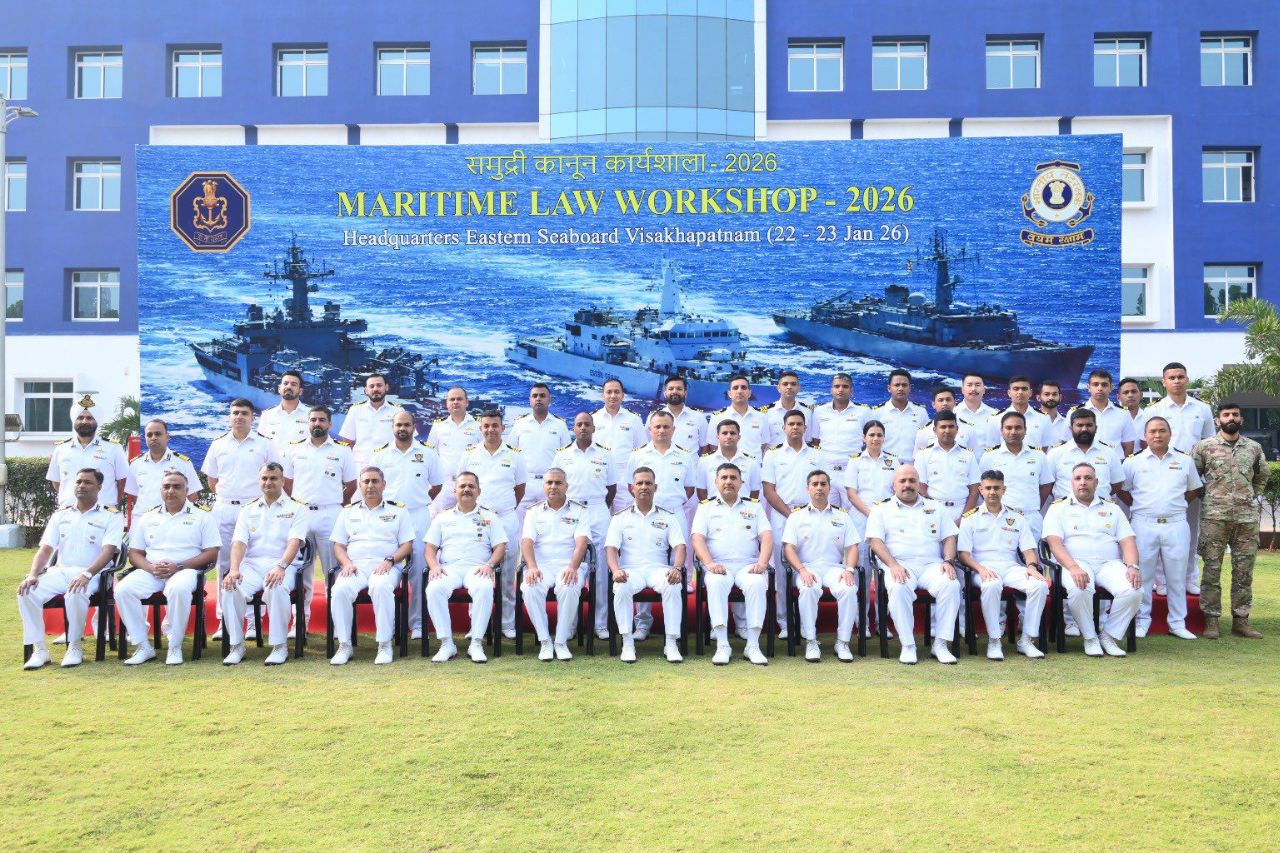
In a significant step toward safeguarding India’s maritime interests and ensuring a robust security architecture for the sea-guarding force, the Indian Navy and Coast Guard jointly organised a two-day Maritime Law Workshop in Visakhapatnam for its officers.
The workshop, held on January 22 and 23, 2026, came at a time when geopolitical contests at sea are increasing, and focused on enhancing the operational readiness and understanding of the naval and coast guard officers of the International Maritime Law and its practical application within the Indian maritime area.
What was the aim of the workshop?
Aimed at familiarising naval and coast guard officers with recent developments in maritime law, the workshop aimed to equip them with the knowledge on rights, responsibilities, and limitations faced by littoral states under the global maritime legal framework.
The workshop laid special emphasis on applying the legal principles to real-world challenges during operations, such as in the Exclusive Economic Zone (EEZ) protection, maritime smuggling, illegal, unreported, and unregulated (IUU) fishing, and grey-zone warfare activities that have increased in the Indian Ocean region.
What is UNCLOS?
A key aspect of the training was the United Nations Convention on the Law of the Sea (UNCLOS). UNCLOS is called the ‘constitution of the oceans’ and defines maritime zones such as territorial waters, contiguous zones, EEZs, and the high seas, while balancing coastal state rights with freedom of navigation.
For India, with an EEZ spanning over two million square kilometres, understanding UNCLOS is critical to enforcing sovereignty, deterring illegal exploitation of marine resources, and managing encounters with foreign vessels in a legally defensible manner.
How were the officers trained in maritime laws?
The participating officers were trained through presentations, interactive discussions, and table-top exercises on simulated maritime scenarios reflecting contemporary threats, according to the Ministry of Defence.
The practical scenarios included interdiction of smuggling networks, handling of foreign fishing vessels engaged in illegal activity, and coordination during law enforcement operations. These are operational situations when jurisdictional boundaries quickly turn into contests.
The idea was to provide an understanding of scenarios, highlighting the practical limits of force, evidence collection, and prosecution under international and domestic law.
How did the workshop help?
The workshop reinforced operational coordination between the Indian Navy and the Indian Coast Guard. While the Navy plays a primary role in maritime defence, the Coast Guard remains the lead agency for maritime law enforcement.
Seamless coordination between the navy and coast guard is essential for ensuring credible deterrence, swift response, and lawful action across India’s maritime zones, and to protect its maritime interests.