


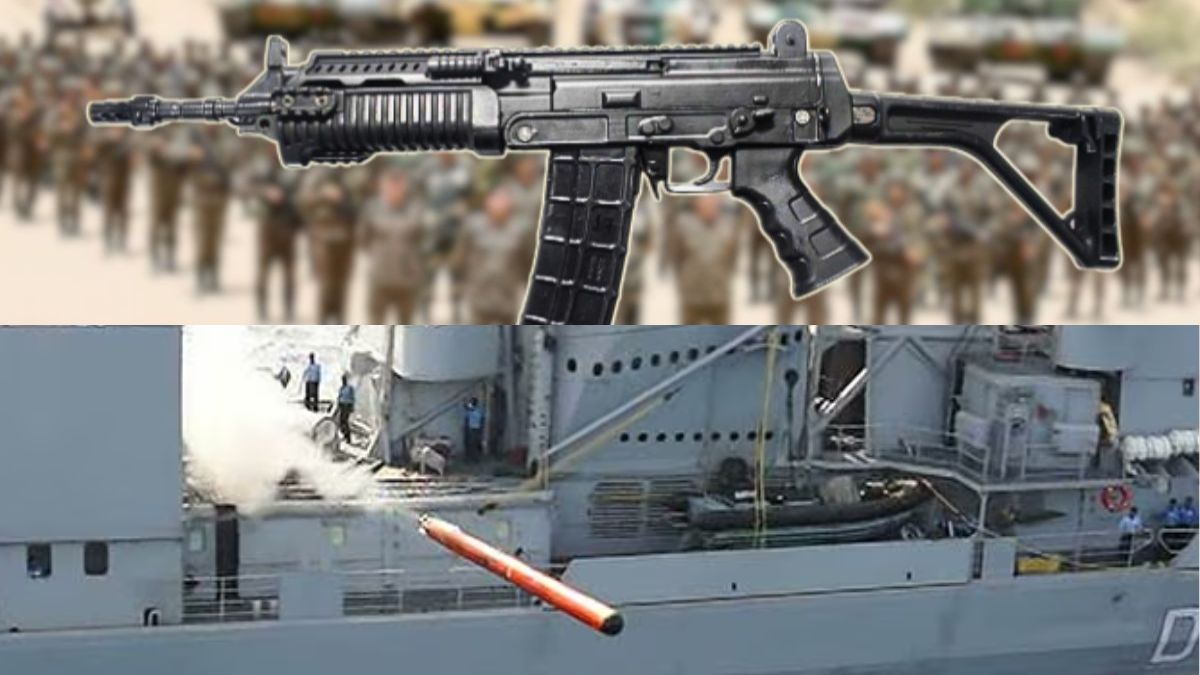
Earlier this year in June, it had emerged that leading defence firm Bharat Forge will manufacture DRDO-designed CQB Carbine for the Indian Army and received an order worth Rs 2000 crore for the same. The Defence Ministry has now signed contracts worth Rs 4,666 crore for CQB Carbines and Heavy Weight Torpedoes.
In a significant defence industry update underscoring India’s push for self-reliance and military modernisation, the Ministry of Defence (MoD) on Tuesday (December 30, 2025), signed contracts worth Rs 4,666 crore for the procurement of Close Quarter Battle (CQB) Carbines and Heavy Weight Torpedoes.
The twin deals will not only enhance frontline combat capabilities of the Indian Army and Navy but also mark a major commercial and technological win for Indian defence manufacturers under the ‘Aatmanirbhar Bharat’ and Make in India initiatives.
Why is the CQB Carbine deal a boost for Indian defence companies?
The larger share of the contracts — Rs 2,770 crore — is for the procurement of over 4.25 lakh CQB Carbines, along with accessories, for the Indian Army and Indian Navy. The order has been placed with Indian private sector firms Bharat Forge Ltd and PLR Systems Pvt Ltd, thereby adding to the government’s Aatmanirbhar push.
This deal represents one of the biggest indigenous small-arms procurements in recent years and replaces outdated legacy weapons with modern, domestically manufactured systems. For Indian companies, it provides assured long-term production volumes, scale, and an opportunity to further mature in-house design and manufacturing capabilities.
The project is also expected to create strong downstream benefits by pulling in Indian MSMEs for component manufacturing, raw material supply, and precision engineering, strengthening the domestic defence industrial ecosystem.
How will the CQB Carbine change infantry combat?
Designed as a core weapon for modern infantry, the CQB Carbine offers compact dimensions, high rate of fire, and superior handling in confined environments such as urban combat zones, counter-insurgency operations, and ship-borne missions.
For Indian forces, this translates into faster reaction times and greater lethality in close-quarter engagements.
What does the Torpedo contract mean for the Navy?
Alongside the indigenous small-arms deal, the MoD signed a Rs 1,896-crore contract with Italy-based WASS Submarine Systems S.R.L. for the procurement and integration of 48 Heavy Weight Torpedoes for the Indian Navy’s Kalvari-class (Project 75) submarines.
The acquisition will significantly enhances the underwater strike capability of all six Kalvari-class submarines, addressing a critical capability gap. Deliveries are scheduled to begin in April 2028 and conclude by early 2030.
Fitting into India’s naval modernisation plans, Heavy Weight Torpedoes form the primary offensive weapon of conventional submarines. The new torpedoes bring advanced guidance systems, greater range, and enhanced lethality, boosting the Indian Navy’s deterrence posture in the Indian Ocean Region.
Meanwhile, the Rs 4,666 crore contracts come amid a record year for defence capital procurement. In FY 2025–26 alone, the MoD has signed capital contracts worth Rs 1.82 lakh crore for the modernisation of the Armed Forces.
For Indian companies, especially private-sector players, the CQB Carbine contract signals growing confidence from the government in domestic manufacturing. It also strengthens India’s credibility as a defence producer, not just a buyer, at a time when global supply chains are under stress.