


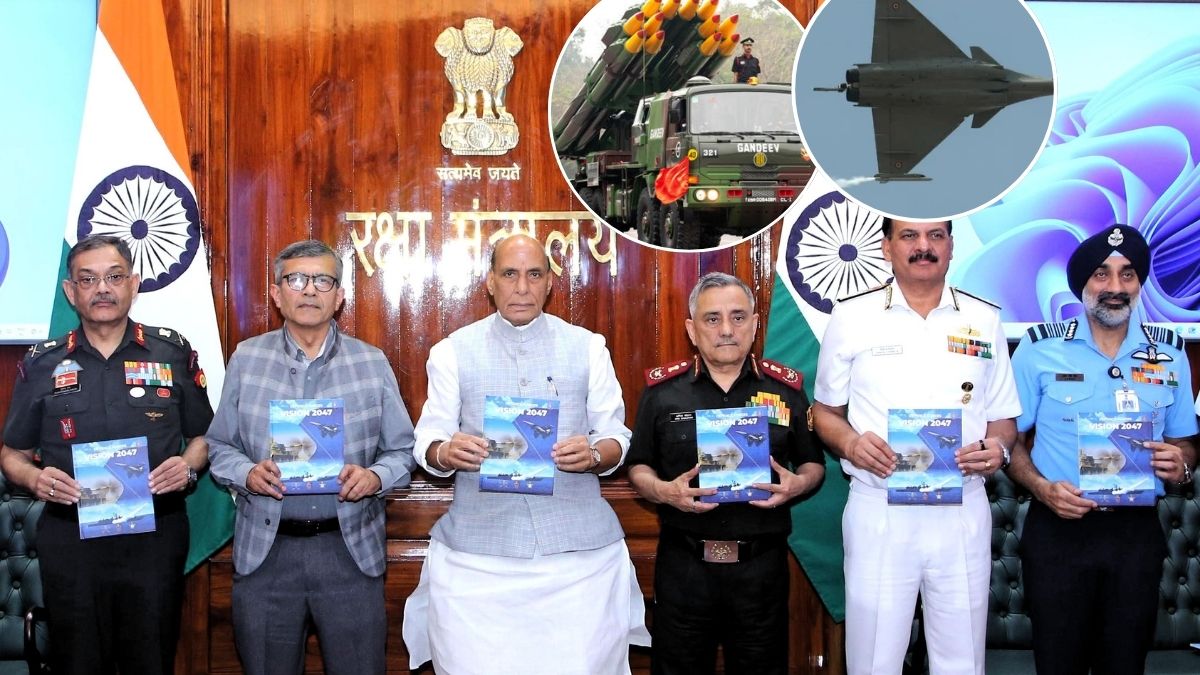
India’s retaliatory action against terror bases in Pakistan and PoK – Operation Sindoor – in May 2025 had proved how jointness and synergy among the tri-services can yield unmatched results. Taking cue from the same, India has unveiled an ambitious roadmap to transform its armed forces for the future.
Keeping jointness and synergy among the services as a central pillar, Defence Minister Rajnath Singh on Tuesday (March 10, 2026) released the “Defence Forces Vision 2047: A Roadmap for a Future-Ready Indian Military”. It outlines sweeping reforms aimed at building a modern, integrated and technologically advanced military by the centenary of India’s independence.
The key document also highlights the importance of innovation, advanced technologies and modern training framework to build a force that is adaptable to future warfare challenges. Prepared by the Headquarters Integrated Defence Staff, the vision document sets out a long-term strategy to reshape the armed forces.
What is ‘Defence Forces Vision 2047’?
Unveiled on March 10, 2026, the the document serves as a strategic blueprint for transforming the Indian military over the next two decades, focusing on structural reforms, capability development and technological modernisation. This is aimed at meeting evolving security challenges while supporting India’s broader goal of becoming a “Viksit Bharat” (developed nation) by 2047.
According to the Defence Ministry, the roadmap aims to create a future-ready force capable of operating across multiple domains – land, sea, air, cyber and space – while responding effectively to emerging geopolitical and security challenges.
The vision emphasises building a combat-ready, agile and integrated military that can deter adversaries and protect India’s expanding strategic interests in a rapidly shifting global security landscape.
Push for jointness and integrated warfare
A central pillar of the roadmap is greater jointness and synergy among the Army, Navy and Air Force. The document promotes deeper coordination in operational planning, military capability development, joint training and command structures. This approach aligns with ongoing reforms aimed at creating integrated theatre commands, which would allow the three services to operate more cohesively during military operations.
By strengthening integration, the roadmap seeks to ensure that India’s armed forces can conduct coordinated multi-domain operations, a key requirement for modern warfare.
Technology and innovation at the core
‘Defence Forces Vision 2047’ document places strong emphasis on advanced technologies and innovation as critical enablers of future combat capabilities. Key focus areas include artificial intelligence and autonomous systems; cyber and space warfare capabilities; advanced surveillance and data networks; next-generation weapon systems.
The roadmap also stresses the need for modernised training frameworks and simulation-based learning, ensuring troops are prepared for increasingly complex battlefield environments.
Boost to ‘Aatmanirbhar Bharat’ in defence
Another major component of the vision is self-reliance in defence production. The roadmap encourages the development and adoption of indigenous defence technologies and platforms, reducing reliance on foreign suppliers while strengthening India’s domestic defence industry.
Officials say this push will not only improve operational readiness and supply chain resilience, but also contribute to economic growth and technological advancement.
To achieve these goals, the vision document outlines a structured timeline with short-, medium- and long-term priorities. This phased approach will guide capability development, institutional reforms, strategic partnerships, technology adoption. The roadmap aims to steadily transform the armed forces into a globally respected, technologically advanced and operationally integrated military by 2047.
A ‘Whole-of-Nation’ security approach
Recognising the complexity of future conflicts, the document calls for a whole-of-nation approach to national security, integrating military capabilities with diplomatic, technological and economic strength.
The strategy underscores that national security in the coming decades will depend on close coordination between government institutions, industry, academia and the armed forces. The roadmap will guide India’s military modernisation efforts over the next two decades, ensuring the armed forces remain prepared for emerging threats.