


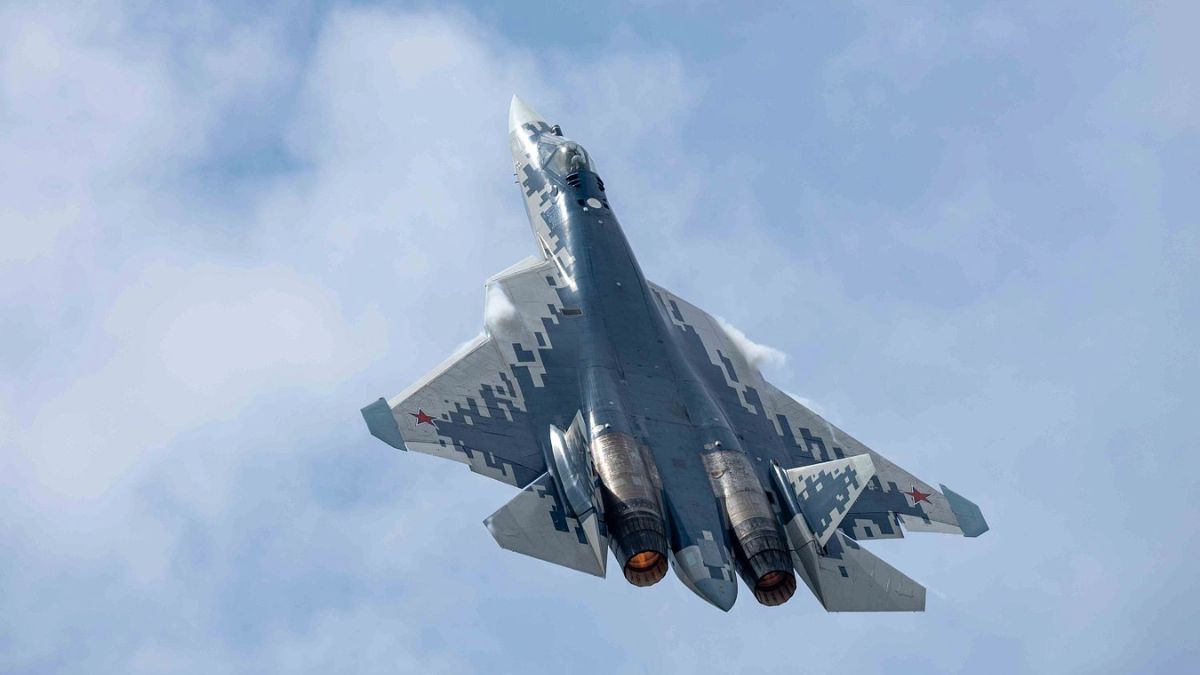
Russia opened its presence at Dubai Airshow 2025 (November 17–21) with the first West Asia appearance of the Su-57E, the export version of its fifth-generation fighter. The unveiling marks a deliberate shift in Moscow’s export posture as Rosoboronexport Joint Stock Company, the export agency of the Rostec State Corporation, uses the airshow to promote not only aircraft sales but also production localisation for regional customers.
Rosoboronexport Director General Alexander Mikheev said the Su-57E forms the centrepiece of Russia’s technology-transfer offer this year. He argued that Russia remains the only country proposing in-country manufacturing options for a fifth-generation platform. The debut comes as several West Asian air forces review long-term fleet modernisation strategies amid wider competition between suppliers from the United States (US), China and Europe.
What does the Su-57E offer to regional buyers?
The Su-57E is being displayed with a suite of internally carried weapons, including RVV-MD2 short-range air-to-air missiles, Kh-38MLE and Kh-69 air-to-surface missiles and the Kh-58UShKE anti-radiation missile. A full-scale RVV-BD long-range air-to-air missile is also part of the Russian exhibit.
Russia says the fighter retains the low-observable shaping, sensor fusion architecture and electronic warfare features of the baseline Su-57 while being configured to meet export policy requirements. A flying demonstration is expected during the course of the airshow.
The timing aligns with increased regional interest in fifth-generation combat aircraft, especially among Gulf states evaluating future air combat concepts and next-generation fleet mixes.
How is local production central to Russia’s pitch?
Mikheev said Russia is offering a co-production package that includes technology transfer, licensed assembly, and training of local engineers and technicians. The proposal reflects a shift in Russia’s defence-industrial strategy, which now emphasises industrial cooperation as a way to secure long-term contracts and sustainability for partners.
The model is designed for air forces seeking greater autonomy in maintenance and upgrades. It also positions Russia as a competitor to collaborative development programmes such as the Global Combat Air Programme, which is being pursued by the United Kingdom, Italy and Japan.
Rosoboronexport’s broader message at the airshow is that long-term partnerships, rather than single-platform purchases, define modern defence procurement cycles.
Which West Asian air forces could be potential customers?
While Moscow has not publicly identified target customers, the Su-57E is likely being positioned for air forces in the United Arab Emirates (UAE), Saudi Arabia, Egypt and Algeria. All four have previously explored advanced fighter options or maintain legacy inventories of Soviet-origin or Russian-built platforms.
The debut also comes as other suppliers expand their visibility in the region. The United States continues to market the F-35, and China is promoting the J-31 family, contributing to a competitive environment in which buyers increasingly seek multiple procurement pathways.
The Su-57E’s appearance at Dubai Airshow 2025 therefore functions as both a commercial initiative and a strategic signal, marking Moscow’s attempt to retain relevance in a rapidly evolving regional market.