


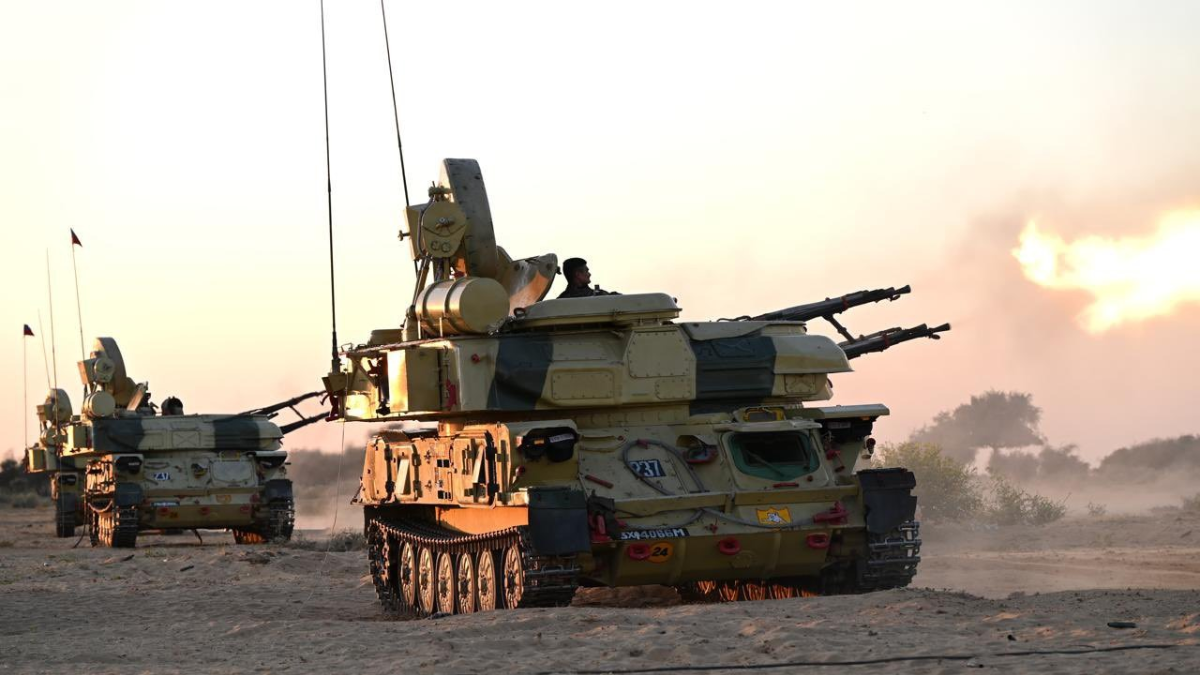
India’s Ministry of Defence signed a Rs 445 crore contract with Russia’s Rosoboronexport on March 27 for additional Tunguska short-range air defence missile systems. The purchase adds to a small existing fleet inducted in the 1990s.
Modern air defence operates in layers. Long-range systems like the S-400 handle high-altitude threats at a distance.
Medium-range platforms like Akash provide area coverage for ground formations. Short-range systems cover the low-altitude, close-range corridor where threats arrive fastest, and reaction windows are shortest. A gap in any layer can be exploited regardless of the capability of the systems above it.
The Threat Environment
Along India’s tense northern and western borders, the threat profile has expanded beyond conventional aircraft and missiles. Attack and reconnaissance UAVs are now widely present above the modern battlefield and have emerged as one of the primary aerial threats. Their small size makes detection difficult, demanding highly capable reconnaissance assets. At the same time, powerful SAMs are too expensive to be used against low-cost drones.
Loitering munitions and low-flying cruise missiles, present in both Pakistani and Chinese arsenals, compound the challenge. The gap between MANPADS and medium-range systems like Akash is where these threats operate. Short-range systems are designed to cover that corridor.
What the Tunguska Is
According to Russia’s National Defence magazine, the Tunguska was the world’s first self-propelled short-range air defence system to combine guns, missiles, and its own radar on a single tracked platform capable of operating without external targeting.
Developed in the 1970s to counter NATO attack helicopters, it entered Soviet service in 1982. Its predecessor, the Shilka, had a reaction time of at least 26 seconds. The Tunguska reduced that to 10 seconds.
The system carries two 30mm automatic cannons with a combined rate of fire of 5,000 rounds per minute, effective to 4 km in range and 3 km in altitude. Eight surface-to-air missiles extend engagement range to 8 km and altitude to 3.5 km, accelerating to Mach 3. Both weapons are controlled through a single integrated fire control system with an 18 km detection range. It is mounted on a tracked chassis capable of 65 km/h on roads, allowing it to operate alongside mechanised units.
Upgrades
Improvement work on the Tunguska began almost immediately after its induction. The Tunguska-M, adopted in 1990, brought improved combat reliability and an upgraded communications system.
The Tunguska-M1 followed in 2003 with further performance improvements, introducing fully automatic target tracking and reducing dependence on operator skill.
Subsequent upgrades added thermal imaging and round-the-clock tracking capability, improving effectiveness against small and slow-moving targets.