


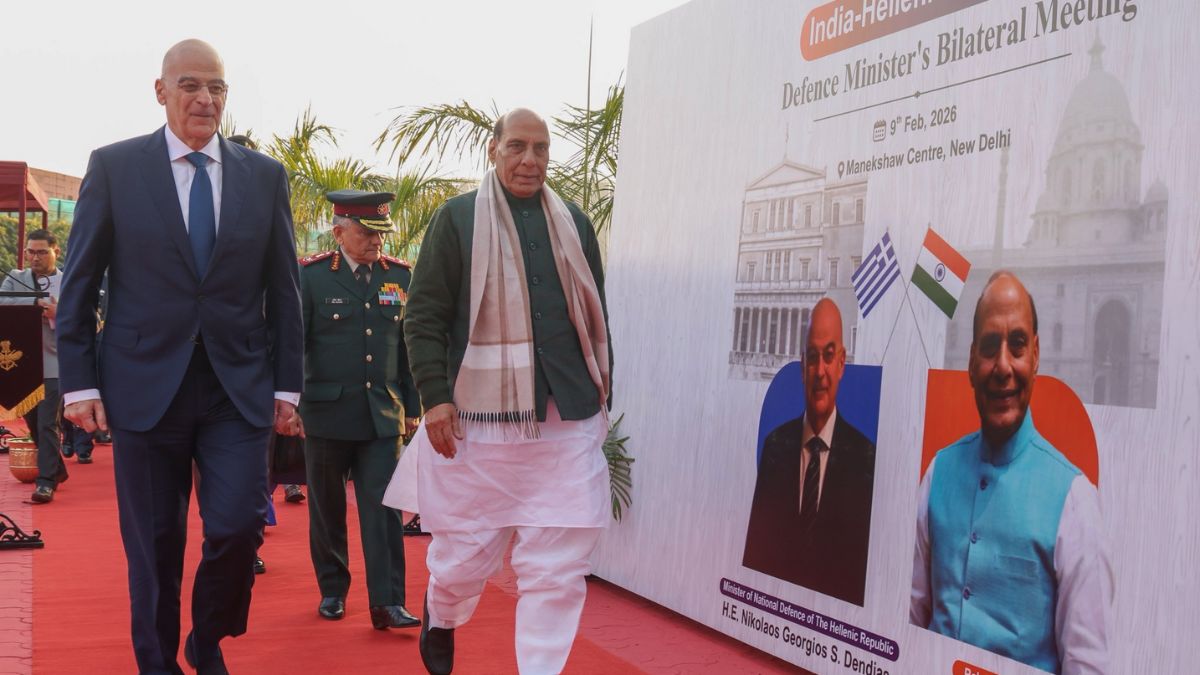
India and Greece took a major step forward in deepening their strategic defence partnership as Defence Minister Rajnath Singh held high-level talks with his Greek counterpart Nikolaos-Georgios Dendias in New Delhi on Monday (February 9, 2026). They exchanged the bilateral military cooperation plan 2026.
The meeting underscored growing convergence between the two countries on security, maritime cooperation and defence industrial collaboration. Discussion between the Indian and Greek Defence Ministers came amid heightened focus on the Indo-Pacific and the Eastern Mediterranean, where both nations see maritime security as a shared priority.
Reiterating that the India-Greece Strategic Partnership is based on shared values of peace, stability, freedom, and mutual respect, both the sides decided to expand capacity of their respective indigenous defence industries through partnership between India’s ‘Aatmanirbhar Bharat’ and Hellenic defence reforms under ‘Agenda 2030’.
Greek presence at IFC-IOR: What does it mean for India?
One of the most consequential outcomes of the talks was the decision to position a Greek International Liaison Officer at the Information Fusion Centre–Indian Ocean Region (IFC-IOR) in Gurugram.
Defence Minister Rajnath Singh described the move as a key step toward enhancing real-time maritime information sharing, domain awareness and coordination between two historic seafaring nations. The development also strengthens India’s role as a hub for maritime security cooperation in the Indian Ocean Region.
How will defence industrial cooperation be expanded?
India and Greece signed a Joint Declaration of Intent on strengthening bilateral defence industrial cooperation, which will serve as the foundation for a five-year roadmap. The agreement is expected to open avenues for joint research, production and technology sharing.
Both the sides also discussed various issues of regional peace and security and acknowledged deepening bilateral defence cooperation and strategic ties.
Bilateral Military Cooperation Plan 2026: What does it outline?
The two sides also exchanged the Bilateral Military Cooperation Plan for 2026, detailing the scope of engagements between their armed forces. This includes structured military exchanges, training interactions and potential joint activities, aimed at enhancing interoperability and trust.
Rajnath Singh emphasised that India places high value on its “time-tested partnership” with Greece, rooted in shared democratic values, the rule of law and commitment to peace and stability. He recalled that bilateral ties were elevated to a Strategic Partnership during PM Narendra Modi’s landmark visit to Greece in 2023, followed by Greek PM Kyriakos Mitsotakis’s visit to India in February 2024.
With this, Singh also expressed his thanks to Greece for its consistent backing of India on issues of core national interest, including cross-border terrorism. He also expressed appreciation for Greece’s support for India’s permanent membership in an expanded UN Security Council, India’s candidature for a non-permanent UNSC seat for 2028–29, and Greece’s strong condemnation of the Pahalgam terror attack.
India-Greece discuss security issues
Defence Ministers of both the sides also exchanged views on regional and global security developments, acknowledging increasing alignment on maritime security and strategic challenges. Both sides reiterated that the India-Greece Strategic Partnership is anchored in mutual respect and shared democratic values.
Earlier in the day, the Greek Defence Minister paid homage at the National War Memorial and inspected a tri-services guard of honour at the Manekshaw Centre. The Hellenic delegation is also scheduled to visit defence and industrial establishments in Bengaluru, engaging with defence PSUs, private industry and start-ups.