


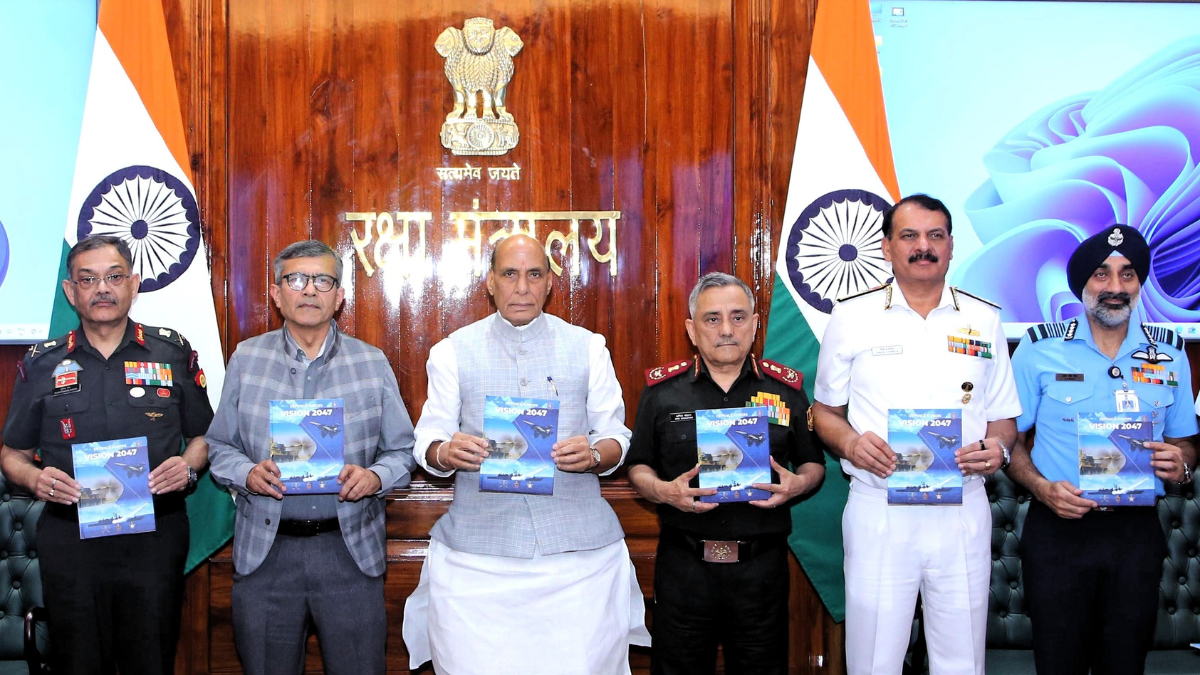
India’s Ministry of Defence (MoD) on Thursday (March 12, 2026) released a key Defence Forces Vision 2047 document that calls for setting up a dedicated, separate entity for handling geospatial mapping, data analysis, and drone operations.
The document also advocated the long-pending proposal for separate commands for space and cyber operations, apart from expanding the air defence system called ‘Sudarshan Chakra’, expected to be fully ready by 2030.
Though Defence Minister Rajnath Singh had unveiled the document on Tuesday (March 10, 2026), the Integrated Defence Services headquarters made it public on Thursday (March 12).
The 47-page document noted that the plan to expand the Ballistic Missile Defence (BMD) and air defence systems for safeguarding the economic and strategic assets and civilian infrastructure against multi-domain threats, as part of Sudharshan Chakra.
India has previously tested the BMD multiple times and used the preliminary version of the Sudharshan Chakra during the May 2025 Operation Sindoor against Pakistan.
Among the recommendations from the document were the creation of the three separate institutions for geospatial operations, data analysis, and drone warfare.
The military already has a temporary agencies that handle space and cyber warfare, apart from special operations, waiting for over a decade now to be upgraded into separate military commands.
The document also recommended adding capabilities for electro-magnetic spectrum domination, which is the ability to control, communicate, and detect in battle, while denying, disrupting, and deceiving the adversary’s communication, radars, and navigation systems.
The document wanted the Indian armed forces to focus on technological advancements, indigenous research and development, and complex systems for achieving self-reliance in capability building.
It also emphasises the need for dual-use infrastructure and creation of ‘surge’ capacities to cater to prolonged high-intensity operations.
The future road-map also recommends three distinct transition phases — Phase I from 2026 to 2030 as an era of transition, Phase II from 2030 to 2040 as an era of consolidation, and Phase III from 2040 to 2047 as the era of achieving excellence in these future warfare capabilities.
Under Phase I, the military should undertake organisational restructuring for multi-domain operations and exercise positive control over the borders against Pakistan and China.
In this phase, the Indian armed forces should look to deter the adversaries from initiating or provoking conflicts, contain standoffs, keep confrontations localised, and combat terrorism.
Through the Phase II decade, the military should aim at achieving the next level of integration, progressing to data-driven operations, and integrating space and cyber into traditional warfare, apart from acquiring the capability to dominate aerospace and maritime domains.
Phase II should be transformative for the armed force, as it should emerge as a world-class military, being a pioneer and leader in all technologies to meet future threats and challenges, ensuring freedom of operations and in areas of interest.
The document envisions India’s dominance and sustainment in the Indian Ocean region through robust domain awareness on the surface, underwater, and in the air.