


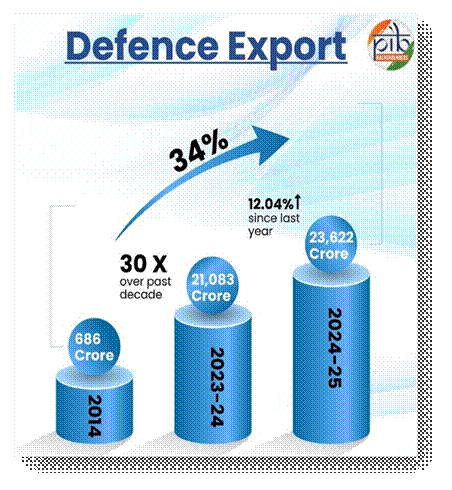
A figure that was less than Rs 1000 crore around a decade ago, has now surged 23X to hit Rs 23,622 crore in the financial year 2025. These are the numbers representing India’s defence exports, indicating how immensely has the sector grown in just around 10 years. And the government is eyeing an bigger growth by the year 2029.
India’s defence sector has crossed a decisive milestone, with the Ministry of Defence now firmly targeting Rs 3 lakh crore in defence production by 2029, a goal that once appeared aspirational but is increasingly being treated as achievable. At the heart of this surge are nearly 16,000 micro, small and medium enterprises (MSMEs) that have emerged as the backbone of the country’s expanding defence manufacturing ecosystem.
Addressing a press conference on Aatmanirbharta in the Defence Sector, Union Minister Mansukh Mandaviya said India’s self-reliance drive has moved well beyond intent and policy declarations, evolving into a strategic and industrial reality.
From import dependence to domestic strength
The numbers underline the scale of transformation. India recorded its highest-ever defence production of Rs 1.54 lakh crore in FY 2024–25, a level unimaginable a decade ago. Today, nearly 65% of defence equipment is manufactured domestically, marking a complete reversal from the 65–70% import dependence that defined the sector ten years earlier.

Indigenous defence production has surged by 174%, rising from Rs 46,429 crore in 2014–15 to Rs 1.27 lakh crore in FY 2023–24. This growth, Mandaviya said, reflects a deep structural shift rather than a one-off spike.
MSMEs emerge as game-changers
A key driver of this momentum has been the rise of MSMEs, with around 16,000 such units now integrated into defence supply chains. Once peripheral players, MSMEs are now manufacturing critical components, sub-systems and assemblies, reducing dependence on imports while strengthening supply resilience.
Their growing role has also broadened private-sector participation, an area that was virtually absent from India’s defence industry until recent reforms.
Reforms that unlocked scale and speed
Looking back, the minister recalled how the sector was long constrained by slow procurement cycles, limited private participation, heavy imports and negligible exports. A series of reforms in procurement and production helped dismantle these bottlenecks.
The Defence Procurement Manual (DPM) 2025 and the ongoing review of the Defence Acquisition Procedure (DAP) 2020 are aimed at improving speed, transparency and innovation. Reinforcing this shift, the Defence Acquisition Council in July 2025 approved proposals worth Rs 1.05 lakh crore for armoured vehicles, surface-to-air missile systems and modern warfare platforms, with priority given to the ‘Buy Indian – IDDM’ category.
What’ fuelling this momentum?
Government spending and industrial infrastructure have played a catalytic role. The defence budget has more than doubled since 2013–14, while defence industrial corridors in Uttar Pradesh and Tamil Nadu have attracted investments exceeding Rs 9,145 crore, expanding manufacturing capacity and employment.
To date, 788 industrial licences have been issued to 462 companies, and nearly 92 per cent of defence contracts in FY 2024–25 were awarded to domestic firms.
Exports surge as India enters global defence markets
Perhaps the most visible sign of India’s defence sector coming of age is exports. Defence exports have grown nearly 34 times, from Rs 686 crore in FY 2013–14 to a record Rs 23,622 crore in FY 2024–25. The private sector accounted for Rs 15,233 crore of this total. India now exports defence equipment to over 100 countries.
The items include bulletproof jackets, Dornier aircraft, Akash missile systems and BrahMos missiles. The introduction of online export systems has sharply reduced paperwork and processing timelines, making Indian firms more competitive globally.
Taken together, the numbers point to a decisive shift: India is no longer just a large defence buyer but an emerging defence manufacturing and export hub. Reiterating the long-term vision, Mandaviya said the objective is unambiguous: Rs 3 lakh crore in defence production and Rs 50,000 crore in defence exports by 2029.