


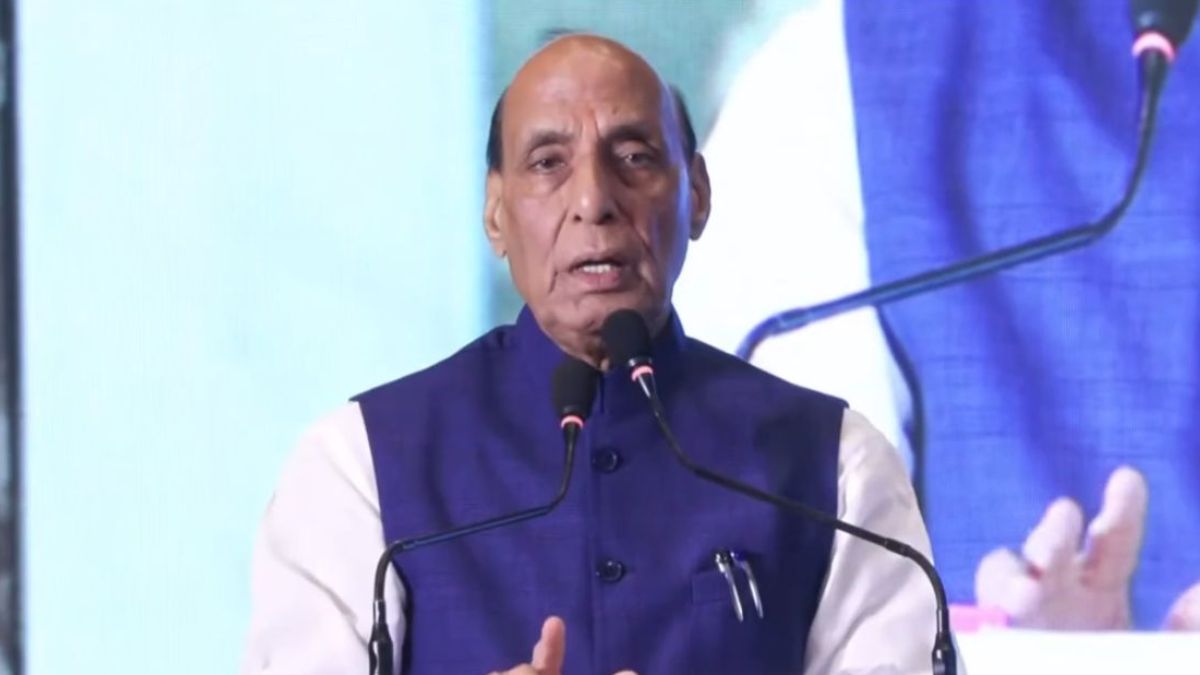
India’s defence exports would touch Rs 29,000 crore in the current fiscal ending this month, even as the Narendra Modi government has set a target of Rs 50,000 crore in the next five years by 2030, Defence Minister Rajnath Singh said on Friday (March 6, 2026).
The Defence Minister also warned that the current West Asia military crisis was directly disrupting supply lines of oil and gas, and the worry was that the current “abnormality” in the global situation was becoming the “new normal.”
Rajnath Singh was speaking at the ‘Sagar Sankalp – Reclaiming India’s Maritime Glory’ defence and maritime dialogue jointly organised by state-run Garden Reach Shipbuilders and Engineers (GRSE) and a private media house in Kolkata.
“The government’s efforts are yielding positive results as, in the Financial Year 2024-25, domestic defence production surpassed a record figure of Rs 150,000 crore, with defence exports touching an all-time high of approximately Rs 24,000 crore,” Rajnath Singh said in the event.
“By April 2026, the defence exports are poised to reach approximately Rs 29,000 crore, and the government has set a target to export defence equipment worth Rs 50,000 crore by FY 2029-2030,” he said.
Rajnath Singh acknowledged that the private industry, today, contributed approximately 25% of the defence platforms/equipment and accessories manufactured in the country, and this participation would increase to 50% share of total defence production by value in the times to come.
In this regard, the Defence Minister pointed out that all the warships and submarines on order for the Indian Navy were under construction only in Indian shipyards, from designing, engineering, construction, to lifecycle support.
He noted that the contribution of the entire ecosystem from the startups and MSMEs to SMEs and large companies in India was leading to “the conglomerate effect,” creating synergy, increasing efficiency, mitigating risks, and establishing the innovation ecosystem in the country.
The government had introduced several financial assistance schemes to advance India’s shipbuilding landscape, including the creation of a dedicated mechanism for long-term funding, liberalised FDI norms, and encouraging the PPP model.
“Under the Maritime India Vision 2030 and Maritime Amrit Kaal vision 2047, investments worth approximately Rs 300,000 crore have been planned to develop world-class shipbuilding clusters,” he added.
The Defence Minister said the current situation in West Asia was “one prime example” of old ideas, old global order, and old perceptions changing rapidly. “These are the uncertainties we need to understand.”
He said what was happening in West Asia was quite unusual, and it was difficult to make concrete comments about the future course of events in that region or in India’s neighbourhood.
“The Strait of Hormuz or the entire Persian Gulf region is crucial for global energy security. When there is a disturbance in the region, it directly impacts the supply of oil and gas,” Rajnath Singh said.
“Moreover, we’re witnessing supply chain disruptions in other sectors as well. These uncertainties have a direct impact on the economy and global trade,” he said.
“The global scenario is an abnormal situation. What is more worrying is the fact that this abnormality is becoming the new normal,” he added.
The Defence Minister also advocated self-reliance as the only way to stay relevant and ready in the present era of uncertainty, emphasising that the current global situation had led to the realignment of supply chains, formation of new equations, and a constant rise in maritime activities, reaffirming the government’s resolve to attain self-reliance in every field.
In this regard, he said ‘technological dynamism’ was a crucial element in today’s world, as technology brought about unprecedented changes in every sphere of life, including in the defence sector, where this dynamism was clearly visible.
Highlighting that high-end and precision technologies were used in the defence sector, he noted that the government aimed to achieve Aatmanirbharta (self-reliance) in defence tech to remain and stay ready for emerging and future challenges.