


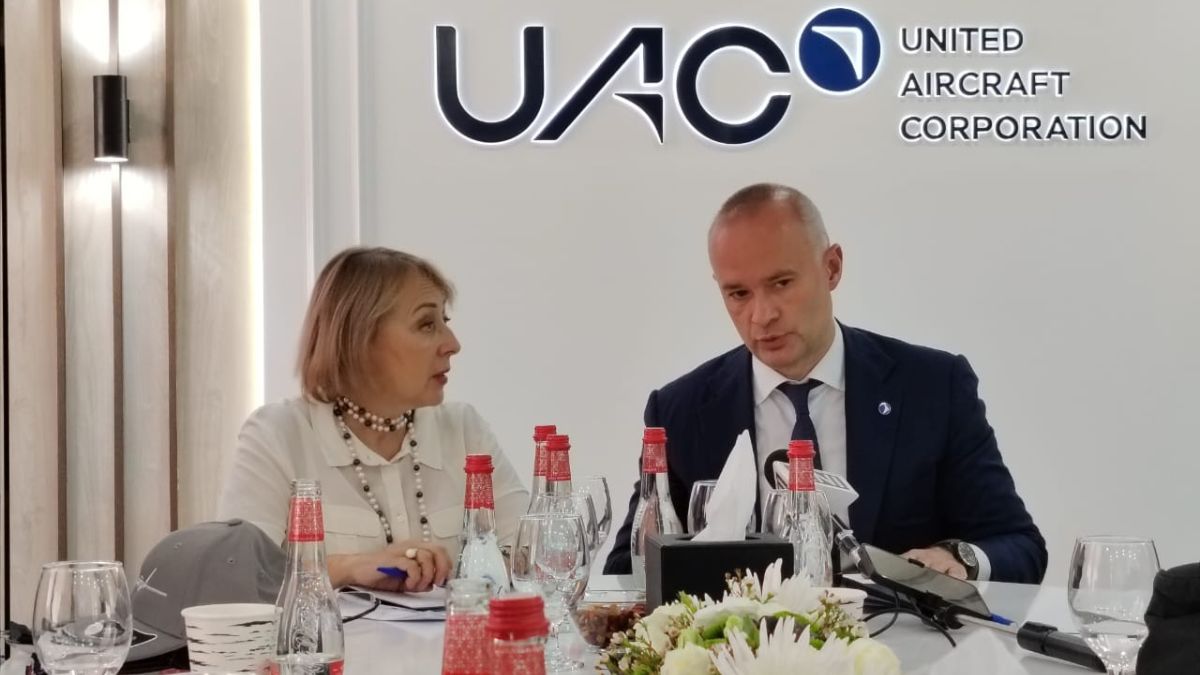
Russia is ready to integrate Indian-made components into its SJ-100 regional jet and build the aircraft in partnership with Hindustan Aeronautics Limited (HAL) as part of the ‘Make in India’ initiative, Vadim Badekha, Director General of United Aircraft Corporation (UAC), has said, speaking to a group of visiting Indian journalists on the sidelines of the Dubai Air Show.
The SJ-100 is a twin-engine regional jet in roughly the 100-seat class, designed for short- and medium-haul routes of about 3,000–3,500 km. Originally developed as the Sukhoi Superjet 100 with extensive foreign content, it has been repositioned as an all-Russian platform with new engines and domestically sourced systems to ensure strategic autonomy.
The offer follows a landmark MoU between HAL and Public Joint Stock Company United Aircraft Corporation (PJSC-UAC) for production of the SJ-100 civil commuter aircraft in India signed in October. At the time, Defence Minister Rajnath Singh hailed the MoU as a “game changer for short-haul connectivity under the UDAN scheme” and “a major stride towards achieving ‘Aatmanirbharta’ in civil aviation”, noting it would be the first complete passenger aircraft built in the country since the Avro era and would strengthen the private sector and generate jobs in the aviation industry.
Vadim Badekha, Director General of UAC, said Moscow is ready to slot Indian suppliers directly into the SJ-100 supply chain if the programme goes ahead in India. Some elements “designed [and] manufactured by [the] Indian side might be engaged in this very commercial aircraft,” he said.
The SJ-100 lies at the heart of the MoU between UAC and HAL, which foresees the regional jet being manufactured in India for domestic airlines and potentially for export to nearby markets.
Badekha described the aircraft as a mature platform which has already been operated extensively by Russian carriers in its earlier Sukhoi Superjet 100 form, using foreign-supplied systems. Those jets, he said, have clocked flight hours comparable to Boeing and Airbus aircraft on domestic routes.
He added that Russia is now in the final stages of replacing Western components with Russian locally designed engines, avionics and subsystems. “We have been completing the programme of replacement of imported component by the Russian local ones. They are currently undergoing the certification flights,” he said, noting that more than half of those flights have already been completed and certification is expected once testing is over.
Despite sanctions and supply-chain pressure, UAC is pitching the new Russian systems as equal to or better than the Western equipment they replace. Badekha said the aim was not only to maintain performance but, where possible, to surpass the original benchmarks and give Russian and future export operators a fully independent support base.
Within this context, the MoU with HAL is being framed in Moscow as a chance to apply the same localisation model used on military programmes, such as the Su-30MKI, to a civil jet. Badekha said UAC hopes to “exercise the same approach” as with Indian fighter aircraft by relying on India’s own design, manufacturing and integration capabilities for key parts of the SJ-100.
Under the proposed plan, HAL would assemble and manufacture the SJ-100 in India, supplying aircraft to Indian carriers and possibly to airlines in South Asia and other neighbouring regions. Indian officials see the project as a way to restart full-scale passenger aircraft production in the country, decades after the last domestically built airliner left HAL’s lines.
In India, the aircraft is being positioned as a candidate to support regional connectivity schemes such as UDAN, filling gaps on thinner routes where large narrow-body jets are not economical. According to Badekha, HAL is now studying the market potential. “Currently, there is the process which comes from our partner, HAL Corporation, which studies, investigates the marketing issues regarding the Indian and some other markets,” he said, adding that several Indian airlines have already expressed interest in operating the type.
(Updates about SJ-100 in paragraph 2.)