


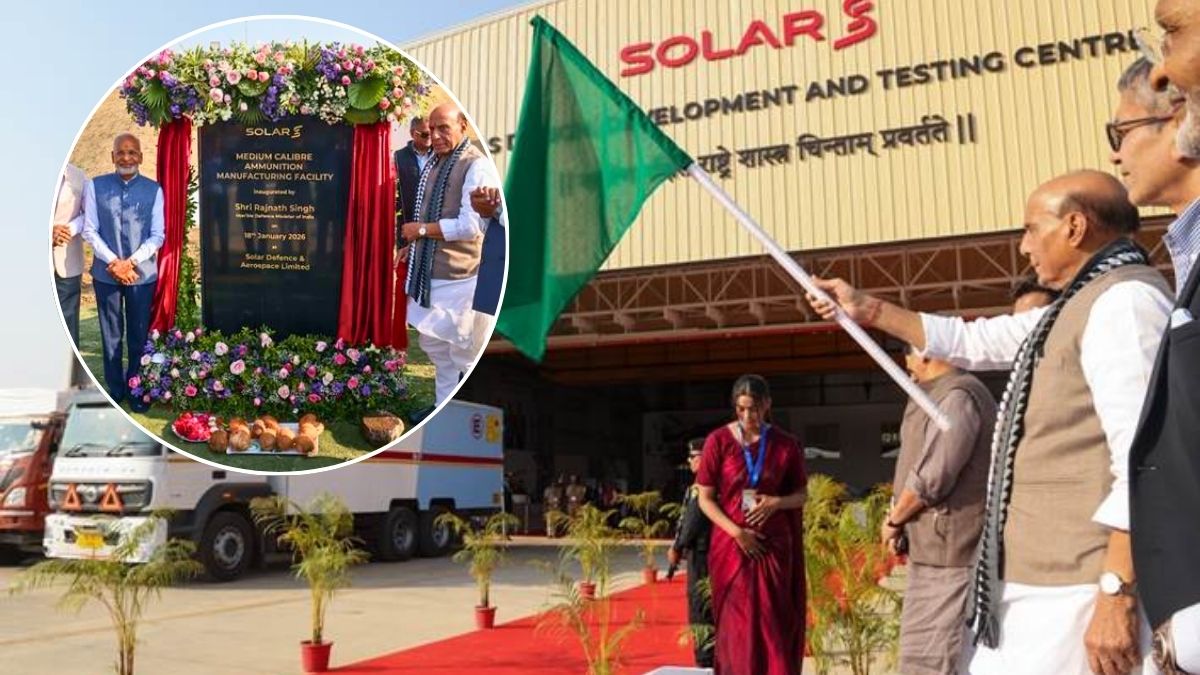
India is steadily marching forward in ammunition production as it is manufacturing quality and reliable products, Defence Minister Rajnath Singh stated as he inaugurated the medium caliber ammunition manufacturing facility at Solar Defence & Aerospace Limited in Nagpur on Sunday (January 18, 2026).
Underlining Narendra Modi government’s determination to make the country self-reliant in critical military supplies and position it as a global defence production hub, the the inauguration of the state-of-the-art facility marked another decision shift in the country’s defence manufacturing landscape.
Flagging off the fully automated plant manufacturing 30mm ammunition, the defence minister also visited the Pinaka Rocket manufacturing facility and flagged-off the first tranche of Guided Pinaka rockets to Armenia.
From shortages to self-reliance in ammunition
Defence minister Singh highlighted that the newly inaugurated ammunition facility reflects how India has moved from a phase of ammunition shortages to one of confidence and capacity-building under the Aatmanirbhar Bharat vision. He also called for an increased involvement of private sector in manufacturing and R&D.
Recalling earlier challenges to India’s defence preparedness, the defence minister said the government’s focus on domestic ammunition manufacturing was born out of hard lessons from the past. He described self-reliance in ammunition as a strategic imperative, especially as modern warfare demands uninterrupted supply chains.
The newly inaugurated facility manufactures 30 mm ammunition, a critical requirement for both the Indian Army and the Indian Navy, and is among the most advanced of its kind in the private sector.
Private sector in defence self-reliance takes centre stage
Rajnath Singh said the plant exemplifies the growing role of the private sector in India’s defence ecosystem, noting that Indian industry is now delivering quality, reliable and combat-proven systems. He pointed to the induction of the indigenously developed multi-mode hand grenade into the Army in 2021 as a milestone.
Commending the Solar Group’s defence capabilities, he also mentioned the combat use of Nagastra drones during Operation Sindoor, where they successfully struck terrorist targets. The Defence Minister expressed confidence that more advanced variants of the system under development would significantly enhance India’s future combat capabilities.
The Nagpur visit also reflected India’s expanding footprint in the global defence market. Defence minister Singh said exports of Pinaka rockets manufactured at the facility have already begun, signalling India’s transition from a major arms importer to a credible exporter.
Bhargavastra Counter drone system
He cited the successful test launch of Bhargavastra, a counter-drone system developed by the Solar Group, as further evidence of the private sector’s technological maturity and its ability to respond to emerging battlefield threats.
Earlier in the day, the Defence Minister visited the Pinaka rocket manufacturing unit and flagged off the first tranche of guided Pinaka rockets to Armenia, a development seen as a significant boost to India’s defence export ambitions.
Operation Sindoor: An example of self-reliance
Calling Operation Sindoor a clear demonstration of why self-reliance matters, Rajnath Singh said the nature of conflict is undergoing a fundamental transformation. He noted that wars are no longer limited to conventional battlefields and now span domains such as technology, energy, supply chains, trade and information.
“New methods of warfare are emerging. Wars are no longer confined to borders. Areas such as energy, trade, tariffs, supply chains, technology, and information have also become new dimensions of conflict. The importance of border vigilance and latest weapons and technologies has increased,” he said.
Irrespective of the nature of war, the need of a robust defence industrial base will always remain. In such a situation, increased private sector’s involvement in manufacturing and research & development is the need of the hour, the defence minister noted.
50% private sector target in defence manufacturing
The defence minister reiterated the government’s goal of raising the private sector’s share in defence manufacturing to 50% or more in the coming years. He said sustained policy support, indigenisation mandates and minimum indigenous content requirements are already boosting industry confidence and accelerating capability development.

The government’s push, he added, has resulted in steady gains in indigenous content across platforms, systems and subsystems, strengthening domestic vendors and reducing external dependence.
Highlighting the scale of transformation, Singh said India’s domestic defence production has grown from Rs 46,425 crore in 2014 to approximately Rs 1.51 lakh crore today, with over Rs 33,000 crore contributed by the private sector. Defence exports, which stood at less than Rs 1,000 crore a decade ago, have surged to a record Rs 24,000 crore.