


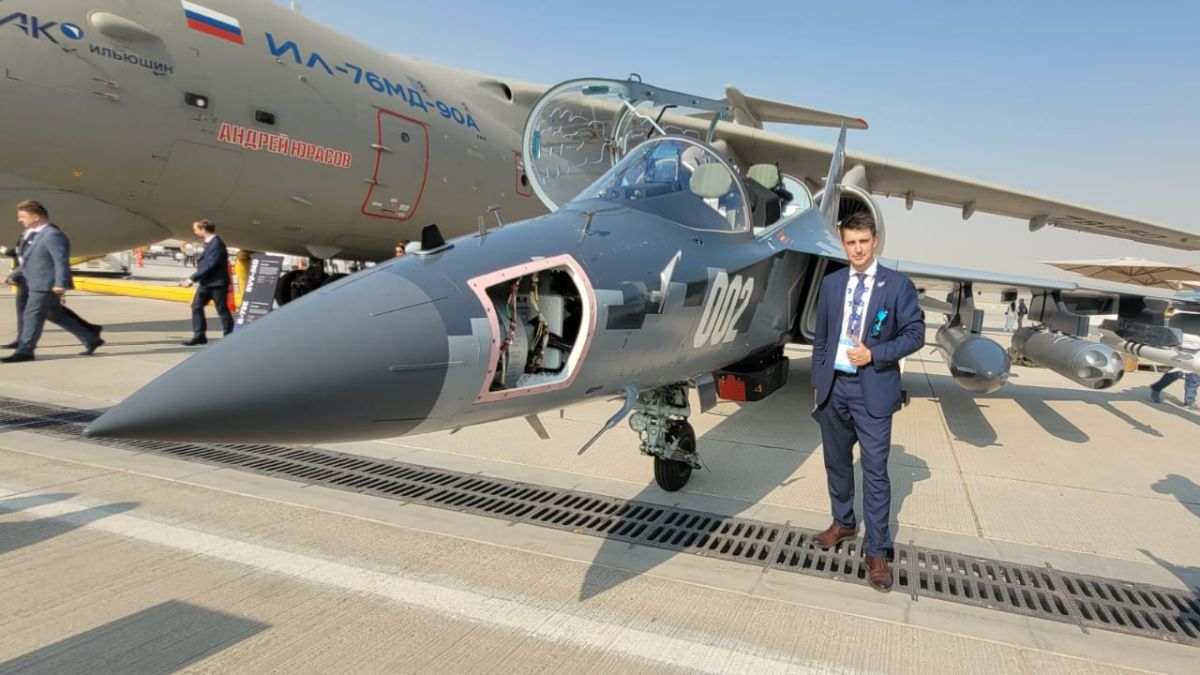
Russia has premiered the modernised Yak-130M combat trainer to international customers for the first time at the Dubai Airshow, pitching the aircraft as a cost-effective light fighter and advanced training platform for fourth-plus-plus and fifth-generation jets.
Displayed in prototype form, airframe “002” was brought to Dubai for its international debut, while two other prototypes–numbered 001 and 003–are being used for ground and flight testing in Russia. A company representative said the research and development phase is scheduled to run until the end of 2027, with the aircraft expected to be ready for export from 2028.
Company representatives said that the aircraft offers a smooth progression for pilots and cadets from basic to advanced training, now extended to preparing crews for 4++ and fifth-generation fighters. The Yak-130M is described as the next step in the Yak-130 family, retaining the basic trainer’s handling qualities but adding a much more capable combat suite to bridge the gap between elementary training and frontline multirole aircraft.
The aircraft has a maximum take-off weight of 10,290 kilograms and a combat payload of up to 2,500 kilograms. Its maximum speed is quoted as Mach 0.9, with a ferry range exceeding 2,000 kilometres when fitted with external fuel tanks. The company claims that in many roles it can accomplish typical combat missions at a cost up to ten times lower than classic tactical fighters, positioning it as a cheaper alternative for air forces that cannot afford to use frontline combat aircraft for every task.
The most visible change from the basic Yak-130 is a new active electronically scanned array (AESA) radar, designated BRLS-130R and produced by Russian firm Radar MMS. Mounted in the nose, it is designed to detect fighter-type targets at up to 70 kilometres in the forward hemisphere and to support beyond-visual-range air-to-air missile employment. It also enables the use of guided and unguided weapons against ground and surface targets, day and night and in all weather conditions.
Radar modes are said to include weather reconnaissance, terrain mapping along the route, recognition of terrain features and automatic tracking of radar-contrast ground and surface targets, both moving and stationary. This is paired with a new central computing complex and updated avionics built around an open architecture, allowing for further upgrades and customer-specific modifications.
To complement the radar, the Yak-130M at Dubai carried the SALT-130K optical targeting pod. This system allows the aircraft to employ precision-guided munitions against ground and surface targets using pre-planned coordinates as well as data received from a ground control station. Detailed technical information on the pod was displayed on a board next to the aircraft.
The weapon fit shown included the RVV-MD short-range air-to-air missile, advertised with a range of up to 40 kilometres and a dual-band infrared seeker with improved resistance to jamming. The aircraft can also carry guided air-dropped bombs in the 500-kilogramme and 250-kilogramme classes, including satellite–inertial and laser-guided variants. Up to 16 bombs can be carried on multi-bomb racks, along with under-fuselage gun pods armed with 23-millimetre cannon.
Survivability has been enhanced with a new self-defence suite installed in wingtip pods. One module houses an electronic warfare package with active jamming and a radar warning receiver, while the other contains a missile-approach warning system. Together with a central controller and countermeasures dispenser, the suite can operate in a fully automatic mode, releasing decoys and activating jamming without pilot input.
Despite the emphasis on combat, the manufacturer continues to stress the Yak-130M’s role as a trainer. Officials say the aircraft is intended to give air forces a single platform that can cover advanced instruction, lead-in fighter training and secondary combat duties.
Asked how the Yak-130M compares with Italy’s M-346FA light fighter, the representative said both aircraft are built around the same idea of offering a cheaper alternative to a full tactical fighter package, but added that Russia expects to be ahead once the Yak-130M completes development and enters the export market.
On the commercial side, the company says more than 100 examples of the original Yak-130 basic trainer have already been sold abroad, mainly to countries in South-East Asia, Africa and among Russia’s neighbours. While precise figures were not disclosed, the representative described the earlier model as a “bestseller” in the early 2010s and argued that the Yak-130M is being developed to meet fresh operational demands from similar customers.
Existing operators of the Yak-130 will be offered an upgrade path. The firm says the basic aircraft can be modernised to Yak-130M standard, an option it expects to appeal to air forces that require more advanced capabilities but cannot afford a completely new fleet.
The aircraft shown in Dubai remains a prototype, and questions about production capacity will only be answered after testing is complete. The company said output planning will be handled by Russia’s United Aircraft Corporation. However, the message at the air show was that Moscow intends the Yak-130M to serve both as a more capable combat asset and as a budget-minded gateway into advanced fighter operations–with every major system, from radar to ejection seats, presented as entirely Russian-made and independent of foreign supply chains.