


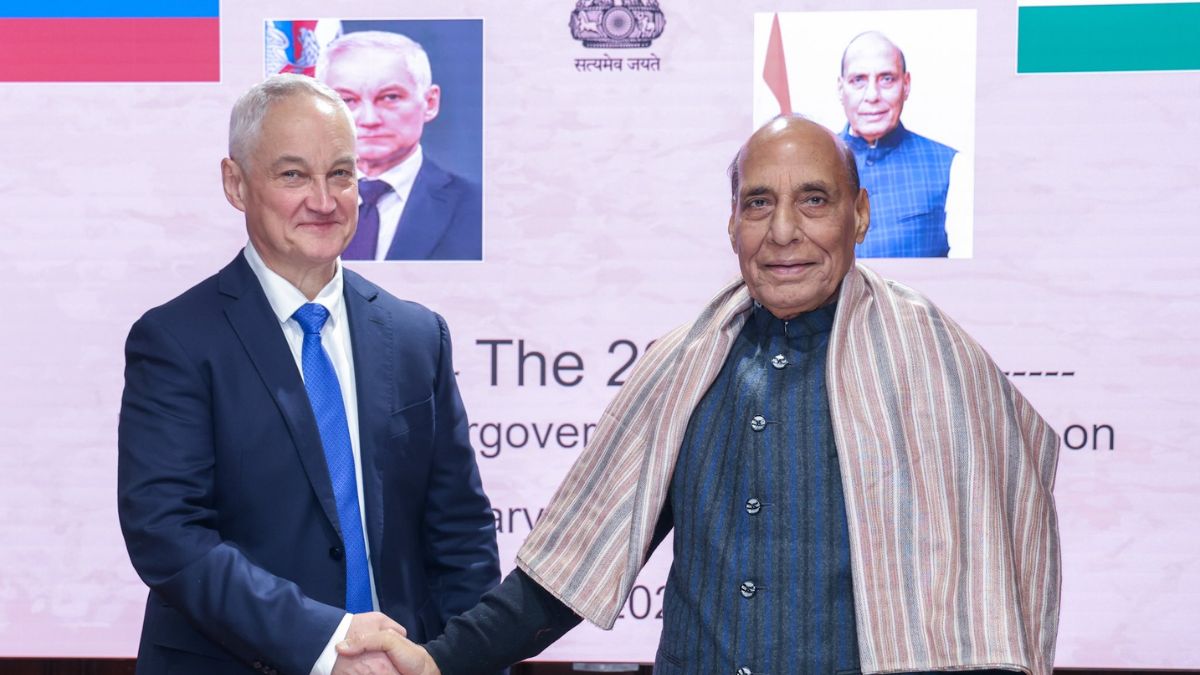
In a powerful signal of enduring strategic trust, India and Russia opened high-level defence discussions even before President Vladimir Putin’s plane touched down in New Delhi for his two-day state visit on Thursday (December 4, 2025). Both sides reiterated that India-Russia ties are based on a deep sense of trust, common principles and mutual respect.
Raksha Mantri Rajnath Singh and his Russian counterpart Andrei Belousov earlier today co-chaired the 22nd India-Russia Inter-Governmental Commission on Military & Military Technical Cooperation (IRIGC-M&MTC) at the Manekshaw Centre. The timing, just hours before Putin’s Delhi landing for the 23rd Annual Summit with PM Modi, underscores how central defence ties remain to the bilateral relationship.
Both leaders reaffirmed that India–Russia ties stand on “deep trust, shared principles and mutual respect,” setting the tone for intensified collaborations in the year ahead.
22nd IRIGC-M&MTC: What signals India sent about defence self-reliance?
During the meeting, defence minister Singh made a clear pitch that India’s defence strategy is anchored in Aatmanirbhar Bharat, focused on building domestic capacity not only for self-sufficiency but for export-led growth. He voiced the Government of India’s determination for capacity building of its indigenous defence industry for both local production and exports.
The minister further stressed that the future of cooperation lies in co-development and co-production, high-end technology partnerships, support for India’s indigenous defence ecosystem. For Moscow, this aligns with its long-standing willingness to share sensitive military technologies with New Delhi.
ALSO READ: A Hug, Handshake And Warm Personal Welcome From PM Modi: How Putin’s Landmark India Visit Started
How did Russia respond, and what are the key takeaways?
Russian Defence Minister Andrei Belousov emphasised that the partnership is “united by decades of friendship and strategic cooperation,” and reiterated that Russia is ready to support India’s quest for defence self-reliance. He also emphasised on deepening relationship between both the countries.
Along with offering to deepen industrial support for Indian defence production, the Russian defence minister also made a commitment to expand cooperation across “niche and emerging technologies”. Additionally, an agreement to continue long-term military-technical projects was also discussed.
Belousov also formally invited Rajnath Singh to Russia next year to co-chair the 23rd IRIGC-M&MTC session in 2026, signalling continuity at the highest levels. At the end of the talks, both ministers signed the protocol document, outlining ongoing and future pathways for bilateral defence collaboration.

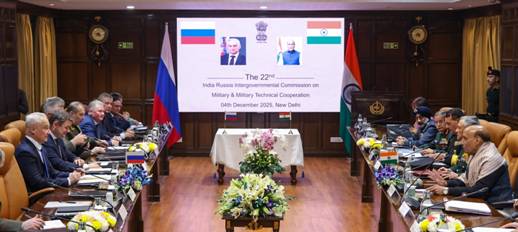
Before the meeting, the two ministers visited the National War Memorial, where they laid a wreath to honour India’s fallen soldiers. The Russian minister also inspected a Tri-Service Guard of Honour, a sign of the military prestige India accords to its closest defence partners.
Why this meeting matters ahead of the Modi–Putin summit
The defence commission session happened just hours before President Putin’s arrival. This signals, among many things, the urgency of expanding military cooperation, Moscow’s intent to reaffirm India as a strategic priority, and New Delhi’s desire to secure stability in supply chains, spares, and joint projects.
With major items such as S-400 systems, Su-57 proposals, nuclear cooperation, and joint military technology development expected to feature during the 23rd India-Russia Annual Summit, the pre-landing defence talks can be perceived as a strategic warm-up. The session effectively laid the groundwork for sharper military engagement.