


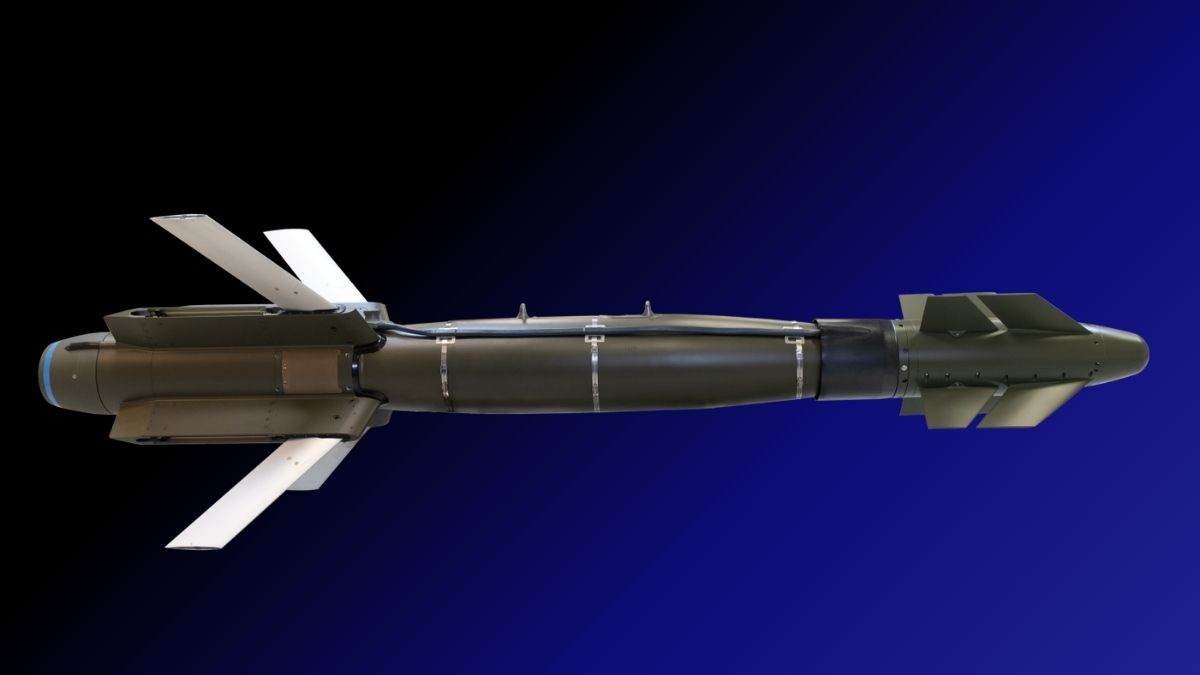
Bharat Electronics Limited (BEL) and Safran Electronics & Defense (SED) have signed a landmark Joint Venture Cooperation Agreement (JVCA) to manufacture the Highly Agile Modular Munition Extended Range (HAMMER) precision-guided air-to-ground weapon system in India.
The agreement marks a major step toward strengthening India’s indigenous defence production while equipping its frontline fighter fleets — the Rafale, Rafale-M, and all variants of the Tejas Light Combat Aircraft (LCA) — with a common advanced strike capability.
The JV will be established as a private limited company with an equal 50:50 shareholding, focusing on the localised manufacturing, supply, and life-cycle support of HAMMER systems for the Indian Air Force (IAF) and the Indian Navy.
The move aligns with India’s long-term plan to expand domestic production of advanced combat systems and reduce dependence on foreign suppliers.
How is HAMMER a combat-proven weapon?
The HAMMER, originally developed for the French Air Force, is a modular, combat-tested precision weapon with a range exceeding 70 km. It is known for its pinpoint accuracy, jam-resistant seeker systems, and ability to launch from low altitudes across complex terrain.
These attributes make it particularly valuable in scenarios requiring deep strikes, bunker-busting missions, and interdiction operations.
India first opted for the HAMMER in 2020 for its Rafale fleet, choosing it over the Israeli Spice-2000 system. A key deciding factor then was Rafale’s ready compatibility with HAMMER, enabling faster operational deployment during periods of heightened security tensions.
How is HAMMER integration in Tejas a major capability lift?
While the Rafale’s integration with HAMMER is straightforward, the decision to arm the Tejas Mk1 and Mk1A variants with the same weapon is being described by international defence analysts as a major leap in India’s air-combat capability.
According to reports, arming Tejas with HAMMER effectively transforms the indigenous fighter from a primarily air-defence platform into a fully multirole aircraft capable of high-precision ground strikes.
With HAMMER, Tejas will be able to conduct bunker-buster operations, interdiction missions, and coordinated close-air-support roles with significantly improved survivability and accuracy.
This capability upgrade is seen as critical for the IAF as its squadron strength is stretched across both the China and Pakistan frontlines.
How is the weapon enabling network-centric strike power for India?
Equipped with HAMMER, the Rafale and Tejas fleets will be able to receive real-time targeting data from airborne early warning aircraft, reconnaissance drones, and ground-based radars.
This enables synchronised saturation strikes on enemy infrastructure even deep inside contested territory, an operational advantage that becomes decisive in potential scenarios along the Himalayan frontier or within the increasingly militarised Indo-Pacific region.
How will software, systems, and supplies be a challenge?
Integrating HAMMER with the Tejas Mk1A will require significant upgrades, including improvements to the aircraft’s weapon-management system, mission-computer software, aerodynamic validation, and encrypted datalink optimisation.
Defence analysts also stress the need for robust domestic supply chains capable of wartime surge production and indigenous development of critical components without compromising the weapon’s accuracy.
Still, the BEL–Safran joint venture is being viewed as a key step toward a more self-reliant India in advanced air-combat systems. The project stands as a strong example of New Delhi’s push for co-development and deeper technology partnerships, on its own terms.