


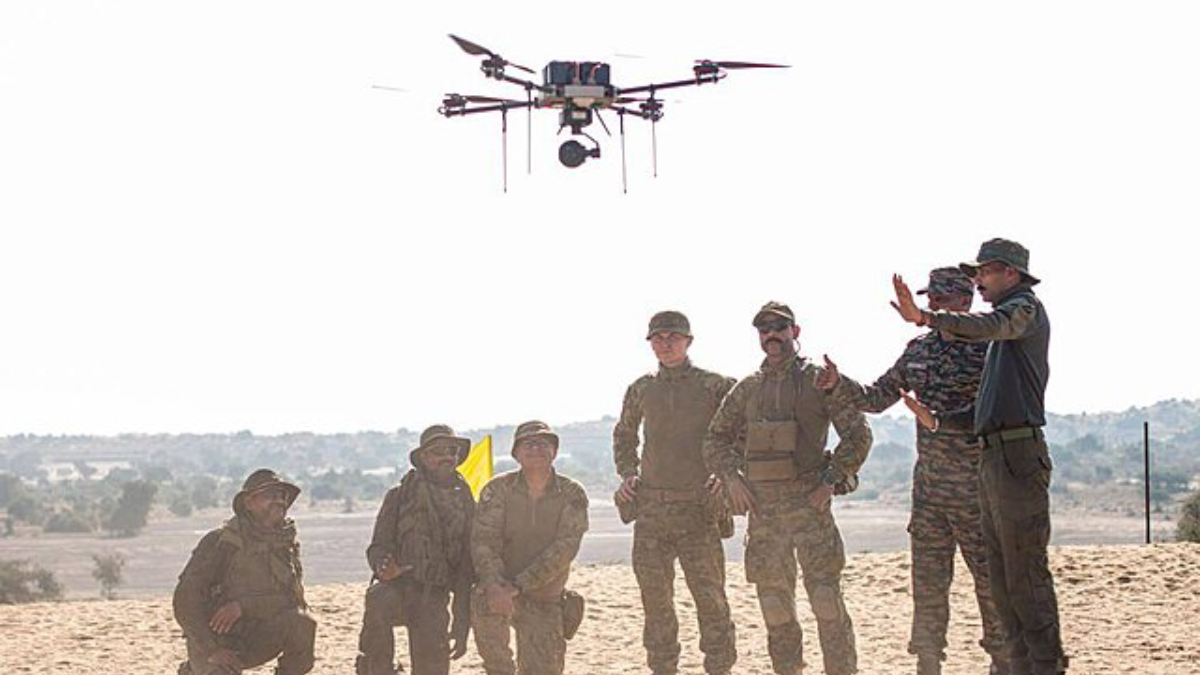
Drawing critical lessons from the ongoing conflict in West Asia, India’s top military leadership has initiated high-level discussions on strengthening the country’s air defence and warfare capabilities, with a sharp focus on countering the growing threat of drone warfare.
According to senior defence officials, the Indian armed forces are prioritising the procurement of advanced anti-drone systems and their large-scale integration with legacy air defence platforms to create a robust, layered shield against small and swarm drones.
The move comes amid increasing evidence from the West Asia conflict that low-cost drones can inflict disproportionate damage by overwhelming even sophisticated defence systems.
Military officers highlighted that one of the most significant lessons from the conflict is the effectiveness of swarm drones as an offensive tool. Iran’s deployment of large numbers of inexpensive drones has demonstrated how such systems can saturate air defences, forcing adversaries to expend costly missile interceptors.
“The cost asymmetry is stark. A small drone is far cheaper than the missile used to intercept it. Swarms can overwhelm even advanced systems, making it imperative to develop cost-effective countermeasures,” a senior officer explained.
To address this challenge, India is exploring the integration of legacy systems such as L-70 air defence guns with modern anti-drone technologies. These older platforms, when upgraded with new targeting and tracking systems, can provide a more economical solution to neutralise drone threats compared to high-end missile systems.
The urgency of these measures is underscored by India’s own experience during the hostilities following Operation Sindoor in May last year, when Pakistan deployed swarms of low-cost drones into Indian territory. Some of these drones were used for surveillance, while others carried payloads, often concealed to evade detection.
Indian forces successfully countered many of these threats using existing air defence systems, but the evolving nature of drone warfare has highlighted the need for further upgrades and integration.
Beyond defence, the Indian military is also considering the large-scale acquisition of swarm drones and robotic systems to enhance its own offensive capabilities. These technologies could be deployed to disrupt enemy logistics, target manufacturing infrastructure, and reduce dependence on human manpower in high-risk operations.
“Robotic systems can significantly reduce casualties while maintaining operational effectiveness. Applications include mine detection, load carrying, and other battlefield support roles,” another officer noted.
The conflict has also prompted a rethink of strategic targeting doctrines. Unlike India’s traditional focus on border areas and terrorist camps, recent strikes in West Asia have targeted critical infrastructure such as energy facilities and administrative hubs, causing widespread disruption to supply chains and logistics networks.
“The identification and prioritisation of deep strategic targets will be crucial in future conflicts,” an official said, adding that India is evaluating how such approaches could be incorporated into its military planning.
At the same time, there is a growing emphasis on strengthening passive defence measures. These include dispersion of assets, camouflage, concealment, development of underground infrastructure, and force preservation strategies to mitigate the impact of large-scale attacks.
Officials pointed to instances where even highly effective systems like Israel’s Iron Dome were challenged by coordinated barrages, illustrating the limits of active defence alone. “No system is foolproof. Passive measures are essential to ensure survivability when defences are saturated,” a third officer said.
Another key takeaway is the need for decentralised warfare. The Indian military is accelerating discussions on the creation of integrated theatre commands to enable more flexible, coordinated, and distributed operations across services.
The West Asia conflict has also reinforced the importance of preparing for both short, high-intensity engagements and prolonged wars of attrition. Military planners are emphasising the need for clearly defined objectives at the outset of a conflict, along with a structured approach to escalation control and conflict termination at every stage.
Echoing this perspective, Indian Air Force chief Air Chief Marshal A. P. Singh had earlier cited Operation Sindoor as an example of how conflicts can be initiated and concluded swiftly with clear strategic intent.
As drone warfare, robotics, and precision targeting reshape modern battlefields, India’s evolving military doctrine reflects a shift toward technological integration, cost-effective defence solutions, and adaptive warfighting strategies designed to meet the challenges of future conflicts.