


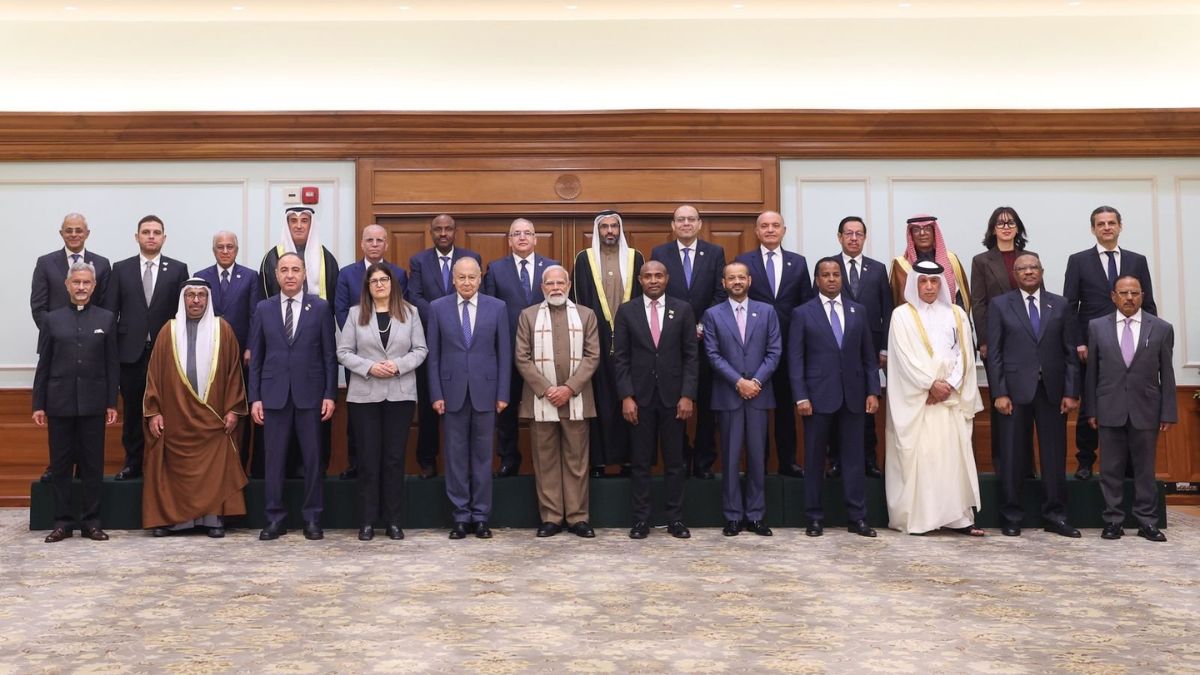
Prime Minister Narendra Modi on Saturday (January 31, 2026) received a high-level delegation comprising Foreign Ministers of Arab countries, the Secretary General of the League of Arab States (LAS), and heads of Arab delegations attending the meeting, as India hosted the second India-Arab Foreign Ministers’ Meeting.
Being held after a long gap of 10 years, the Foreign Ministers of Arab countries marked a significant diplomatic moment as New Delhi took on the role of host. The first meeting was held in Bahrain in 2016, during which the Ministers identified 5 priority verticals of cooperation – economy, energy, education, media, and culture.
The meeting notably comes at a time when the Middle East is at the centre of global churn – geopolitically, economically and strategically – making the timing particularly consequential. The engagement underscored India’s renewed push to position itself as a steady, long-term partner in a region grappling with conflict, transformation and recalibration.
PM Modi’s message to the Arab world
During the interaction, Prime Minister Modi highlighted the deep civilisational and people-to-people links between India and the Arab world, noting that centuries of cultural, commercial and intellectual exchange continue to shape contemporary ties. Looking ahead, Modi outlined his vision for a future-ready India-Arab partnership.
The Prime Minister also reaffirmed India’s commitment to expand cooperation across trade and investment, energy, technology, healthcare and other priority sectors for mutual benefit, calling the Arab world part of India’s extended neighbourhood. On regional geopolitics, the PM reiterated India’s consistent support for the Palestinian people and welcomed ongoing peace efforts, including the Gaza peace plan.
He also appreciated the Arab League’s role in promoting regional peace and stability at a time of heightened uncertainty. “Confident that enhanced cooperation in technology, energy, trade and innovation will unlock new opportunities and take the partnership to new heights,” he said on X.
Jaishankar frames Middle East’s moment of upheaval
Opening the ministerial meeting, External Affairs Minister S Jaishankar described the Middle East as a vivid example of the broader upheaval underway in the global order, driven by shifts in politics, economics, technology and demographics. “Nowhere is this more evident than in West Asia and the Middle East,” Jaishankar said.
He stressed that developments in the region directly affect India as a proximate neighbour with deep stakes in regional stability. The EAM pointed to the Gaza crisis as emblematic of the region’s global impact, recalling key milestones such as the October 2025 Sharm el-Sheikh Peace Summit and the adoption of UN Security Council Resolution 2803 endorsing a comprehensive peace plan for Gaza.
What conflicts did India flag as global concerns?
Beyond Gaza, Jaishankar highlighted a series of regional flashpoints with global ramifications like Sudan’s devastating conflict, threats to maritime security from Yemen, instability in Lebanon where Indian troops serve under UNIFIL, Libya’s stalled national dialogue, and Syria’s uncertain trajectory.
These crises, he noted, are not isolated but interconnected, underscoring the need for sustained diplomatic engagement and collective responsibility.
EAM Jaishankar highlighted that the leaders have adopted Delhi Declaration and the Executive Programme for 2026-28 which will go a long way in strengthening India – Arab partnership.
Counter-terrorism emerges as a shared priority
Terrorism featured prominently as a common security challenge linking India and the Arab world. Jaishankar stressed that cross-border terrorism undermines international norms and must be met with zero tolerance. Jaishankar noted that “targeted societies have the right to self-defence,” calling for stronger global cooperation to combat terrorism in all its forms.
Calling terrorism a “common threat” in both the regions, Jaishankar underlined that it is essential that we strengthen international cooperation to combat what is a global scourge. “Zero-tolerance for terrorism must be an uncompromising universal norm.”
Jaishankar underlined that India’s ties with League of Arab States members have evolved into strategic partnerships, spanning energy security, trade, technology, food and health security, and the welfare of Indian expatriate communities — India’s largest diaspora abroad.
What does the India-Arab partnership look like going forward?
According to the External Affairs Minister, the India-Arab Cooperation Forum would serve as a practical platform to translate intent into outcomes. The agreed 2026-28 agenda covers traditional sectors such as energy, environment, agriculture, tourism, culture and education, while expanding into digital technology, space, startups and innovation.
Counter-terrorism, parliamentary exchanges and the newly launched India-Arab Chamber of Commerce, Industry and Agriculture also feature prominently. As India builds technology-driven, people-centric capacities, Jaishankar said sharing best practices could deliver tangible gains for both sides.
With India hosting the ministerial meeting after ten years, the gathering signalled a reset with renewed momentum, one that aligns historical ties with present-day strategic realities. The discussions reflected a shared recognition that India and the Arab world are natural partners.
Worth noting here is that India-Arab trade stands at over $240 billion, with bilateral hydrocarbon trade exceeding $107 billion. India imports over 95% of LPG, 60% of LNG, while 47% of crude oil from Arab League countries, along with over 50% of fertilisers and related products.